
Earth, by Deepa Mehta is an intelligent and deeply moving personal account of the partition of India.
In August 1947 the departing British colonial rulers announced the division of the subcontinent into a Muslim-controlled Pakistan and a Hindu-Sikh dominated India. The partition was organised by the British Labour government with the support and collaboration of the Muslim League and the Indian Congress Party.
At least 11 million people—Muslims, Hindus, Sikhs and others—caught on the wrong side of the dividing lines were driven out of their homes. Some reports put the death toll from communalist pogroms and rioting at one million. The greatest numbers were killed in Punjab, which was split in two. Tens of thousands died in weeks of carnage.
Many commentators have described this event as one of the worst man-made tragedies of the last half-century. It was a political catastrophe whose reverberations are still being felt, and one that has plunged the sub-continent into three wars and in recent months brought India and Pakistan to the brink of nuclear war. (As a point of information, the first proposal drawn up by the British in 1947 was called “Plan Balkan” and envisaged the fragmentation of India. It was abandoned and partition adopted after concerns were raised about the dangers posed by the disintegration of the Indian military.)
Deepa Mehta's film, which bases itself on Bapsi Sidhwa's novel Cracking India, portrays this disaster through the eyes of a child—Lenny, an 8-year-old crippled girl—from Lahore, the Punjabi city that saw some of the bloodiest pogroms. The experiences, hopes and fears of this young girl provide an intense portrait of the period.
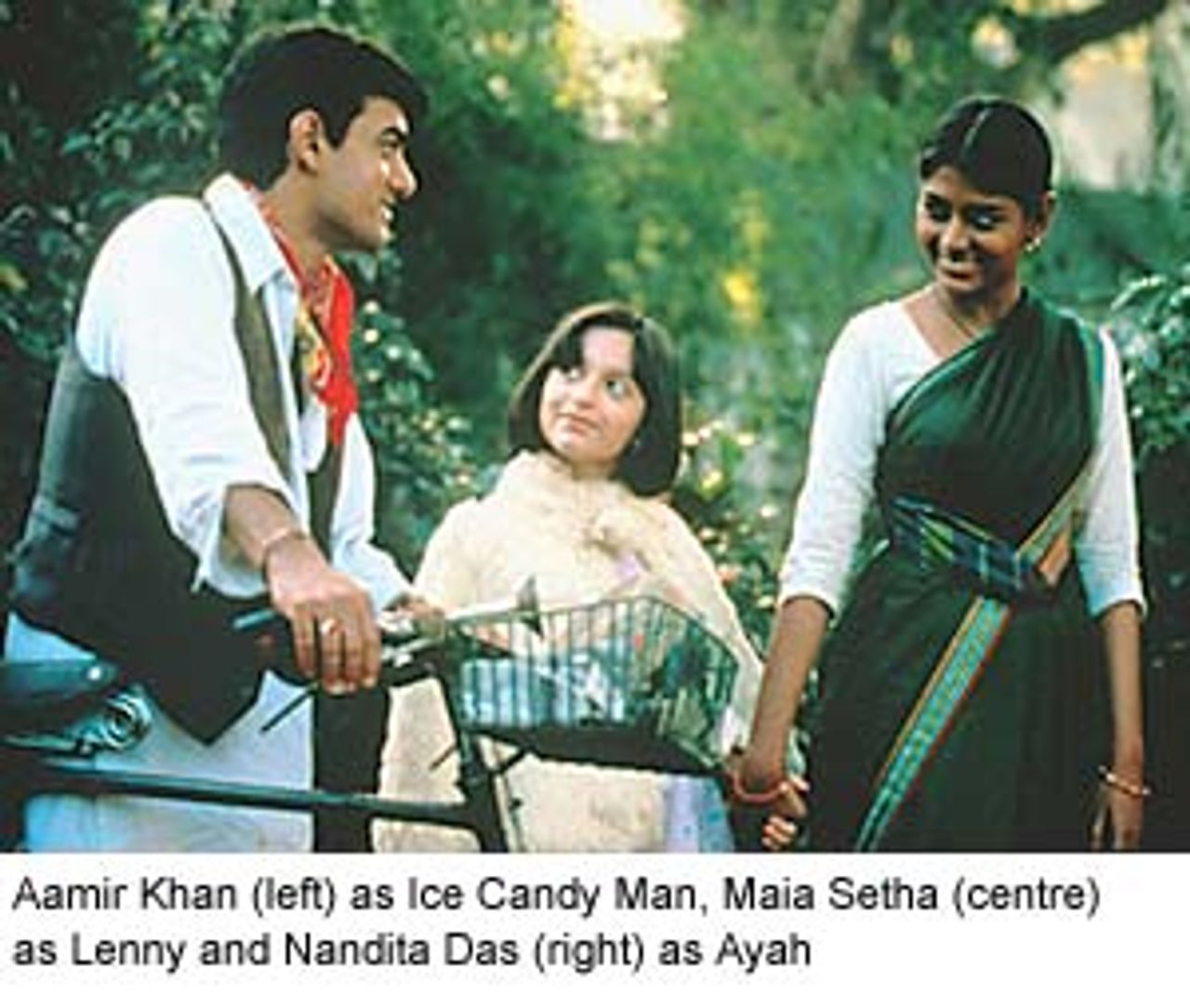 Young Lenny (Maia Sethna) belongs to the Parsee minority, a religious sect that immigrated to India from Persia during the 9th century in order to escape religious persecution following the rise of Islam. The Parsees, because of their willingness to cooperate with the British colonial rulers, carved out a comfortable existence as merchants and industrialists.
Lenny's family is well off and maintains friendly relations with the British authorities and the various religious groupings. The family household has six servants drawn from a number of different religious backgrounds. Lenny has a warm and loving family and a life free of care. Her nanny, Ayah Shanta (Nandita Das), a beautiful young Hindu woman has several young men—Sikh, Hindu and Muslim—wooing her and who also treat Lenny with equal affection. The harmony in Lenny's life, however, begins to break up as the date approaches for the British to quit India and they prepare to divide the sub-continent.
A dinner party held at the house, attended by the British Inspectorate of Police and Mr Singh, a Sikh friend of the family, erupts over the future of the country. Lenny and her precocious young cousin, hiding under the dinner table, hear Singh denounce the British.
Relations between Lenny's parents and various business associates start to turn sour. Everyday jokes and innocent games between friends of different religious backgrounds are replaced by bickering and harsh remarks over religion and family bloodlines. Leaders of the religious and ethnic groupings begin jockeying for positions within the new order being established by the departing British authorities.
Even as the mood becomes charged with rumours and dangerous tensions, Ayah's love-life blossoms and her affections turn towards Hasan (Rahul Khanna), a Muslim. Hasan urges Ayah's friends to stand by each other and resist the increasing fanaticism.
But rising tensions are inflamed with reports of murder, rape, and rioting mobs wrecking homes, shops and temples and mosques. Ice Candy Man (Aamir Khan), another young man vying for Ayah's affection, is inexorably drawn in by communalist rhetoric; each rumour and massacre report unhinging the previously stable and affable young man.
When Ayah falls in love with Hasan, Ice Candy Man, enraged by jealousy and wound-up by the mob atmosphere, leads a group of Muslim rioters to Lenny's house to demand the removal of all Hindu servants, including Ayah. The servants attempt to protect Ayah, claiming that she has left the house. Lenny, disoriented by the menacing mob and trusting the Ice Candy Man, admits that Ayah is still in the house. The young nanny is dragged off to her death. Lenny's innocent mistake will haunt her for the rest of her life.
One British film critic has described Earth as a "mawkish look at the impact of partition on a small group of friends of mixed religions ... a Bollywood influenced confection ... that attempts to shock with a catalogue of atrocities".
These condescending remarks are without foundation and leave one wondering what sort of film would satisfy this critic. Perhaps a cold impersonal account, in which real people are translated into silent, abstract numbers, figures to be examined like microbes in a laboratory test-tube?
In opposition to the climate of cynicism and callous indifference to the fate of ordinary people, Earth is a courageous and humane film. Mehta is clearly animated by a determination to end the long silence by western filmmakers and artists about this terrible chapter in the 20th century.
The film is rich with comments from its characters denouncing partition and double-talking local politicians. One particularly notable moment sees the film's protagonists listening to a radio broadcast by Congress Party leader Jawaharial Nehru, India's first prime minister.
Nehru declares: “At the stroke of the midnight hour [August 15, 1947], when the world sleeps, India will awake to life and freedom.” These comments are greeted with cynicism and disgust, with one of the characters later declaring that "independence from the British will be soaked in our brothers' blood".
Excellent performances by its cast, in particular Maia Sethna as Lenny and the alluring Nandita Das as Ayah; and an hypnotic musical score by A. R. Rahman, with lyrics by Javed Akhtar, one of India's leading poets, combine to make Earth a powerful work.
In a world where nationalism prevails in popular culture, Mehta's film is a breath of fresh air, a salutary warning of the consequences of chauvinism and religious bigotry and a testimony to this director's principled approach to filmmaking.
* * * *
Earth is the second of Mehta's trilogy set in India. The first of the series, Fire (1996) sparked a wave of controversy in India, and brought her into direct conflict with extreme right-wing Hindu nationalists.
Set in contemporary New Delhi, Fire's main characters are two lower middle class women, trapped in arranged marriages, who form a warm and loving lesbian relationship. The internationally acclaimed film, which was released uncut in India, played for three weeks before Hindu fundamentalist formations denounced it as obscene, immoral and offensive to Indian culture and the Hindu religion, and attempted to have it banned.
The extreme right-wing Shiv Sena movement organised demonstrations, forcing the closure of several Bombay and New Delhi cinemas. It issued a statement declaring: "If women's physical needs are fulfilled through lesbian acts, the institution of marriage will collapse and the reproduction of human beings will stop."
Members of the organisation stormed cinemas, tearing down posters and smashing windows. Demonstrations were organised outside the home of one of the film's stars. Protesters threatened two actors and a director who publicly defended the film. Mehta also received a number of death threats. The film was withdrawn from cinemas, pending another censorship review, but later re-released uncut. Extreme-right wing elements are still trying to have the film banned.
In one interview Mehta explained that the film's central theme was loneliness and hypocrisy. " Fire is about a lack of choices," she told one newspaper. "Why doesn't anyone talk about that? Every character in the film, whether male or female, is a victim of society's rules and regulations."