
Over the next several weeks the World Socialist Web Site will post a series of articles examining the economic, social and political roots of the riots that erupted in Cincinnati, Ohio in April. Below we are publishing an introduction to the series and the first part
Last month Cincinnati, Ohio was the scene of several days of protests and rioting after the April 7 police killing of Timothy Thomas, an unarmed teenager and the fifteenth black male killed by police in the last six years. After rioting erupted in several minority neighborhoods, officials placed the city of 331,000 under a state of emergency, imposed a dawn-to-dusk curfew and dispatched hundreds of police officers and state troopers, who fired tear gas, rubber bullets and beanbags filled with lead pellets at angry citizens. By the time the violence was over scores of people were hospitalized, widespread damage had been done to storefronts and businesses and more than 800 people were jailed for rioting, looting and curfew violations.
The intensity of anger in Cincinnati came as a shock to national and local authorities. While supporting the police crackdown of the street protests and rioting, the Bush administration, state and local politicians, business leaders and civil rights officials scrambled to demonstrate their willingness to address complaints about police misconduct and poverty in the city’s African-American neighborhoods.
John Pepper, the CEO of Procter & Gamble, whose headquarters in the city’s downtown area stands less than a mile from where the worst rioting occurred, acknowledged that the police shooting had only “triggered” the riots, and that there “are definitely deeper economic roots that have to be addressed.” His concerns were echoed by Democratic Mayor Charlie Luken, who warned, “There are flash points like ours in every city in America. If there is a mayor in any major city not worried about the coming summer, then he or she is not thinking.”
During the week of rioting, the news media provided only sporadic coverage of events, as if the declaration of martial law in a major American city was a story of secondary importance. After tensions died down the story was dropped. In the month following the largest urban disturbance in America since the 1992 Los Angeles riots, no serious analysis of its causes has appeared. In relation to Cincinnati, the media’s operative principle has been the less said, the better.
What accounts for this extreme sensitivity over a public discussion of last month’s events? For one thing, the riots punctured the picture of American society that official public opinion-makers have sought to foster, and which they have apparently come to believe. If one were to accept their version of reality America is enjoying a golden age of prosperity, from which virtually all have benefited.
The truth is the explosion of anger and violence in the nation’s twenty-third largest metropolitan area offers a glimpse of the social contradictions that have accumulated during the economic boom, and the extent of social discontent growing in the country. If such upheavals occur after nearly a decade of economic expansion, what will happen as a downturn tosses millions of working people out of their jobs and they suddenly find out that the social safety net has disappeared?
A portrait of Cincinnati reveals the staggering levels of social inequality that are characteristic of every US metropolitan area, where 8 out of 10 Americans reside. One recent estimate notes that the economic disparity between the richest 5 percent of the population in the Cincinnati area and the poorest 5 percent is second only to the Tampa Bay, Florida area, the worst in the country.
During the 1990s, Cincinnati’s Fortune 500 companies—Procter & Gamble, Kroger, Federated Department Stores, Chiquita Brands International—and locally-based finance, business services and biotechnology companies prospered. Record profits, the booming stock market and large tax cuts allowed corporate executives, big investors and the most affluent layers of the middle class to enrich themselves.
At the other pole of society the poorest Cincinnatians, cut off from welfare and other social services, relied on low-paying jobs, temporary agencies and homeless shelters. For the bulk of working people in the metropolitan area—like their counterparts throughout the US—longer working hours, multiple jobs and greater debt were the only means to make ends meet.
What media commentary on Cincinnati there has been has focused almost exclusively on the city’s race relations and the police department’s long history of abusing minorities, which is generally presented as more egregious than in most cities. No doubt these factors—which are problems far from unique to Cincinnati—played a important role. However, the semi-official ban on critically examining the social and economic structure of America—and the deep class divisions of this society—prevents any serious insight into the causes of police brutality, racism and poverty, let alone providing any progressive solutions.
Despite years of Affirmative Action set-asides for minority-owned businesses, the election and appointment of black mayors and other city officials, the integration of police departments, these problems persist and are getting worse. This only underscores that in the final analysis police brutality and racism are the products of class oppression and the unwillingness and inability of America’s ruling elite and political establishment to address the fundamental question of social inequality.
Thirty years ago, after a violent wave of urban riots swept through Detroit, Newark, Cincinnati, Los Angeles and scores of other American cities, the Johnson administration’s Kerner Commission on Civil Disorders called for massive government spending to stop the country’s drift towards racial and economic polarization. In words that are scorned today by Democrats and Republicans alike, the commission concluded that America needed a “commitment to national action—compassionate, massive and sustained, backed by the resources of the most powerful and the richest nation on this earth.”
The American ruling class never made such a commitment and Johnson’s Great Society programs gave way to massive outlays for the Vietnam War. By the mid-1970s, the failure of anti-poverty programs to solve the urban crisis became grist for right-wing politicians, particularly in the Republican Party, who exploited concerns over taxes, economic insecurity and crime to advance their reactionary agenda of budget-cutting, law-and-order repression and tax breaks for the wealthy. The Reagan-Bush years were characterized by massive budget cuts—federal aid to the largest 24 cities was reduced by 38 percent in real dollars between 1980 and 1990—and attacks on the poor, whose supposed immorality was said to be responsible for poverty, crime, teenage pregnancies, drugs, etc.
By the time of Clinton’s election in 1992 the Democratic Party had repudiated its association with the New Deal and Great Society. Clinton stepped up the attack on social programs, while at the same time promoting free market policies, such as “enterprise zones” and other incentives to big business, as the solution to urban problems. The gutting of welfare and other programs, Clinton claimed, would break the dependency on government hand-outs, teach the poor the benefits of work and provide them with the positive role models needed to kindle their own entrepreneurial spirit. For the wealthy—including a growing layer of black capitalists—these policies had the added benefit of reducing their taxes and assuring an ample supply of cheap labor.
As social inequality in the cities increased and the social safety net was gutted, politicians from both parties stepped up police repression. During the Clinton administration America’s prison population reached two million—the largest in the world—and police abuse scandals erupted in Los Angeles, New York City, Detroit, Cincinnati and many other cities. Phrases such as “racial profiling” became part of the American lexicon.
 For some 32 million Americans, nearly half of whom are children, poverty is already a daily reality. The rolls of the impoverished will increase as hundreds of thousands of former welfare recipients exhaust their time limit for receiving benefits under “welfare reform,” and millions of lower-paid workers, including large numbers of minority workers who were the last to be hired, lose their jobs in an economic downturn.
In the Bush White House working people face an unabashed defender of big business, whose major initiative is to spend the government surplus to provide the largest tax cut to the rich in history. To finance this transfer of wealth, the administration’s budget proposal includes cuts in funding for city hospitals, the Head Start education program, child care, job training and other vitally needed social programs.
Last month’s events in Cincinnati provide an indication of the social anger building in America. This discontent will only intensify as wider layers of working people—hit by corporate downsizing, the decline in living standards and the intensification of the social crisis—come to see that like the most oppressed layers of working class in the inner cities, they too are victims of a social order that sacrifices social needs to the enrichment of those on top.
Part 1: gentrification and police repression
Long before the April 7 police killing of unarmed black teenager Timothy Thomas set off riots in Cincinnati, Ohio, the city’s police department was notorious for its abuse and brutality of working class and minority citizens. More than three decades ago, on June 12, 1967, a riot erupted in the city’s mainly minority neighborhoods after years of police abuse and deteriorating living conditions. The riot, which was suppressed by the Ohio National Guard and resulted in one death and 404 arrests, was one of a series of violent upheavals that spread across America’s black ghettoes in the summer of 1967. Less than a year later, in April 1968, the city was again torn by riots following the assassination of civil rights leader Martin Luther King.
In 1968 the Johnson administration’s Commission on Civil Disorders concluded that the impoverishment of Cincinnati’s segregated neighborhoods and police officers’ practice of “stopping Negroes on foot or in cars without obvious basis” and using loitering laws disproportionately against minorities, had greatly contributed to the 1967 riots.
Tensions between residents and the police erupted again a decade later as social conditions deteriorated along with the loss of thousands of manufacturing jobs in the area. In 1978-79, over the space of 18 months, white police officers killed four black civilians and black civilians killed four white cops. This time the police and their supporters launched a series of angry protests and city officials acceded to their demands for high-powered .357 magnum weapons, more lethal ammunition and bulletproof vests. At the time the Mayor’s Community Relations Panel concluded: “The public questions whether or not the Police Division can police itself, and more seriously, whether elected officials and appointed officials are willing to control police.”
In 1981 the US Commission on Civil Rights concluded that police in the city were guilty of using excessive force and other abuses, and officials entered into a consent decree to improve policing. Over the ensuing two decades, as the killings and beatings continued, there were more investigations, more citizen review boards, more Justice Department and Ohio oversight agreements and more community-oriented policing programs. Like other big city police forces, the Cincinnati department underwent court-ordered cultural diversity training, adopted stricter rules on the use of deadly force and increased the number of minority police officers and supervisors. Since 1986, the number of black police officers in Cincinnati has more than doubled, to 28 percent of the force, a proportion larger than in many other cities, including New York City.
 These measures did little to stop the police abuse and killings. In the last six years alone, the Cincinnati Police Division (CPD) has killed 15 people while apprehending them—all of them black males. The police murder of 19-year-old Timothy Thomas, which sparked the riots, was the fourth such killing since last November when—within the space of 24 hours—police killed two African-American men, including a mentally ill homeless man accused of stealing soap and deodorant.
On March 15, just weeks before Thomas was killed, the American Civil Liberties Union and a local civil rights organization filed a suit in federal court charging that city officials had been complicit in what they described as a 30-year pattern of racial discrimination by police. The suit charged that officials have “tolerated, acquiesced in, ratified and been deliberately indifferent to practices by members of the CPD... of stopping African American citizens without reasonable suspicion of criminal activity” and subjecting them to abuse and violence.
The lawsuit detailed several cases of black citizens being stopped in their vehicles or on foot, handcuffed, pushed to the ground and held for lengthy periods of time, even after a suspicion had been disproven. Police regularly use abusive language, the lawsuit stated, in order to provoke a citizen into a reaction that can then be used as the basis to charge a crime. They also concoct minor infractions to justify unconstitutional searches and seizures, and in many cases drop these charges before they come to court.
Between March 1999 and December 2000, African Americans—who make up 43 percent of the city’s population—were charged with 81 percent of all citations issued by the CPD for driving without proof of insurance; 72 percent of the citations for driving under suspension or without a license; 70 percent of those issued for driving without a seat belt; and 79 percent of all jaywalking citations.
Last year Cincinnati Police Chief Thomas Streicher publicly admitted that racial profiling takes place. But when the City Council this March ordered police to record the race of everyone they stopped, he said the measure was “insulting.” Keith Fangman, the president of the city’s police union, denounced city officials saying, “They now believe the same officers who are out there committing illegal acts are now going to fill out these forms and tell on themselves. It’s ridiculous.”
Timothy Thomas was a frequent victim of police harassment. According to Hamilton County, Ohio records, during a three-month period early last year the black teenager was cited for 20 traffic violations—such as driving without a license or not wearing a seatbelt—which could not have been detected by police until they stopped him. On two separate occasions in March 2000, different police officers stopped Thomas twice in one day. At the time Thomas was killed he was wanted on 14 misdemeanor counts, including 12 traffic citations and two counts of obstructing justice for running away from police.
This is the background to the police killing of Thomas by Officer Steven Roach in the early morning hours of Saturday, April 7: At around 2:13 a.m. two off-duty police officers working as security guards at a bar in the Over-the-Rhine neighborhood spotted Thomas, who had eluded arrest before, and began chasing him down the street. Falling behind the youth, the police officers radioed for help and another 10 policemen—including Officer Roach in a patrol car—joined a 10-minute chase through the empty lots and back alleys of the impoverished neighborhood. At around 2:20 a.m. Roach confronted Thomas in an alley and fired one shot, hitting the teenager in the chest. Nine more officers then arrived on the scene, following by an ambulance that took Thomas to University Hospital, where the young father of a three-month-old son was declared dead.
Officer Roach later claimed that the young man had been reaching into his waistband for what the policeman believed was a gun. No gun was found.
Shortly after the killing, Thomas’s mother Angela Leisure told the local media, “They keep asking me why did my son run? If you are an African male, you will run,” she said.
Her sentiments were shared by black and white residents from Over-the-Rhine, interviewed by the World Socialist Web Site.
Henry James, 26, said, “I’ve been harassed by the same police officer who killed Thomas. He jumps out of his patrol car and chases people down all the time. When are they going to do something about this mess around here? They’re not protecting the community; and the black police are just as bad as the white police officers.
“Hamilton County Prosecutor Mike Allen has never prosecuted any police officer for killing someone. They just suspend the police officers and eventually it dies out. Instead they want to prosecute us for rioting and violating the curfew. In Cincinnati there is no chance of life getting better. It’s going to go back to the same thing. They’ll turn around and do the same thing in six months from now.”
Shawn, 24, said, “I’ve been beat up by the police for no apparent reason. One time I was coming out of the building and they grabbed me and began choking me by the neck. I was scared that they’re trying to hurt me, so I broke away, but I didn’t get far. They maced me and put me in handcuffs and in the backseat of their car. I’m back there telling them I didn’t do anything. The police officer told me to shut up, so I told him to shut up and he maced me again. They took me down to the Justice Center and they whipped me there too.
“We face this every day. I’m scared to walk down the streets sometimes, never knowing what is going to happen to me. If you ask the others around here they will feel the same way. Most of the kids have been picked up by the police. They pick us up for nothing, and they put pressure on you to confess to something. They make you admit to doing something so that you will have a record. When they pick you up the next time, they just add more stuff to your record. Then you get stuck in the court system and get appointed a Public Defender, whose got hundreds of other cases. We call them Public Pretenders because they don’t defend you, they just cop a plea. The worst thing is you have to pay $30 to go to jail. They call it a lock-up fee.
“I don’t know why they are doing this. They are being racist. They don’t do this in the suburban neighborhoods. But if we were walking through a rich neighborhood they would say. ‘What are you doing out here? You don’t belong out here.’”
Ann Beach said, “The police mess with people. My friend and I were walking down the street and the cops harassed us because I’m white and he’s black. I thought that prejudice stuff was over, because we all have to live in this world together. Everyone should be treated equally, but it doesn’t happen. One thing’s for sure, the police harass poor people more than the rich.”
The class divide
Racism is no doubt widespread in the Cincinnati Police Division. Drawn from the more backward elements in the area—which remains one of the most segregated in the US—they have been encouraged by the reactionary political climate in Cincinnati, which has long been a Republican stronghold. It is one of the few cities in the US where a handful of Ku Klux Klan members, protected by the police, publicly erect a cross in the city’s main park each year.
But the continued violence and abuse is not only attributable to racist police officers.
In several cases over the last six years black police officers have been involved in the murder of African Americans. Moreover, as the ACLU lawsuit implies, the city government, which has for years included several black City Council members and other officials, has been complicit in the targeting of minorities.
The actions of the police cannot be understood outside of understanding the function they serve in a city that is so sharply polarized between economic classes. Like every other American city, Cincinnati in the 1990s has undergone a deepening class division between the haves and the have-nots. It is under these conditions that the police have emerged as the chief enforcers of a social policy to marginalize the poor and protect the private property and well-being of the affluent.
The city’s decades-long population loss, coupled with the growth of the suburbs, has created a “doughnut effect.” In the middle of the donut is a concentration of low-income residents in Cincinnati’s Over-the-Rhine, West End, Avondale and Bond Hill neighborhoods, who live far from better-paying job opportunities and suffer from the highest rates of poverty in the metropolitan area. The city’s affluent residents live on the East End, with its $700,000 to $800,000 homes, and outside city limits in the wealthier northeastern suburbs of Indian Hill, Blue Ash and Sharonville.
Household median income in Over-the-Rhine is $8,600 compared to $26,774 in the city as a whole and $54,800 for the 13 counties of Ohio and neighboring northern Kentucky and southwestern Indiana that make up the Greater Cincinnati Metropolitan Area. A family of four with an income below $17,029 is living in poverty, according to the US government.
The poverty rate in Over-the-Rhine approaches 95 percent, and the area houses many of the city’s homeless shelters, soup kitchens and drug and alcohol rehabilitation centers. A drive through the neighborhood provides a picture of destitution and desperation, with trash-filled lots, abandoned houses and storefronts and dozens of unemployed young men congregating on street corners with nothing to do. Most of those who work rely on the dozens of the low-paying day labor and temporary agencies that dot the neighborhood.
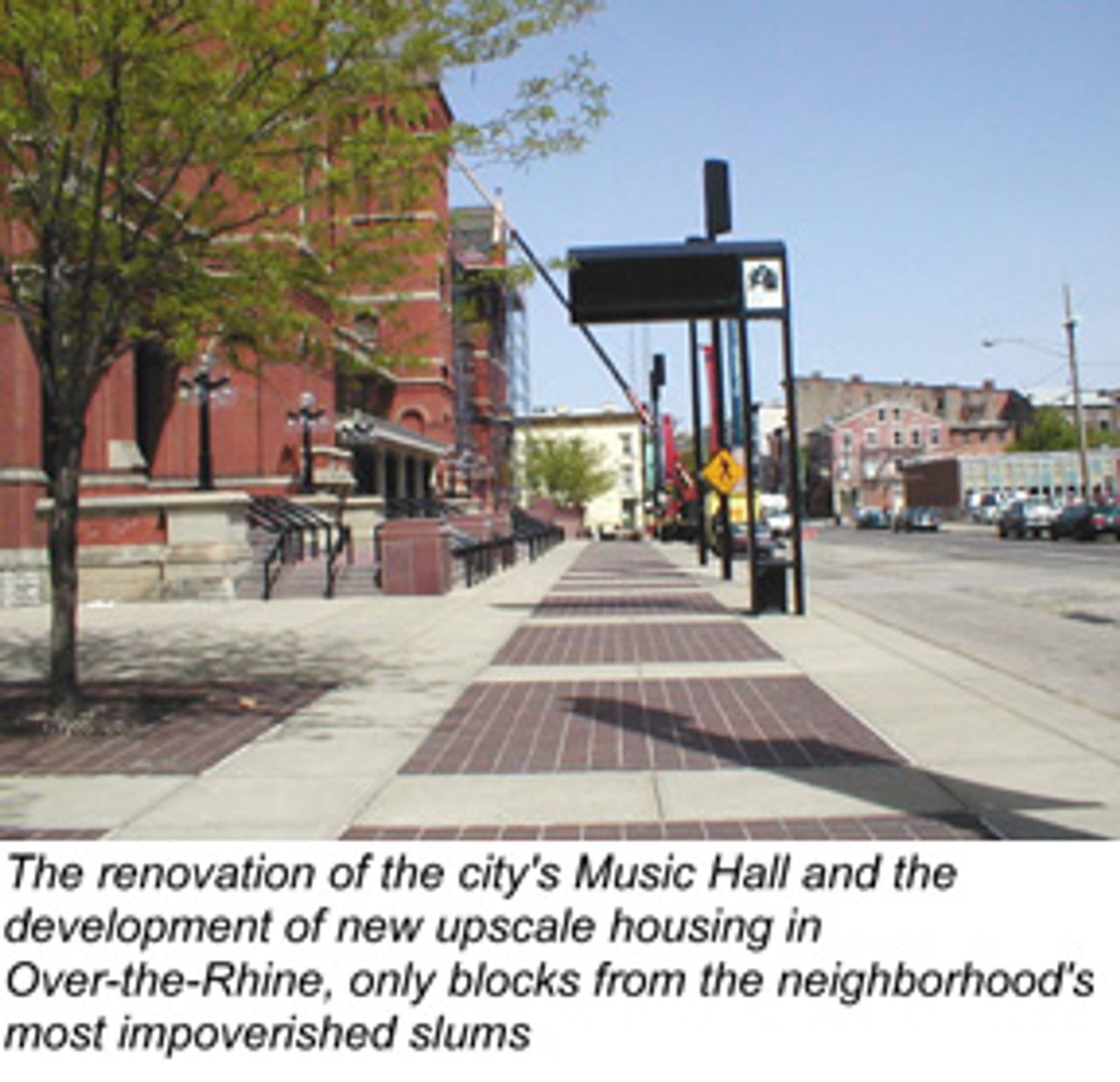 Over-the-Rhine is surrounded on three sides by hills, many of which include the homes of the city’s affluent residents. On the fourth side is the Central Business District, where some of America’s largest corporations have their headquarters, including Procter & Gamble, Chiquita Brands International, Kroger and Federated Department Stores. Downtown is also the scene of vast construction sites, including the $1 billion project to build two new sports stadiums and other tourist attractions adjacent to the Ohio River.
Over the last several years—in an effort to stem the loss of middle and upper-income residents and the loss of tax revenue—city authorities have offered incentives to real estate developers and businesses such as hi-tech start-ups. Much of this attention has been focused on the low-cost Over-the-Rhine area, where according to City Councilman James Tarbell—a large property owner in the neighborhood—500 buildings, 250 storefronts and 2,500 residential units stand vacant.
In 1993, the city amended an urban renewal plan adopted in the mid-1980s—which had set as the neighborhood’s top priority creating a minimum of 5,520 low-income units—and began offering tax breaks to encourage market-rate housing. Over-the-Rhine was also designated an historic district, so that developers could receive a tax breaks to restore the original buildings.
These policies spurred the growth of a strip of bars, restaurants and nightclubs along Main Street, attracting higher income suburban residents and young professionals, who have moved into apartment lofts and other high-rent units. There has also been a proliferation of Internet companies seeking cheap office space in what is being dubbed the “Digital Rhine.” The city plans to add $4 million to its housing budget in 2001 to fund more market-rate developments citywide, and a significant amount is expected to go for housing downtown and in Over-the-Rhine. At the same time the city has sought to block funding for ReStoc, a nonprofit group that builds low-income housing in the area.
The Over-the-Rhine Foundation, an organization affiliated to the Cincinnati Chamber of Congress, cites as its goal “increasing market-rate housing to boost the economic profile of the neighborhood.” While it states that it will accomplish this goal without forcing people out, in reality many poor residents rely upon low-rent housing, which is quickly being replaced by units that only the affluent can afford. In response to the point made a WSWS reporter that this policy will adversely affect the homeless and unemployed, Marge Hammelrath, executive director of the foundation, blamed the victims, stating, “The people who are not going to work refuse to help themselves. Some people just aren’t going to work because its easier.”
The gentrification of Over-the-Rhine has resulted in the displacement of poorer residents, similar to what has taken place in many US cities, including San Francisco, where the influx of Internet companies in the Mission District has driven out working class and poor families. An article in a Cincinnati circular called the Downtowner boasts that new housing being built in the Prospect Hill area near downtown—starting at $479,000 a unit—has the “San Francisco feel.”
In this process the Cincinnati Police Division has emerged as a publicly-funded security force for the private developers and businessmen who are trying to rid the neighborhood of “undesirables.” Increased police patrols have been augmented by police officers moonlighting as private security guards for area businesses. In addition, several businesses pay the city to hire off-duty uniformed police to guard their patrons and their cars. The police have carried out a crackdown on squatters, panhandlers and unemployed youth, using the city’s juvenile curfew ordinance.
On a monthly basis, the police also conduct block-by-block sweeps to arrest dozens and charge them with alleged drug- and alcohol-related offenses. After one sweep that netted nearly 80 arrests, it was revealed that Hart Reality, which owns and manages hundreds of apartments in the neighborhood, paid police overtime costs. Police Chief Thomas Streicher said the realty company routinely put out “a tremendous amount of money” by hiring off-duty officers to help protect its property. Streicher added, “This helps push them back off the streets. We realize we can’t stop them completely, but we can help keep people from being exposed to it.”
Following the 1996 robbery-killing of a young white musician who worked at a local nightspot, the Over-the-Rhine Chamber of Commerce began running an ad in one of the city’s daily newspapers listing the names and addresses of twenty-five persons arrested for soliciting or for drug-related offenses during a four-month period in 1996. The ad urged that these persons “stay out” of the neighborhood—“unless you plan to help us build a healthier, more liveable community.”
The city administration then passed an ordinance—championed by Republican City Councilman Phil Heimlich—designating the neighborhood as a “Crime Exclusion Zone.” The provisions of the ordinance included banning from the neighborhood for 90 days nonresidents arrested there on drug or prostitution charges and extending the exile to one year for those convicted for those crimes. “This is absolutely crucial for the future of Over-the-Rhine,” Heimlich said, “because if the neighborhood is to attract economic development, we have to first stabilize it and reduce the crime there.”
The ordinance stayed in effect until a federal court struck it down in January 2000, after a lawsuit filed by the American Civil Liberties Union. The suit was taken on behalf of a woman who was barred from visiting her grandchildren in the neighborhood because of a previous marijuana charge that was later dropped, and a homeless man who faced criminal trespass charges if he appeared at a shelter in the neighborhood.
In addition, police officers are often hired on “special detail” through the Cincinnati Police Division to work as security guards for the Cincinnati Metropolitan Housing Authority (CMHA). These officers are routinely permitted to use master keys to units owned by African Americans and conduct searches of their living units without consent, without a warrant and without any probable cause or other justifiable reason.
As in other cities, such as New York, Cincinnati police officers are expected to make arrest goals or quotas. Police officers are also rewarded for high volumes of arrests, while facing discipline for failing to achieve an “expected” number of arrests. The end result is that the police arrest more low-income and minority persons, who are least likely to fight the charges in court.
Cecil Thomas, a retired black police officer who now heads the city-funded Human Relations Commission, described the modus operandi of the police: “They drive up in their cars real fast, slam on the brakes, and see who runs. The one who runs must be wanted.”
When anger exploded over the death of Timothy Thomas and years of abuse last month, police once again stepped in to protect the property of the city’s wealthy elite. As angry youth and protesters began marching downtown to Fountain Square, the center of the city, scores of riot-equipped police and officers on horseback set up a blockade to contain the “problem” in Over-the-Rhine, so that any damage would be done in the neighborhood.
To be continued.