
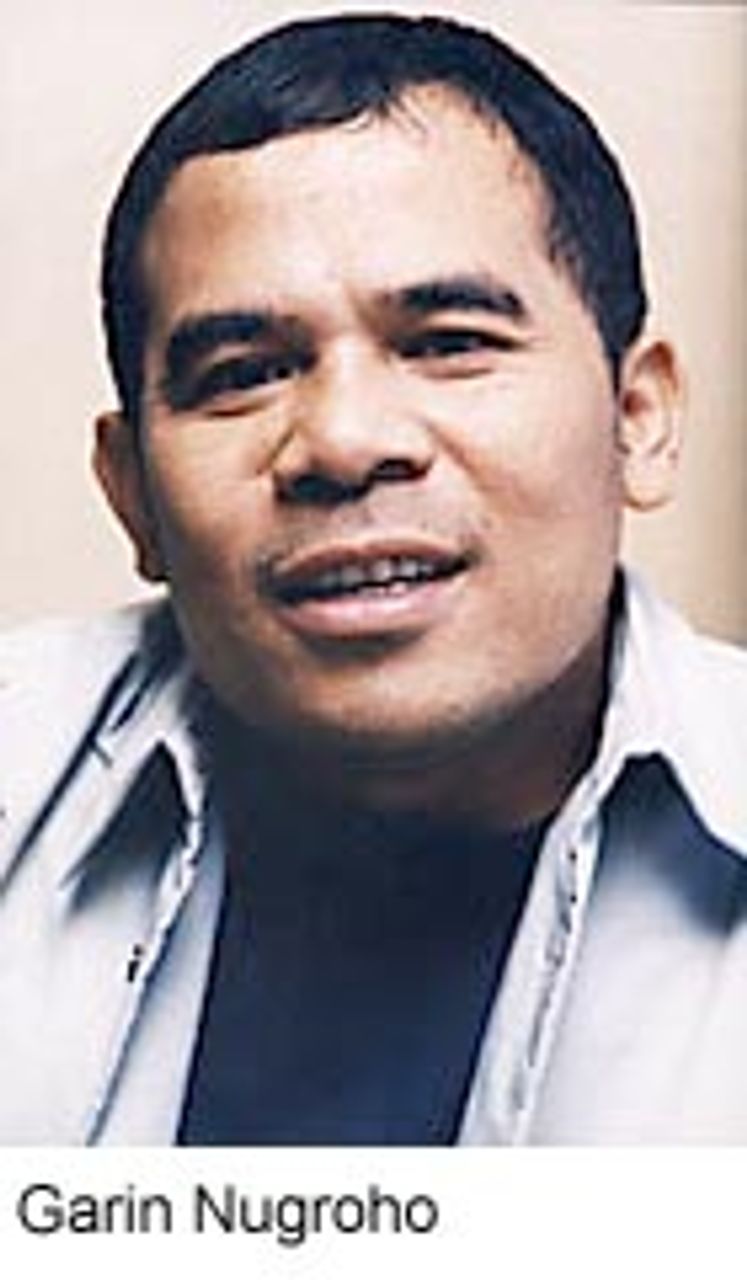
 Indonesian filmmaker Garin Nugroho spoke with the World Socialist Web Site last month when his latest film, The Poet (Unconcealed Poetry), was screened at the Asian-Pacific Film Festival in Sydney. Nugroho, who was born in Yogjakarta in 1961, studied filmmaking at the Jakarta University of the Arts and later law at Indonesia University.
Regarded as one of Indonesia’s leading directors, Nugroho has made five features and over 20 documentaries since his film debut in 1991. This includes Love is a Slice of Bread (Cinta Dalam Sepotong Roti) [1991], Letter to an Angel (Surat Untuk Bidadari) [1993], And the Moon Dances (Bulan Tertusuk Ilalang) [1995] and Leaf on a Pillow (Daun Di Atas Bantal) [1998]. The latter film, which is about street children in Jakarta, was banned by the former Suharto regime.
The Poet (see WSWS review) is set in 1965 during the bloody massacre of Indonesian Communist Party (PKI) members and government opponents by the Indonesian military with the support of Muslim extremists and the backing of US, British and Australian intelligence forces. Although figures vary, the number of people slaughtered is estimated to be anywhere between 500,000 and one million.
Central figure in the film is Acehnese poet Ibrahim Kadir, who was arrested and jailed for 22 days on suspicion of being a PKI member. Later released without charge, Kadir, who plays himself in the movie, witnessed the fear and trauma of those facing military execution. As he explains in one of the chilling narrations: “I saw a young mother and her infant child shot dead. Their bodies fell to the ground and fell over the cliff. I looked up at the sky and saw the moon and stars screaming.”
Nugroho’s black-and-white film is set in two adjoining cells in an Acehnese prison—one for men and one for women. Kadir and other actors use a traditional poetic form called “didong”, a rich blend of music, poetry and song accompanied by handclapping, to powerfully recreate the terror of these times. While The Poet, which was shot in six days on 1.5 billion rupiah ($390,000) budget, provides no detailed documentary evidence on the military coup or its aftermath, it is the first independent Indonesian film on the subject.
Richard Phillips: Why did you decide to make a film about the 1965 coup?
Garin Nugroho: Although I had no experience or knowledge about what happened in 1965 I grew up in the shadow of this event and under the authoritarian system that followed. Even though I’d done nothing wrong I kept coming up against things that forced me to think about what had happened.
As you know, if you try to do anything in opposition to the government in Indonesia they always respond by accusing you of being a communist. If you wrote something referring to or quoting from Marx then the government would say you were a communist and a dangerous individual. And these accusations are not restricted to just one individual, they have repercussions for that person’s whole family and pass from one generation to the next.
This means that many people are still suffering from the consequences of 1965, whether they were connected with the communists or not. There is no exact figure about how many were killed but whatever the numbers everyone in Indonesia lives under this shadow. So I made this film to show that what happened was against all of humanity. And if you don’t try and understand what happened then it is impossible to prepare a decent future for the next generation or the country as a whole.
RP: When did you begin the project?
GN: I started preparing two-and-a-half years ago and like all my films tried to research it extensively, studying whatever books I could find. I had not met Ibrahim Kadir but had read some of his poetry and decided to set the film in Aceh. We met for the first time when he came to Jakarta to shoot the film. My initial proposal for The Poet was connected to my concern that events in the Balkans could happen in Indonesia, which is also a multicultural society, and that there had to be a dialogue, without revenge, about our history.
RP: Most of your actors are not professionals. How did you work with them?
GN: Many were from Aceh and had no acting experience but we had a lot of discussion and many rehearsals. This meant that we could do a small number of takes and keep editing to a minimum. It was a very emotional experience. Ibrahim Kadir suffered from recurring nightmares and would wake up every night. It was very difficult for him to relive these events but he said that it lifted a weight off his shoulders. It was also very important for others involved who began to realise how this history had been covered up.
RP: What did you know about 1965 coup?
GN: Like most people in Indonesia I didn’t know all that much. The government dictates common understanding about this event and according to them the PKI was planning to make Indonesia communist and crack down on religion. Although many people knew this was not true we were told this story from elementary school through to university.
RP: Did you have any access to accurate historical accounts?
GN: No, not inside Indonesia. Of course outside Indonesia you can find a lot of material in the universities. There are many books and many interpretations available about 1965.
RP: What have you read about the involvement of the CIA and the British and Australian governments in these events?
GN: I think the evidence that has been published on their participation is true. Recent information on this, I think it was published in the US, shows this. Indonesia had an important position internationally at that time. It was a key member of the non-aligned movement and the idea of a bloc of countries in Asia, Africa and other places was of concern to the US and others. There were concerns about the attitude of countries like Indonesia to China and Russia and Sukarno knew very well the views being expressed by America and other countries about this.
But my film does not attempt to deal with these issues—there are so many questions you could deal with. Its aim was to explore the emotional effects of this event on a few individuals and through that provoke discussion. I want to create a situation where people feel free to voice their opinions about this event.
RP: What difficulties did you encounter making the film?
GN: When I started many people said I was crazy and that I’d be killed. My producer said it was suicide and my mother, who used to work for the Red Cross, spent two hours telling me about the massacres she knew about in Bandung under colonialism and the mass killings in 1965. She told me that I could be one of the bodies in the killing fields. My friends also warned me.
I listened to everyone but decided that although it might be dangerous it had to be done. The dark shadow of this event affects everyone’s personality. You cannot think properly and you cannot understand yourself unless you trace this history.
If you imagine yourself a tree and then discover that some of your leaves are dying. In order to lead a healthy existence you have to find out what has caused these leaves to die. This is what we confront in Indonesia. Americans can discuss and argue about the Vietnam War but we have to remain silent about what happened in Indonesia in 1965. This is very unhealthy.
RP: Do you think this is possible under the present regime?
GN: It’s difficult because this is not a popular issue in Indonesia. For example during the last few months some religious groups have tried to confiscate literature from Indonesian bookstores they say is related to communism. This means that the same issues are coming up again.
RP: How would you assess the situation since Suharto’s fall?
GN: I think we are passing through a transitional stage. The term crisis in the Chinese language means “dangerous opportunity” and this is what we now confront in Indonesia. We are in limbo. There are the dreams, hopes and political frustrations of many people who want to change the situation and make it more democratic. But there is also economic instability and the danger of new political anarchy and the old elements returning to take control.
RP: I understand you’ve screened the film in Indonesia. What was the response?
GN: It was shown in Jakarta and at the university but hasn’t been seen by a lot of people. I would like to screen it in Aceh but this isn’t possible yet because there are curfews. At the moment my film has wider distribution outside Indonesia than inside but it represents an important achievement. For example, the advertising poster we used showed a soldier putting a bag over the head of one of the prisoners about to be executed. This is the first cinema poster in Indonesia that shows someone in military uniform doing this sort of thing. Showing this will encourage other people to speak out.
RP: A member of the audience last night claimed you were rekindling bad memories and this would produce more violence. What’s your comment on this?
GN: It was an interesting remark but I don’t agree with it. I have to admit though that I had the same opinion a few years ago.
RP: Why did you change?
GH: Under Suharto there was strict censorship and there were certain issues you could not explore. Every time I made a film I kept encountering these problems and so I asked myself why is this happening, why is life like this? I’ve done nothing wrong in this society. I didn’t kill anyone. I didn’t interfere in other people’s problems and I never forced anyone to see my films.
I began to wonder what had happened to produce this sort of system in my country. It might be difficult to investigate your own history at first, and it might take time, but it is impossible to ignore it. This applies to everyone, not just filmmakers or artists. Unless we do this we will never have democracy.