
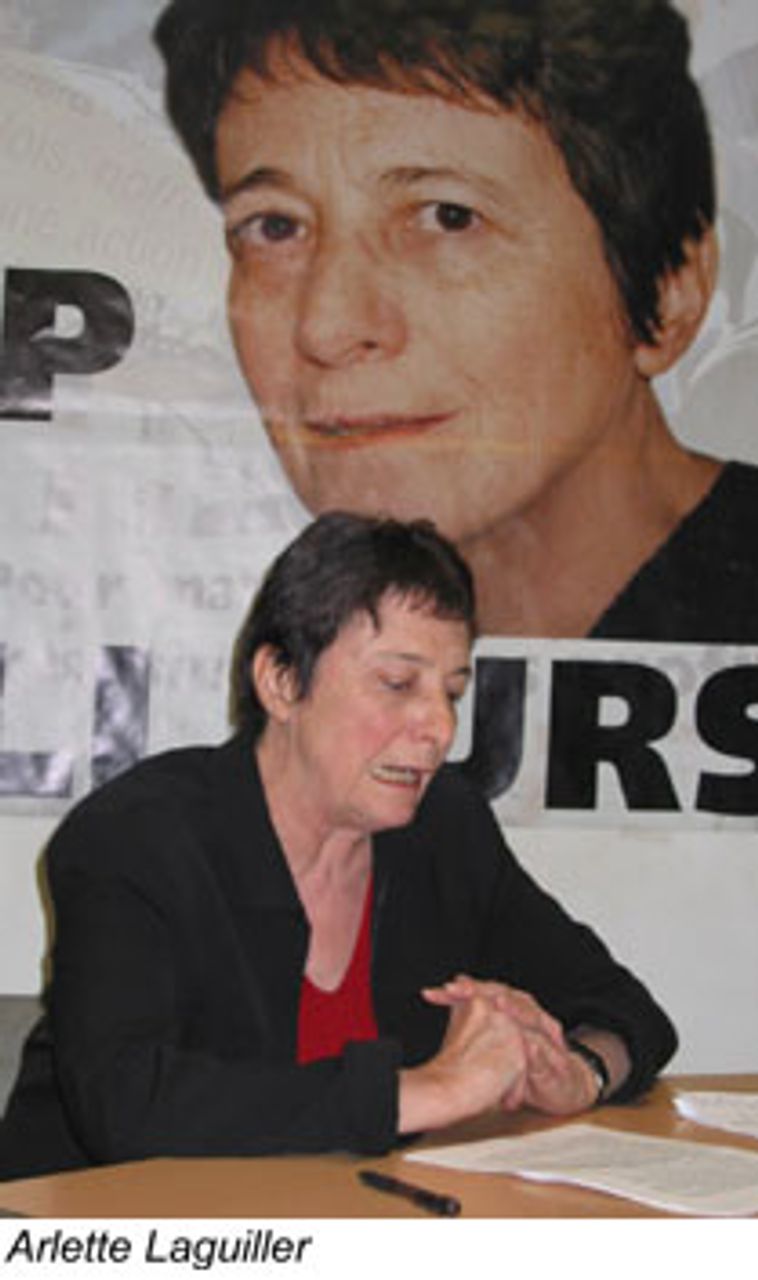
 On the evening of May 5, the World Socialist Web Site spoke with Arlette Laguiller, presidential candidate of Lutte Ouvrière. The interview took place at a party office in a suburb of Paris. Lutte Ouvrière had called a press conference to give its assessment of that day’s runoff election, in which incumbent President Jacques Chirac of the right-wing Gaullist party defeated the neo-fascist National Front candidate Jean-Marie Le Pen.
On April 29 the editorial board of the World Socialist Web Site had published an open letter to Lutte Ouvrière (LO), Ligue Communiste Révolutionnaire (LCR) and Parti des Travailleurs (PT). The WSWS called on these organisations, which had received a combined total of almost three million votes in the first round of the presidential election, to lead an active campaign for a working class boycott of the second round. [No to Chirac and Le Pen! For a working class boycott of the French election: An open letter to Lutte Ouvrière, Ligue Communiste Révolutionnaire, and Parti des Travailleurs]
None of these parties have officially replied to the open letter. However, a supporter of the WSWS and the International Committee of the Fourth International, who sent a copy of the open letter to Lutte Ouvrière, received a short reply which accused the WSWS of misrepresenting the position of Lutte Ouvrière, but said nothing about the merits of the proposal for a boycott or the political analysis of the crisis in France elaborated by the WSWS.
Following last Sunday’s press conference, this reporter interviewed Laguiller on her party’s assessment of the French elections and its attitude to the call made by the WSWS and the International Committee of the Fourth International for a boycott of the second round.
Below we publish the interview, followed by a commentary.
WSWS: We wrote an open letter...
Laguiller: Yes, I remember vaguely now...
WSWS: We proposed that your organisation, as well as the LCR and the PT, call for a boycott of the second round of the election. We argued that a boycott had a very different character than a call for voters to cast a blank ballot. A boycott signified a rejection not only of Le Pen and Chirac, but of the entire political framework that produced this phoney and undemocratic choice between a fascist and a representative of big business. The boycott aimed at mobilising the working class as an active political force, at putting the working class at the forefront of the opposition to the political establishment as a whole—its left wing and right wing, as well as the fascist reaction.
Laguiller: First of all, what do you mean by a boycott? What is a boycott, in your view? Is it abstention? Is it burning the ballot boxes?
WSWS: No, a boycott means that you appeal to the working class and to all organisations which claim to represent the working class to organise a boycott ...
Laguiller: How? Do we call on people to stand in front of the polling stations, to burn the ballot boxes?
WSWS: No. It’s a tactic that is not specific to the working class. Recently the referendum organised by the dictator-general of Pakistan, Musharaff, was very effectively boycotted by the bourgeois opposition.
Laguiller: Honestly, without the mobilisation of the working class, which is absolutely non-existent in this country at the moment as far as struggles are concerned, I fail to see the distinction you make between a boycott and abstention. If your reproach, or advice rather than reproach, is to tell us that rather than a blank or spoiled ballot, we should advocate abstention—because a boycott is abstention, it’s one and the same thing—then that means: Don’t get involved with what’s happening.
Well, we stood in the first round. We didn’t boycott these elections. We did not abstain in these elections, since in the first round we had a candidate, me, Arlette Laguiller. So we had, let’s say, a responsibility to say something to our voters for the second round. And we thought it was positive to ask them to make the gesture of casting a blank or spoiled ballot rather than being mixed up with those who decided to go on holiday, to relax for the weekend and go fishing, as we say in France, on that day.
But you are talking about an active boycott. We are not in a situation, more precisely, we do not have a relationship of forces that permits an active boycott. And we always put forward proposals that we think are in line with the relationship of forces and with what the working class is prepared to do in a given country.
Perhaps the Pakistani revolutionaries had that favourable relationship of forces...
WSWS: They were not revolutionaries, they were bourgeois parties...
Laguiller: I mean to say, perhaps it’s because they had that position of strength to boycott. But that adds up to abstaining, to not participating in the election. For our part, we know, of course, that among our voters some cast a blank vote, or wrote “no, no” on the ballot, or put nothing in the envelope, or tore up a Chirac voting slip, or, I don’t know. There are ways of showing your disagreement.
In any case, our principal propaganda for two weeks has been to say: “Not a single vote for Le Pen and not a plebiscite for Chirac.” That means, as a matter of fact, that we refused to choose between two, at the end of the line, representatives of capital, of the bosses, even if one of them, Chirac, has not got exactly the same ideology as the other, Le Pen. Nevertheless, both are representatives of the bosses, and whether one or the other were elected, he would have made the working class pay to ensure profits for the big capitalists.
This is the propaganda campaign we’ve carried out. We haven’t only provided an election-day line on the ballot slip, we have equally campaigned to explain how, even if there are ideological differences, both are representatives of the bosses. And especially to denounce the fact that the left, which very well knew that Le Pen couldn’t win power—we are obviously not in the same situation as Germany in 1932/33—and so to show the duplicity of the left, which, to avoid an accounting for the record of their policies carried out against the workers for five years, rallied behind Chirac’s candidacy. They did this so as to be in another situation now, today, without having once had to say how the policies they carried out turned the workers away, a part of the working class, from voting for the Socialist Party or the Communist Party.
That’s how it was. So perhaps you would have acted otherwise. But we, the relationship of forces being what it is, with the responsibility we have, since we stood in the first round and we did have a little over 1,600,000 voters, we were obliged, all the same, to give a voting recommendation, even if it was for a blank or spoiled vote.
WSWS: Why didn’t you propose to the LCR and the PT that they do the same thing?
Laguiller: The LCR was quick to disappoint us by finally rallying to the vote for Chirac. Olivier Besancenot, the LCR candidate, announced his intention to vote for Chirac. That put paid to any possibility of a common call for a blank or spoiled vote, since they were not in agreement with that and they let themselves be enticed by the siren’s song of the left, which, for their part, called for a vote for Chirac. In the end the LCR did the same thing as the plural left in this country.
As for the Parti des Travailleurs, their position seemed to be a bit closer to ours, but it is an organisation with which we have had no organisational contact for over thirty years. So there’s no discussion, as there has been for a whole period with the Ligue Communiste Révolutionnaire.
WSWS: But there are also the 1.2 million voters for Besancenot (LCR) and the 130,000 for Gluckstein (PT). Why didn’t you make an appeal to them? I don’t think they took too kindly to voting for Chirac. The tactic of placing demands on other organisations claiming to be revolutionary is well known in the Trotskyist movement.
Laguiller: Yes, but I think our positions in relation to them were sufficiently well known for them, if they’d wanted to, to rally to our position. They could have done so. They sat on the fence for a few days, but finally they came down on the side of the plural left rather than our position, and in the end we were the only ones to defend our position. That’s it.
The time available for the interview with Laguiller—a little more than ten minutes—was limited, and it was not possible to go into more detail regarding the various points raised in the open letter. Nevertheless, the interview made clear that the differences between the World Socialist Web Site and Lutte Ouvrière are not based on misunderstandings or mistaken interpretations.
Lutte Ouvrière’s thoroughly passive reaction to the results of the first round of voting, the absence of an independent initiative or serious counteroffensive against those calling for a vote for Chirac—the response which has been described and commented upon by the WSWS over the past two weeks—was more clearly expressed in Laguiller’s comments than in any official statement made by her party.
Her statement that a mobilisation of the working class “in terms of struggles” is “absolutely non-existent in this country at the moment” appears almost nonsensical when one considers the events in France over the past two weeks. Three million voters cast their ballots for parties calling themselves Trotskyist, including 1.6 million for Arlette Laguiller, in the first round of the presidential election on April 21. Thereafter, millions took to the streets to demonstrate against Le Pen. Yet Laguiller can detect no mobilisation of the working class.
This position expresses a drastic underestimation of the explosive social tensions that led to the election results of April 21 and the ensuing mass demonstrations. Laguiller’s words resonate with complacency and point toward her rejection of her own political responsibility.
It is noteworthy that she justifies her rejection of a boycott campaign with reference to the “relationship of forces”. For decades this argument has been used to blame the working class for the failure of political organisations claiming to represent the working class to provide leadership. It does not occur to Laguiller that the aim of a boycott campaign is precisely to create new political conditions and begin the clarification of workers and youth required to change the “relationship of forces”.
Such a campaign would hardly have prevented the second round of voting (which was not its intention, in any event), but it would have placed the working class in a far stronger position for the struggles to come. It would have made clear that there was an alternative to the electoral farce that presented workers with no genuine choice and enabled a corrupt and discredited representative of big capital, Jacques Chirac, to pose as the saviour of democracy.
When Laguiller says, “[W]e always put forward proposals that we think are in line with the relationship of forces and with what the working class is prepared to do in a given country,” she sums up, unwittingly, the classic position of political opportunism, as opposed to Marxism. Opportunists begin from the subjective level of consciousness of the working class, as they assess it, and seek to adapt their program accordingly. Marxists, on the other hand, proceed from objective conditions and the tasks imposed by these conditions on the working class, and fight to raise the consciousness of the workers and bring it in line with these tasks.
Lutte Ouvrière claims to be Trotskyist, but in fact Trotsky spent a large portion of the last period of his life opposing the arguments raised today by Laguiller. In an article written in 1940 on the lessons of the Spanish Revolution, Trotsky vigorously argued against the position that the defeat of the revolution could be explained by references to the “relationship of forces”, rather than by an examination of the role of parties, their leaderships and their cadre.
“To cancel these elements from one’s calculations is simply to ignore the living revolution, to substitute for it an abstraction, the ‘relationship of forces’; because the development of the revolution precisely consists in the incessant and rapid change in the relationship of forces under the impact of the changes in the consciousness of the proletariat, the attraction of the backward layers to the advanced, the growing assurance of the class in its own strength. The vital mainspring in this process is the party, just as the vital mainspring in the mechanism of the party is its leadership. The role and responsibility of the leadership in a revolutionary epoch is colossal” (“The Class, the Party and the Leadership,” published in The Spanish Revolution (1931-39), by Leon Trotsky, Pathfinder Press).
In the second part of the interview Laguiller sought to demonstrate that Lutte Ouvrière had indeed resisted the campaign for the re-election of Chirac. But her words simply make clear how limited this resistance was. Instead of a collective, active campaign—a boycott—Lutte Ouvrière proposed the road of passive, individual protest—submitting a blank ballot paper.
In so doing, Lutte Ouvrière was insisting that its supporters take part in the electoral farce. Why? From the standpoint of the political independence of the working class, there is no difference between abstention and casting a blank ballot. Both are forms of individual protest.
There is a difference, however, from the standpoint of bourgeois parliamentarianism. Laguiller’s insistence that her supporters at all costs go to the polls—although, as she herself admits, there was nothing to vote for—can only be regarded as a mark of respect for the institutions of the French Fifth Republic, precisely those bourgeois institutions that deprived the working class of any real choice and assured Chirac the continuation of his presidency.
It is not here a matter of rejecting in principle any participation in bourgeois elections. As the WSWS explained in a previous statement [The left and the French presidential election: An exchange of letters on the politics of Lutte Ouvrière]: “Our call for a boycott is not based on the belief that socialists, in general and in all cases, must refuse to participate in bourgeois elections. That would be a sterile and reactionary abstentionism which would convince the workers only of our unseriousness. So long as the working class is not strong enough to overthrow the ruling class, it has no alternative but to make use of the existing political forms to conduct its struggle.
“However, we are dealing not with just any election, but with a runoff May 5 between the principal political representative of the French bourgeoisie and a fascist demagogue. In those concrete conditions, the task of the working class is to repudiate that choice in the most public and demonstrative fashion, through a boycott. Workers should refuse to give any sanction or legitimacy to this political farce, or to the policies of the government which emerges from it.”
Laguiller’s answer to the last question—why she refrained from making an appeal to the voters supporting the LCR and the PT—demonstrates LO’s characteristic complacency and passivity. One can sum up Laguiller’s position with the formula: we are all of the same opinion—we should not tread on one another’s toes. When Besancenot decides for Chirac, that is the end of the matter. No efforts are made to appeal to his voters and supporters. There is an unspoken agreement not to get in each other’s hair. There is no serious fight, through a living struggle over policies, aims and means, to unite the workers and give them a correct political orientation.
Trotsky characterised this brand of politics as centrism.