
 King Lear is among the most complex and contradictory of Shakespeare’s works. While the play has no single character with the intellectual or sensual appeal of a Hamlet, Falstaff, Cleopatra, Richard III or even a Rosalind, it treats in the most vivid and dense language a vast array of problems. The tragedy’s cumulative effect is deeply troubling and, in its own fashion, subversive.
One has only to consider Act IV, Scene VI, in which the old king, now ostensibly mad and dressed in rags, encounters a former leading nobleman, now blinded and cast out, and the latter’s son, posing as a beggar, to gain a measure of the world-turned-upside-down character of the play. “Through tattered clothes small vices do appear; Robes and furred gowns hide all,” says Lear, in one of his indictments of the hypocrisy and criminality of the rich. And this in a drama dating from approximately 1605.
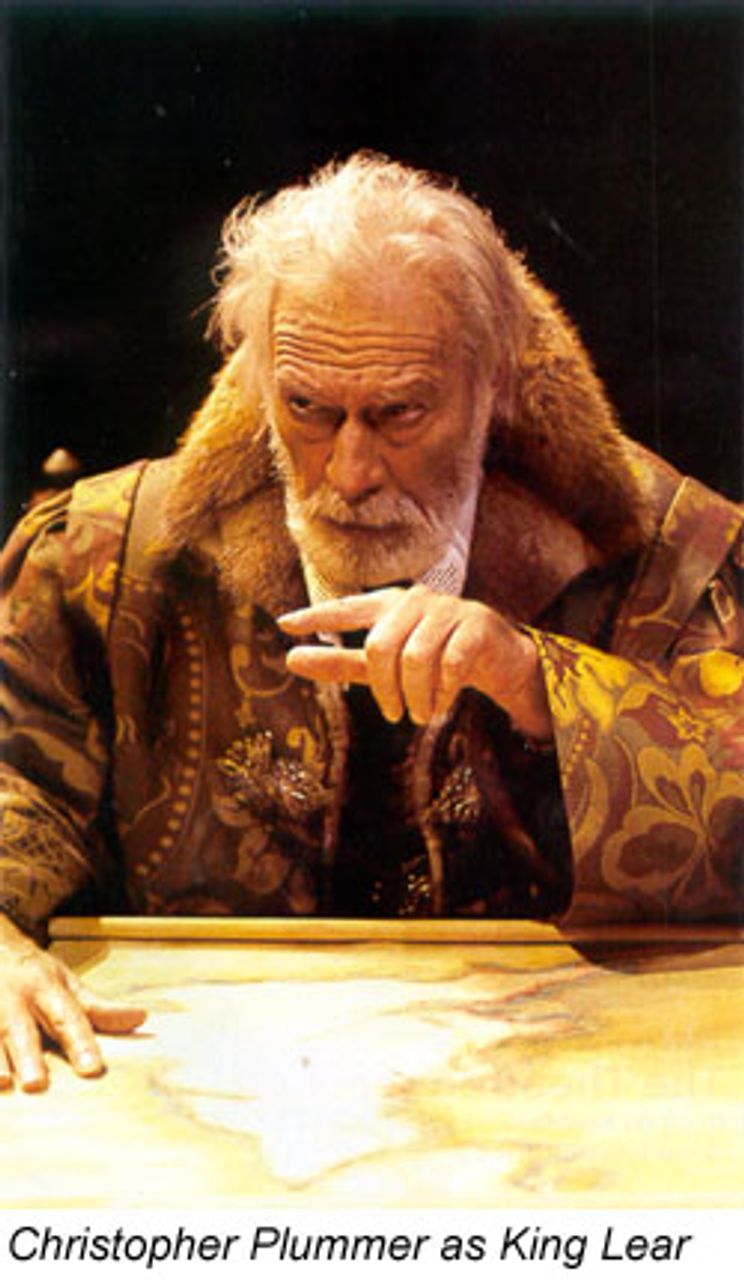
This season’s Stratford Festival of Canada production of King Lear, directed by Jonathan Miller and with Christopher Plummer in the leading role, was a credible and humane, if limited, version of the play. If nothing else, the production confutes the argument advanced by a number of influential critics since the early nineteenth century that the tragedy is too monumental for the “mere” stage, with its imperfect resources and human material, and ought to be approached solely as a literary work.
The story of King Lear is briefly this: in a mythical ancient Britain, King Lear, by now an old man, has decided to retire from active rulership and intends, while maintaining certain prerogatives, to divide his kingdom among his three daughters and their husbands. The refusal of his youngest daughter, Cordelia, to favor her father in public with a flowery declaration of love causes the despotic and vain Lear to disinherit her and apportion her share of territory between his two other daughters, Goneril and Regan.
This sets off a tragic sequence of events. Once they have a taste for power, Goneril and Regan turn on their father, eventually deprive him of his privileges and cruelly turn him out of doors. A war erupts between the British forces, led by the husbands of the two eldest daughters, Albany and Cornwall, and the French army, whose camp includes Cordelia (who has married the king of France). Lear and Cordelia, after a brief but tender reconciliation, meet a tragic fate.
A second strand of the narrative involves the Duke of Gloucester and his two sons, Edgar and Edmund. The latter, born out of wedlock, sees his ambitions blocked by his illegitimacy. A remarkable Machiavellian, Edmund sets out to redress that situation by turning his gullible, sensual father against his brother—with considerable, and terrible, success.
The play consists until the very last moment, when the handful of exhausted survivors gather themselves, of a spiral of suffering that knows few equals in drama. While the evildoers are ultimately thwarted, they have in the meantime wreaked extraordinary havoc. Indeed this ever-deepening suffering is itself one of the play’s subjects. In an aside, Edgar, upon seeing his sightless father for the first time, observes to the audience, “The worst is not / So long as we can say ‘This is the worst.’”
The British-born Miller (born in 1934) has a long history of directing for the stage and of directing King Lear in particular. He was also responsible for two versions of the play shown on British television (in 1975 and 1982). Miller, who trained to be a medical doctor before initially making a name for himself in the comic revue Beyond the Fringe in the early 1960s, believes in an uncluttered approach to Shakespeare.
He told John Coulbourn of the Toronto Sun last summer, “I think the most difficult thing is getting rid of all the expectations that it’s about a long-bearded noble man raging at the heavens in a hypothetical, pre-Christian, elf-land. It’s acquired this sort of Himalayan reputation. It’s actually a very accessible play with lots of good comedy. It’s very funny actually.” Eric Williams, a writer based in Toronto, paraphrased Miller’s half-joking comment in a television interview—conducted while he was directing Lear in Stratford—to the following effect: “[King Lear is] A straightforward play really, about a dysfunctional family. People think it’s cosmic because of that annoying storm in the middle.”
This reaction against bombastic productions of the drama is understandable and even desirable. More than one staging of Lear has reduced the play to several hours of wailing and gnashing of teeth. The presentation of unrelieved suffering is ultimately self-defeating: an audience becomes inured to it and ceases to be shocked or horrified. A degree of restraint ought to be on the order of the day when a director and his cast confront the succession of heinous betrayals and crimes that make up King Lear. In any event, as I shall discuss below, the tragedy in Lear goes beyond the merely personal. To focus morbidly on the individual fate of Cordelia or even Lear would somehow miss the point. In this regard, I believe Miller’s instinct is correct.
Presumably the director is also responding negatively to the bleak, despairing and “destabilizing” versions of Lear that appeared on European and North American stages in recent decades (particularly the 1960s and 1970s), using contemporary events (the Holocaust, the Berlin Wall, etc.) as a foil. It is perfectly true, as he suggests, that the play is accessible and contains a good deal of humor, although it is often of a lacerating variety.
Nonetheless, Miller’s comments alone would be cause for some apprehension. The absence of histrionics and pomposity, desirable as that may be, is not identical to having a fully worked out vision of the play. One can be hostile to all manner of artificial stimulants, including a false “avant-gardism,” without being convinced that a common-sense, “positivist” production is the sole or even a substantially more progressive alternative.
This Lear is performed on a bare stage, save for the occasional table or chair, in Jacobean-style dress, with no hints of pre-Roman Britain. “If you set it in a savage world, the savagery that ensues is no surprise,” Miller told Coulbourn of the Sun, adding that if it is set in Shakespeare’s time: “You suddenly think what a very fragile thing civilization really is.”
Beginning with Plummer, the performance of the play is clear and intelligent. A fine actor, Plummer (born in 1927) brings a good deal of thought and compassion to the lead role. Particularly memorable are his appearances in the opening scene, when he sweeps in dressed in luxurious robes, and in Act IV, Scene VI, when, a far humbler man who has lost everything of material value, he enters with flowers and weeds in his hair. The appearance in the “mad scene” in particular is quite a remarkable moment, when one considers that the actor involved is known ordinarily for his rather dignified and formal manner. It is not an entirely small thing to make a “fool” of oneself in this fashion. The effort and sacrifice themselves are indicative of the humanity and sincerity being brought to bear.
Taken as a whole, however, while Miller has directed an even-handed and understated production, it is not an extraordinarily illuminating one. One can be false in any number of directions, not only the bombastic. His decision to emphasize the humor, and generally lighten the atmosphere, at times strikes quite the wrong note. I found the characterization of Edmund, the bastard son of Gloucester, particularly misguided. Again, it is one thing to avoid the obvious pitfall of making Edmund (Maurice Godin) a stock villain, it is another to transform the part into a quasi-comic role. This is one of those tempting and clever notions that should have been resisted. In the first two acts, one can get away with playing Edmund “for laughs,” as he mocks his credulous father and brother and generally plots out his advancement. As the drama darkens, however, one grows increasingly uneasy with the approach; the events are simply too ghastly to make it appropriate or convincing.
There is a difference between a production done with a “light touch” and a lightweight production. Miller’s Lear has elements of both. One does not know to what extent the director is accommodating himself to the perceived inability of his audience to undergo a complex experience, when he suggests that Lear is merely a “straightforward play ... about a dysfunctional family.” In any event, there is no reason to agree with his assessment. And the only alternative is not necessarily the “cosmic.”
In my opinion, and contrary to the views of a number of influential critics, King Lear is far more a social than a family tragedy, as I will consider below. An extensive network of intimate biological relations is sketched out (father-daughters, father-sons, sister-sister, brother-brother—everyone but the mother is physically present), but never deeply explored. To a certain extent, it is the family drama that strikes one as the more historically-determined and historically-limited element in the play. Whatever his original intention, Shakespeare, it seems to me, discovered a considerably more pressing set of problems to dramatize.
In any event, Miller’s rather banal comment points toward the production’s underlying weakness. One can be too “straightforward,” too evenhanded. There are critical moments and passages that require urgency and underlining, and here that is largely lacking. Instead, there is too much that comes from the textbook of standard theatrical technique. To give an example: it is unnecessary, and an underestimation of one’s audience, to direct the actress playing Regan (Lucy Peacock) to begin casting longing looks at Edmund well before the drama indicates a relationship between the two characters. This “foreshadowing” is mere laziness, mere routinism, and suggests that not enough is taking place on deeper levels.
And this routinism extends to most of the performances (Plummer, Domini Blythe as Goneril and Godin, although the result is not entirely happy, are the principal exceptions). Miller is not responsible for the mediocrity of many of his actors or the general performance level at Stratford, but he has clearly not declared aesthetic war upon them either. The artistic result is a certain flatness and dullness, particularly in the second half of the piece. The quantity and quality of intelligence and straightforwardness at work prove inadequate to propel the production to the heights of psychological and social insight that a fully developed rendering of the titanic drama would demand.
That being said, the Miller-Plummer staging, whatever its weaknesses, had a considerable value, both in itself as a theatrical experience and as a stimulus to a further study of King Lear.
It might be useful, in considering how the recent production may have fallen short and how another approach might be taken, to consider the play and its social-tragic aspects in greater depth.
A happy ending for 150 years
King Lear disturbed official Britain in the wake of the Restoration of 1660. So much so that between 1681 and 1838 Shakespeare’s play was supplanted on the stage by a version that made Edgar and Cordelia lovers and gave the play a happy ending, with all the major figures surviving. (Between 1810 and 1820 no version of the drama was performed, out of fear that audiences might see a parallel between Lear’s mental state and that of the decrepit and insane George III.)
Attitudes toward King Lear within literary and theatrical circles evolved during the course of the twentieth century, as the emphasis on the play’s redemptive and ultimately “positive” aspects (in either its Christian or humanist forms) was replaced by a considerably bleaker or even nihilistic view. The great traumas of the 1930s and 1940s no doubt had something to do with this, but then so did, particularly in Britain, a general loss of confidence and growing pessimism within layers of intellectuals as bourgeois society entered into an overall moral and economic decline.
A Marxist critic would stand aside from both interpretations. It is not clear, in fact, that director Peter Brook’s conception that “as characters [in King Lear] acquire sight it enables them to see only into a void” is any more valid than A.C. Bradley’s notion (in 1904) that “any actor is false to the text who does not attempt to express, in Lear’s last accents and gestures and look, an unbearable joy.”
The dark and pessimistic approach dominated for a number of decades, especially after Brook’s influential production in the early 1960s, later made into a film (with Paul Scofield). In British playwright Edward Bond’s 1970 reworking of the play, as noted by R.A. Foakes in his Hamlet versus Lear: cultural politics and Shakespeare’s art, “Cordelia survives being raped by rampaging soldiers only to rebuild at the end a state as horribly cruel and repressive as the one her father ruled at the beginning.”
The chilly school of postmodern-influenced “cultural materialists” in the 1980s took matters farther, one of their members viewing the play, according to Foakes, as “the locus of a distinct, politically dynamic sequence of intersecting discursive practices, replete with competing ideologies.” With at least more directness, Jonathan Dollimore rejected both the Christian redemptionist and liberal humanist readings in favor of the view that King Lear “is, above all, a play about power, property and inheritance” (Radical Tragedy: Religion, Ideology, and Power in the Drama of Shakespeare and His Contemporaries).
The value of this school of academic literary “leftism” is questionable at best. If Lear is nothing more than an historical document of this sort, than it is not immediately apparent why the play should have gripped audiences over the course of many years, and continues to do so. There must be represented in the drama certain elements of deeply meaningful human experience, common to the early seventeenth century and our own day, that go beyond the problem of “power, property and inheritance.” After all, primogeniture is largely a thing of the past and monarchs wielding any real political power are few and far between.
To the extent that within a certain body of recent criticism there was an element of protest against the “Shakespeare industry” and the use of Shakespeare to validate “British identity” and “British culture” in particular, one can feel a certain sympathy. The institutionalizing of Shakespeare is hardly an unmixed blessing. There is much to be criticized about the major festivals devoted to his works, including a great quantity of going through the motions. How and why to approach Shakespeare remains a problem for modern theater companies, even the most specialized. The necessary critical purposefulness and urgency, which have to be drawn from contemporary reality and needs, are often lacking.
Nonetheless, the widespread staging of Shakespeare’s works testifies objectively to more than merely varying attempts, as they are sometimes portrayed, to take in money from tourists undergoing relatively superficial encounters with “high culture.” One current web site lists some 185 Shakespeare festivals in seven countries, lasting from a few days of performance to year-round activities, with no doubt wildly varying levels of acting skill. (California alone boasts more than 30 festivals and companies, including the African American Shakespeare Co. and two all-female troupes.)
One might add that historically the socialist workers movement, including of course its co-founder Karl Marx (who had large passages of Shakespeare committed to memory), has always had the deepest attachment and connection to the great English playwright. Even before Marx, Thomas Cooper, a radical shoemaker in Leicester, formed the “The Shakespearean Association of Leicester Chartists,” and upon arrest “for fomenting riot and on a false charge of arson, he raised money for the legal expenses of himself and his fellow-accused by putting on a production of Hamlet” (Jonathan Bate, The Genius of Shakespeare). Shakespeare was a staple of the educational efforts organized by the socialist movement in the late nineteenth century: for example, the Section d’Art of the Belgian Workers party in 1891-92 had Shakespeare on its program, along with Ibsen, Wagner, William Morris and Verlaine.
Shakespeare’s plays endure, in whatever flawed theatrical fashion, not primarily because of bourgeois cultural assumptions or stratagems, but because they picture life, including the inner life, in great depth.
The “radical” approach to King Lear—reasoning that Lear, after all, is a king and a despot, a co-equal of Goneril and Regan (or worse), a swine among other swine who more or less deserves what he gets—denies that the central character or anyone else in the drama undergoes any significant experience. The chief trouble with this artificially “objective” and “cold-eyed” approach is that it remains entirely hemmed in by the obvious.
Shakespeare, no more than any other artist, even the most brilliant and insightful, could not jump out of his skin. He wrote plays in which the leading figures were kings, queens, princes and dukes and the prevailing or emerging social order and social relations were more or less taken for granted, at least on the conscious level. The critic who devotes years to belaboring, albeit in high-flown and obscure language, this elementary truth, is largely wasting his or her time and ours.
The question remains: what is there in the experience of King Lear and the other characters in the play that speaks to an audience not composed of courtiers or leading bourgeois and not convinced that every occurrence on earth is either part of a divine plan or a sign of the “ultimate cruelty of things,” an audience looking for insight into both historical and contemporary reality?
Something important happens
For the play to have meaning, it seems to me, one has to begin from the proposition that Lear (and not only he) undergoes a radical change in his mental and moral state, a change that has far-reaching implications. If one does not start from the premise that something important happens in the play, something unusual and even shattering, then one might as well be writing about the prices on the London wool market in 1605 or the daily life of the court of James I.
At the play’s outset the king is thoroughly oblivious to the realities of his own world and even his own family. His plan to discover from his daughters’ formal public declarations, as a supposed condition for a reward of additional territory, “Which of you shall we say doth love us most,” is a symptom of a self-deluded state. So too is Lear’s response to Cordelia’s refusal to take part in the ritual and to his right-hand man Kent when he comes to her defense.
Shakespeare portrays this self-deluded state as something of an occupational hazard. Insofar as Lear is a privileged ruler he is deprived of understanding, insofar as he gains knowledge he is incapable of ruling and ashamed of privilege. This is not a personal failing. The play provides glimpses of a brutal social reality which obliges the ruler (and the privileged in general) to remain ignorant of the conditions of the poor if he is to retain his sanity, that is to say, to continue making decisions that benefit the wealthy and powerful.
The family and social dilemmas come together in this. The normal ruler is trained to shut his eyes to the misery of the population. Lear becomes vulnerable to a wider reality when he puts himself at the mercy of his daughters and finds himself suddenly homeless and stripped of his retinue and privileges. He discovers a far greater tragedy than his own in the condition of those with whom he shares the open heath in Act III. At this point the family tragedy turns into something else. The Stratford production treats this decisive scene as merely one among many.
(Whoever wants to contest the notion that the brutality of 17th century English life plays a particularly prominent role in King Lear has the language of the play to contend with. Investigation reveals that words such as “poor,” “beggar,” “wretch,” “rags,” “charity,” “bare,” “nothing,” “worst,” “cold” and “naked” appear considerably more often in Lear than in the other leading tragedies, Hamlet, Othello and Macbeth. A number of other words, including “houseless,” “bareheaded,” “raggedness,” “unaccommodated,” “hovel” and “poverty” appear only in Lear.)
Lear’s mental collapse is entirely understandable, almost inevitable, given the impossible contradiction rapidly exposed between the model of the world on which he previously based his actions (including the assumption, supported by formal and meaningless proofs, that his daughters loved him) and the reality to which he is exposed.
The onset of madness and an increased social perception and concern are closely identified in Lear. The first occasion on which the outcast king begins to doubt his sanity in a more than rhetorical fashion (“My wits begin to turn”) coincides with his initial expression of compassion and concern (“How dost, my boy? Art cold?,” addressed to the Fool). The second occasion (“O, that way madness lies. Let me shun that; / No more of that.”) is immediately followed by the extraordinary speech that one commentator terms “a kind of proto-socialism”:
Poor naked wretches, wheresoe’er you are,
That bide [endure] the pelting of this pitiless storm,
How shall your houseless heads and unfed sides,
Your looped and windowed [full of holes] raggedness defend you
From seasons such as these? O, I have ta’en
Too little care of this.
Lear’s full-blown “madness” in Act IV, Scene VI is accompanied by the most explicit social criticism and self-criticism. He begins almost immediately to denounce his formerly deluded state, which had been encouraged by those around him in court: “They flattered me like a dog [i.e., like they were fawning dogs] and told me I had the white hairs [of wisdom] in my beard ere the black ones were there. To say ‘ay’ and ‘no’ to everything that I said ‘ay’ and ‘no’ to was no good divinity.... They are not men o’ their words; they told me I was everything. ’Tis a lie.” Here is a Hamlet-like conclusion, that everything in official life has been a falsehood.
He launches his most violent attacks on social injustice and the powerful in society in this scene. Lear tells the blind Gloucester that he “may see how this world goes with no eyes,” in other words, with his ears. He conjures up an imaginary judge verbally abusing a “simple [humble] thief,” and explains to Gloucester that the difference between legally constituted authority and the criminal is an arbitrary one: “Hark in thine ear. Change places and, handy-dandy, which is the justice, which is the thief?” This is remarkable material.
In Act 1, Scene 4, the disguised Kent has obtained employment from Lear by flatteringly telling him that he has “that in your countenance which I would fain call master.” Lear asks, “What’s that?” The reply is “Authority.” By Act IV, Scene VI Lear has a different conception. He notes that a beggar will run from a barking dog, and adds: “There thou might’st behold the great image of authority: a dog’s obeyed in office” [even a dog is obeyed when it is in a position of power].
The mutilated Gloucester echoes Lear’s criticisms of the wealthy and even adds an appeal for social equality. Earlier in Act IV, Scene VI he calls on heaven to let the “superfluous and lust-dieted man” [he who has more than he needs and will not share] ... “feel your power quickly.” He continues: “So distribution should undo excess / And each man have enough.” Edgar, Gloucester’s persecuted son, goes farther, actually taking the part of a beggar, Poor Tom, a “naked fellow.”
In their bitter recriminations Lear, Gloucester and Edgar are vindicating Lear’s Fool, who has been stingingly indicting his master’s folly and society’s hypocrisies from the play’s first scene. The jester disappears from the play after Act III. In effect, he becomes superfluous. When Lear makes his next appearance, unaccompanied, he is mad and speaking in riddles. He has become his own Fool. The playwright has Lear tell us this in the same scene, if we will only take the old man at his word, when he pronounces himself and every other human being such a creature: “When we are born, we cry that we are come / To this great stage of fools.” On three further occasions Lear refers to himself as a fool or foolish, finally telling Cordelia during their reconciliation, “You must bear with me. / Pray you now, forget, and forgive. I am old and foolish.”
The Soviet critic Aleksandr A. Smirnov wrote of Lear that, “Having endured need and privation, he begins to understand a great deal of what had hitherto been incomprehensible, and to regard his power, his life, and mankind in a different light” (Shakespeare: A Marxist Interpretation). The spectator has the possibility of doing the same.
It would be false and misleading to suggest that King Lear is any kind of social-revolutionary manifesto. One feels, as always with Shakespeare, that he is simply and implacably following to the end, with immense artistic genius, the logic of the problem he has set himself, in this case, the physical and psychological fate of a king reduced by a series of events, including devastating family conflict, to the level of a pauper. Explaining how and under the impact of which social forces and influences Shakespeare set himself such a task and why he undertook it in 1605 or so is the task of serious scholarship.
Lear dies looking for signs of life in the corpse of his daughter Cordelia. “No, no, no life? / Why should a dog, a horse, a rat have life, / And thou no breath at all?” He passes away unceremoniously, asking for one of his buttons to be undone. Audiences and critics of an earlier day, who apparently entertained a somewhat sentimental view of Cordelia in particular, found the play’s ending unacceptable.
In the deepest sense, however, King Lear is far more than the tragedy of an individual or group of individuals. There is something superpersonal about the drama; the individual passion, as Trotsky suggested, “is transformed into a fate of a certain kind” (Literature and Revolution). One feels strongly that there is no possibility of a happy ending to the drama, even that there ought not to be one, based on the logic of what one has seen unfolded.
How could there be a comforting resolution within the confines of Shakespeare’s world, which is the world of the play? There is nothing gratuitous about the tragedy and violence in King Lear. Rather, the massive suffering speaks in part to the massive dimensions of the problems dramatized, unsolvable under the social conditions of the early seventeenth century. The suffering is an emblem, above all, of this unsolvability, has a world-historical quality and is entirely fitting.