
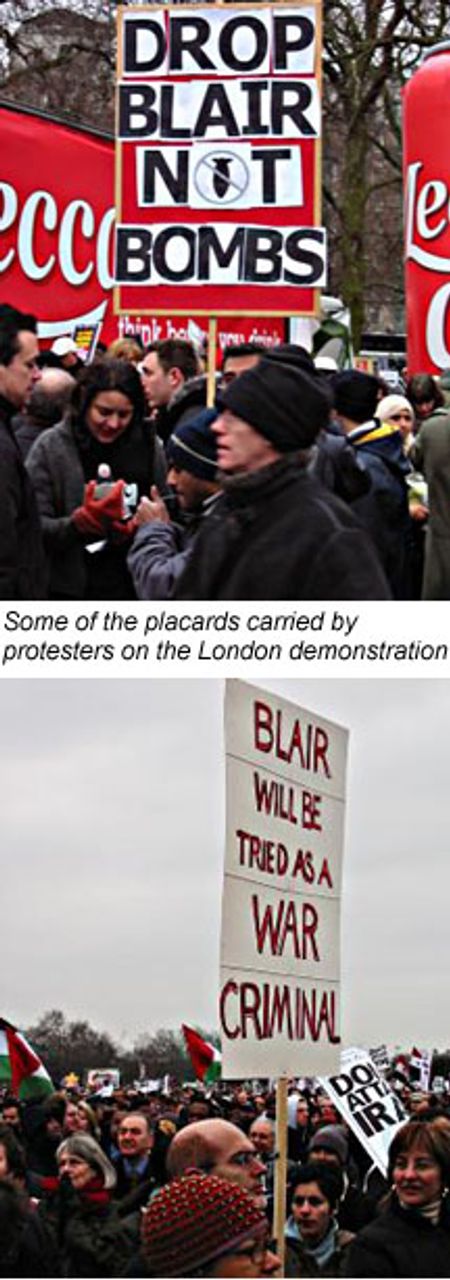
 Up to two million people took part in the London demonstration to protest war against Iraq. The exact figure was difficult to calculate due to the sheer weight of numbers, but the demonstration stretched across the capital—From Hyde Park past Buckingham Palace, to the Houses of Parliament and beyond.
For more than a week the media and political establishment had speculated on the demonstration’s size. Half a million was considered a great success, and would make it the largest political protest in British history. In the end, the turnout was much larger, making it quite simply the largest demonstration in the UK of any kind, ever.
It took some people more than five hours to walk the three-and-a-half-mile route, with marchers still arriving in the park long after the official rally had closed at 5:30 pm. Ariel photographs showed a packed park, but even that was deceptive as there was a constant turnover of people gathering to listen to a speech or two before moving on—their place quickly taken by others.
It seemed that virtually every town was represented. The number of coaches had multiplied in the final days leading up to the march, leading local radio stations to issue urgent appeals for coach companies or individuals to help provide transport to the capital. Trains were also commissioned.
Even before the march officially set off at 12:30 pm, thousands were already on the move along the route. It was probably the most diverse demonstration ever witnessed in Britain—white, black and Asian people, every generation, accent, a host of nationalities and varied social backgrounds. From firefighters, who only recently suspended their strike action over pay, visible in their uniforms, to pensioners, teachers, healthcare workers, lawyers, artists and house wives. It was a microcosm of British society.
For a significant proportion, it was their first ever protest. Most noticeable was the large numbers of young people—teenagers, students and young workers made up a sizeable part of these “first timers”, which also included large numbers of women. These were not “radical” youth as is usually conceived, but youth that are becoming politically radicalised by events.
The demonstration was remarkably good-natured but by no means lighthearted. Again and again people said they felt compelled to participate, that they had the impression something historic was underway, that the world was being remade in some fundamental sense that they could not quite put their finger on.
Everyone rejected the US and UK’s claim to be concerned with Iraq’s “weapons of mass destruction”—it was patently a war for oil, and more than that, for world domination. For that reason, even though most official speakers at the rally made clear they would support war against Iraq, providing it was conducted through the United Nations, this was not the sentiment on the march. There was overwhelming hostility towards an attack on such a poor and vulnerable country. This was combined with a more inchoate and confused sentiment—a nascent class resentment and mistrust against a ruling elite that, in the case of Iraq, was demonstrating its indifference and contempt for the democratic will of working people.
“They always ignore us,” people said in reference to the powers-that-be, but this time it’s gone too far. The preparations for war against Iraq were so blatantly in defiance of public opinion and the government’s attitude so openly anti-democratic that it could no longer be allowed to pass. Now was the time to draw the line and say “no further”.
This was not simply a march, but the beginnings of a social movement, albeit a defuse one. People wanted to be part of something larger than themselves—to change things positively. Though the Stop the War Coalition—an umbrella organisation ranging from bourgeois politicians to religious groups, radical activists and individuals—had convened the demonstration, this was a largely spontaneous movement—a fact evident in the number of homemade placards declaring: “Not in my name, poodle,” “Regime change begins at home,” “Who armed Saddam—Who trained bin Laden?” and “No evidence linking Blair to the British people.”
There were relatively few organised political banners—whether from trade unions or other groups. This was not surprising, given that virtually the entire British establishment supports Blair’s line. Reflecting that Labour is now the party of imperialist plunder, its presence was confined to a handful of rather pathetic branch banners.
Prime Minister Tony Blair was inadvertently the main recruiter for the demonstration. His arrogant insistence that he would continue his war preparations regardless of popular support mobilised hundreds of thousands on the streets. Many felt bolstered by the knowledge that London was only part of a series of protests across the world, the international display affirming that they were not in the minority after repeatedly being told otherwise.
The platform of speakers included Liberal Democrat leader Charles Kennedy, the Rev. Jesse Jackson, former Labour minister Mo Mowlem and former Labour MP Tony Benn, former Algerian President Ahmed Ben Bella and various trade union leaders. Their line was overwhelmingly one of trying to bolster support for the United Nations and presenting the European powers, Germany and France, in particular, as a bulwark against US aggression. They left open their willingness to go to war, under the right circumstances.
It fell to various radical organisations to provide some political camouflage for those on the platform. Supporters of the Socialist Workers Party such as Lyndsey Germain and “left” trade union leaders such as Bob Crow made demagogic noises against Blair and the establishment, but proposed nothing that would fundamentally challenge him. They were reduced to holding up the trade unions as a vehicle for change, promising to fight for a recall of the Trades Union Congress to discuss the war and even to propose cutting off funding to the Labour Party. The unions would “bring down Blair”, they claimed, unless he changed course—empty rhetoric given that they steered clear of the call for a political drive to oust Blair from the Labour Party leadership.
The World Socialist Web Site and Socialist Equality Party of Britain had stalls at the start and finish of the demonstration, where supporters distributed thousands of copies of the statement, “The tasks facing the antiwar movement,” one of only a handful of leaflets being distributed. People went out of their way to get a copy, eager for political analysis, and many said they knew of the World Socialist Web Site and appreciated its daily coverage of events.
 Amongst those who spoke to our reporters was Annette, a housewife from Hitchin who came to the march with three of her five children.
“I used to think I could make my mark in the world and to make the world a better place by bringing up my kids as free-thinking, wholesome young people,” she said. “You know, to set an example by eating organic food and caring for the environment and all that kind of thing. I used to feel safe—that everything would be all right. But it’s not all right. The system is sick.
“I feel now that I am surrounded by ruthless political and economic forces that make the unfolding of the better side of the human spirit impossible. I am gripped by a feeling that I need to do something much more radical.
“We are not asked if we want this war. It’s an insult to democracy. For me, Bush and Blair personify the death of democracy. We live in a system where money rules, not human need. People are in the grip of something. They are fed up of the lies and hypocrisy. They feel they have no rights to make decisions. They want to believe in something—to make the world a better place.
“I believe that what we are fighting is not just Blair or Bush. They represent just the tip of the iceberg of the imperialistic process that has been developing over decades. I am willing to fight for a world that has different priorities than the capitalist system, and I am willing to look into socialist ideas because I need a movement.”