
The recent 22nd Vancouver International Film Festival screened some 325 films from more than 50 countries. The festival is the largest showcase of Canadian films in the world and presents the greatest number of East Asian films outside Asia. Nearly 70 documentaries were shown this year.
The programmers in Vancouver face the same chief difficulty as everywhere: the relative scarcity of outstanding dramatic material. A number of the interesting films presented at the Toronto festival in September made their way here as well, including Jafar Panahi’s Crimson Gold (Iran), Wang Xiaoshuai’s Drifters (China), Samira Makhmalbaf’s At Five in the Afternoon (Iran), Ra’anan Alexandrowicz’s James’ Journey to Jerusalem (Israel) and Marcelo Piñeyro’s Kamchatka (Argentina).
The Vancouver festival showed a number of other valuable works, including Abjad (Abolfazl Jalili) and Deep Breath (Parviz Shahbazi) from Iran. There are growing indications that intelligent (i.e., critical) life is returning to eastern Europe and the Balkans; this was suggested by Small Town (Jan Kraus) from the Czech Republic, Fuse (Pjer Zalica) from Bosnia and Jagoda in the Supermarket (Dusan Milic) from Serbia. Among the documentaries, Condor: The Axis of Evil, from Argentinean filmmaker Rodrigo Vasquez, and Dance Under the Swastika (Annette von Wangenheim), from Germany, stood out for their straightforwardness and honesty.
The Asian films in general were disappointing, particularly the South Korean and Taiwanese works, continuing a trend that has deepened in the last few years. In this region especially, an enormous crisis of historical perspective “weighs like a nightmare on the brain of the living”—a crisis perhaps epitomized by the fact that one of the most sensitive and observant of the East Asian filmmakers, Lee Chang-Dong, is now the culture and tourism minister in the South Korean government!
The lively and not easily classifiable Golden Chicken (Samson Chiu) from Hong Kong was something of an exception to the rather dreary East Asian rule. And Wang Bing’s nine-hour documentary Tiexi District: West of the Tracks (in three parts), about China’s decaying rust-belt, while deeply problematic, is a work that cannot be dismissed or ignored.
In general, the screening of so many documentaries might be seen in part as an effort to “make up for” the general inability of fiction works to grapple seriously with the character of contemporary social life; but, in the final analysis, the non-fiction material inevitably reveals many of the same general problems.
What are some of these problems? Above all, that the typical contemporary artist understands very little in reality about the society in which he or she lives and works. There is a great deal of cleverness, technical wizardry and formal virtuosity in present-day art and film, but a very weak grasp of social and historical processes, the processes ultimately determining the fate of humanity.
The work of filmmakers, novelists, playwrights and poets in particular inevitably centers on human relationships of one sort or another. But to what extent do these artists pass beyond surface impressions at the moment and explore the underlying tendencies at work in society? As the artistic results demonstrate, here is a large group of people—extremely well compensated in some cases, not in many others, but, in any event, recognized as a distinct professional grouping—who often understand next to nothing about the deeper content of their chosen subject matter. This may seem astonishing at first glance, but it is a fact of life.
Too many contemporary filmmakers indeed boast of their indifference to social and political realities and their ignorance of history—that is to say, the determinants of their own field of specialty. Imagine the surgeon who sat down and calmly explained to an astonished patient and his or her family members, “Well, no, I never actually studied gross anatomy, pathology, biochemistry, physiology and such, but this hospital has state-of-the-art equipment, I’m known for my hand-eye coordination and, in the end, really, a good surgeon just works from his gut. Trust me.” Such people would lose their licenses, perhaps end up in jail. Yet, artistic “quacks” are permitted to ply their trade without protest.
And the difficulties persist even in those cases (such as the massive Tiexi District) where the artist piles up everyday detail and empirical facts about social life. It has been noted more than once that a gulf separates apprehension from comprehension.
The understanding of history and society within the artistic intelligentsia as a whole has declined—and in fact, such an understanding has itself become largely discredited—in a manner unprecedented in the modern age. The retreat of layers of the middle class since the last wave of radicalization in the 1960s and 1970s into hedonism and selfishness; the enrichment of a considerable portion of those involved in the media, entertainment and “culture” industries; the ideological confusion produced by the collapse of the Soviet Union and the triumphalist propaganda proclaiming not merely the “death of socialism,” but even the inadvisability or impermissibility of social awareness in general—these interrelated processes have had an impact.
The typical artist today lacks that “deep understanding of real conditions” of which Marx wrote approvingly. He or she lacks elementary knowledge, and therefore intuition about the great social driving forces and familiarity with those economic features of life—property, capital, class interest, etc.—that major novelists and dramatists at one time considered ABC. It was not for nothing that Balzac wrote: “Tell me what you possess and I will tell you what you think.”
The contemporary artist lacks social science to a dangerous extent. He wanders about among historical or social problems like a hostile stranger, uneasy and unsure as to his footing, feeling out of place. Of course, his approach to these matters must be distinguished from that of the historian or revolutionist. Under the best of conditions, art refracts and transforms reality in accordance with its own laws and needs, but the artist still has at his disposal only the material provided “by the world of three dimensions and the narrower world of class society” (Trotsky). Absent from most present-day cinema and literature is any attempt to make a painstaking analysis of what actually is.
The emergence of a worldwide social and political crisis, deepened by the aggressive and belligerent policies of the present administration in Washington, is beginning to have an effect on the stagnant artistic climate, particularly among a section of younger and more rebellious artists. A radicalization is no doubt under way. A growing sensitivity to human suffering and to the disastrous economic, social and moral consequences of social inequality is making itself felt. But major problems remain. Even those who show an increased interest in the fate of humanity continue to work with socio-aesthetic methods and concepts that impede or block the development of the most penetrating drama.
We insist that that there is a relationship between artistic forms and social processes. The drama did not arise historically, contrary to the apparent opinion of many today, merely to provide the artist an arena in which he might show off certain technical skills, parade his trivial fantasies or generally indulge himself. It arose as a means by which fundamental human relationships, ultimately traceable to the conflicts between great social forces, might be displayed, examined and made comprehensible.
This notion has been under attack for decades, in the name of a struggle against didactic “message” art or “meta-narratives.” No doubt the oppressive influence of Stalinist-populist “Socialist Realism,” with its templates handed down by a bureaucracy or national “people’s leader” who knew what was best for everyone, had to be resolutely combated. But by whom and on what social basis? From the left or from the right?
Much of what we see today is the all-too-convenient and self-serving product of the right-wing response—or a highly confused, semi-Postmodernist reaction—to the pat and overbearing social drama of previous decades. This has not led to a more nuanced, intricate and many-sided approach to social reality, but the rejection of an approach to social reality on any basis. Instead, individual psychological life and history are held entirely apart. Characters and situations are determined haphazardly and subjectively, without a meaningful reference to “the motives behind the motives” (i.e., the social necessity that finds expression in individual and accidental happenings).
Deprived of genuine nourishment, individual psychology is inflated, over-extended, falsified. Purely “private” matters, uninformed by social life and therefore distorted, dominate. The relationships between people are not grasped at their most meaningful levels, and the connections provided are either abstract or arbitrary. Great attention may be paid on occasion to milieu and social setting, but generally as phenomena quite apart from the content of the human relationships depicted. In historical works, while enormous attention is paid to getting the external trappings right, present-day, ahistorical motives and values are imposed on the chronicled figures and situations. Moreover, the historical process is presented, at best, as unknowable and, at worst, proof of man’s essential filthiness and brutality throughout the ages.
Resisting the trend, in part
Certain films and filmmakers resist these trends, at least in part. A number of Iranian screenwriters and directors have dedicated themselves to uncovering social reality (as well as a number of Chinese filmmakers; and, in the late 1980s and early 1990s, some of the Taiwanese). Here too, there are limitations. Taking their cue from Italian neorealism of the postwar years, the best Iranian filmmakers direct their attentions to the circumstances of the oppressed, their everyday struggles for economic and psychic survival.
This plebeian realism is a healthy trend in many ways, but it provides a circumscribed view of social life. The difficulties of the poor are treated as static and eternal, and the nature of Iranian society as a whole goes untreated. The relations between all the classes and social layers are rarely touched upon. Some of this is due to the pressures of censorship and official repression, but not all. The Iranian artists have largely been cut off from the extensive history of secular, left-wing opposition to reaction in the region, including Islamist extremism. In terms of the larger historical and social questions, they proceed blindly. Nonetheless, honest and serious work continues to go on there. In fact, this year’s films mark something of a revival.
Abolfazl Jalili is a veteran filmmaker, several of his films—A True Story (1996), Dance of Dust (1998) and Delbaran (2001)—having appeared at film festivals in North America. Abjad (which refers to the manner in which schoolchildren learn the Persian alphabet) represents a considerable jump in his artistic work. It is quasi-autobiographical, set in Iran on the eve and during the aftermath of the earthshaking Iranian revolution of 1979 that tragically led to the Islamic regime coming to power.
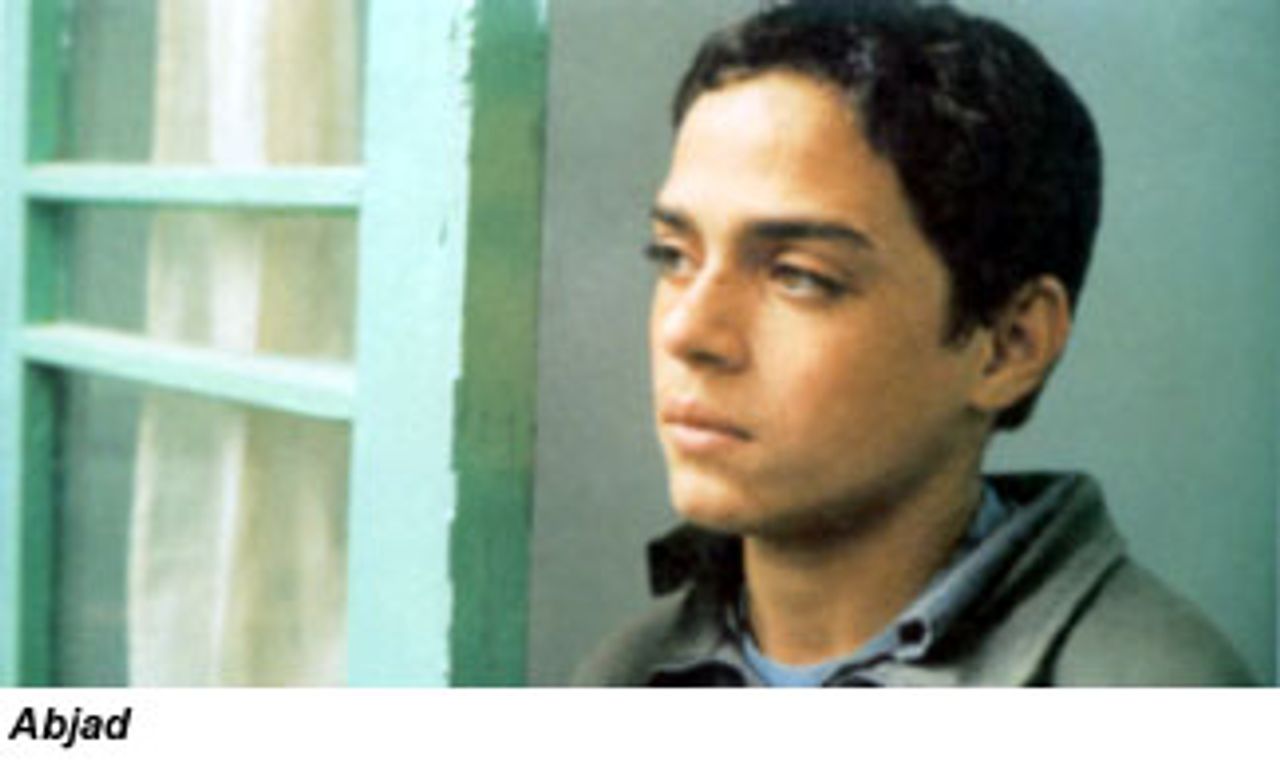 The film’s central character is a teenage boy, Emkan (which means “possibility”), living in a town outside Tehran. The boy is in continual motion. We first see him running, and he never stops throughout the film. And not purposeless motion. Emkan is in a state of “permanent rebellion,” against repression, against all the barriers to art and love and a more humane society.
In one of the first sequences, he draws a woman’s face and is punished for it. “Drawing a face is prohibited.” His hand is beaten with a cane. Nothing stops him, however. Everything is prohibited—music, drawing, photography—and he carries on with every activity. And he’s beaten or punished every time. One cleric declares: He who plays music and he who listens will burn in hell. Emkan’s uncle tells a different story: The Lord created music.
The youth finds a book of poetry in a bag and decides he wants to be a writer. Next, we see books being burned in a garbage can. He falls in love with a beautiful Jewish girl, Massoum. This upsets everyone, including her male cousins, who also beat him and drive him off, saying, “Stick to your own cousins, it’s against your own religion.” Emkan continues to pursue the girl, even when her family later goes into exile after the Islamic regime comes to power.
He also leads political protests, presumably against the Shah’s regime and school officialdom. Emkan falls in love with the cinema—Massoum’s father owns the local movie theater. He comes into conflict with his strong-willed and traditionalist father, who is portrayed with considerable humanity and dimension. The older man has his own frustrations, finding himself after decades on the job bossed around by “a man of twenty-two.” The corruption and nepotism he sees in his office disgust him. Emkan’s father comes to accept his son’s love for the Jewish girl: “If it’s real, go find her.”
The new regime presents its own problems—the cinema is closed, the Jewish family is forced out. Emkan’s long-distance search for Massoum results merely in another beating at the hands of her relations. He sets off for Tehran, the big city, full of hope and ideals, with a considerable lived experience already behind him. “I’ll film the story of my life,” he announces. The film ends with Massoum’s voice reciting a love poem, as Emkan once again propels himself across the screen.
This is a remarkable, lively, intelligent film, with at least two or three well-drawn characters. One gets a taste for some of the problems, tragedies and pleasures of modern Iranian life.
Jalili’s portrait of youth in perpetual revolt, with all its implications for the present day, was obviously too much for the reactionary Iranian authorities, who prohibited him from attending the Toronto and Venice film festivals. The filmmaker was scheduled to attend the Vancouver event, and then cancelled. One can only presume that even more political pressure was applied. The international artistic community must come to his defense, along with the other Iranian filmmakers, such as Babak Payami, who have come under attack recently. [See “Interview with Babak Payami, director of Silence Between Two Thoughts” and “How does the artist portray historical tragedy?”]
Again, the film has distinct limitations. Jalili views himself as an “Islamic humanist.” He explains his intentions in Abjad: “My version of Islam is quite different from the definition given in the Western world... Today, unfortunately, people, organizations and states use terror and violence in the name of Islam. According to our president [Mohammed Khatami], our age is one of ‘dialogue between civilizations,’ and not a time of violence and war... I would like to bear witness to the fact that my religion is a source of humanism and sincerity... In this time of torment and fear, I would like my film to show that Islam is a school of love, the bearer of a message of justice, friendship and brotherhood.”
This is no doubt a statement made with great sincerity, but it does not provide an adequate guide for understanding modern life and society. Our age is neither one of the “clash” nor the “dialogue” of “civilizations,” but the global collision of great social classes.
Parviz Shahbazi’s Deep Breath also concerns itself with Iranian youth and its discontent, although in a somewhat less direct and more self-conscious fashion. The film focuses on two young men adrift in Tehran, one wealthy and bored, the other poor and desperate. They run into the forces of repression, too, at school, in the streets from police. Their hopes seem blocked at every turn.
Mansour and Kamran find themselves holed up in a cheap hostel. Mansour, the wealthy one, tells his friend, “The battery [in his cell-phone] is going dead, just like me.” They steal a car from a middle-class woman and pick up a hitch-hiker, a college student. She’s a breath of fresh air, with all her female “otherness.” As one critic noted, she’s “beautiful, curious and funny.” She can’t stop talking. Like Emkan in the other film, she too is in perpetual motion, permanently restless, like Iranian youth as a whole, one suspects. “I just keep on walking, no matter what,” she tells an increasingly fascinated Mansour. He, of course, falls completely in love with the energetic girl.
But the generally bleak conditions in which the two young men find themselves loom over everything. Someone says of the pair, “One doesn’t care if he lives, the other wants to live if only to irritate someone.” They find it difficult to breathe; life in Iranian society is like a never-ending state of drowning. Mansour finds the girl, loses her, loses his friend. Things threaten to fall apart, despite the best intentions. Life and society must be changed for these young people to have a chance. The last thought is not adequately worked out or spelled out, but its implications resonate in the film.