
Published belo w is the second part of a report delivered on January 22, by Nick Beams to an expanded meeting of the World Socialist Web Site International Editorial Board (IEB). Beams is a member of the WSWS IEB and National Secretary of the Socialist Equality Party (Australia), which hosted the meeting in Sydney from January 22 to 27, 2006. Part one was published on February 28. The final part will published on Thursday March 2. David North’s opening report to the WSWS IEB meeting was published on 27 February. Further reports will be published subsequently.
The economic contradictions of China are matched only by those of the United States. In fact, both are shaped by the same global economic processes. The Chinese and American economies are locked together in a financial symbiosis, in which the US goes deeper into debt in order to provide the export markets on which the growth of the Chinese and world economy as a whole depend. At the same time, the Chinese and other East Asian central banks place their export revenues in US financial markets to keep the process going.
The most striking expression of the developing financial crisis is the growth of US external indebtedness. The US current account deficit, which stands at around 6.4 percent of GDP, could reach 7.5 percent in 2006. And even higher percentages are predicted in the immediate future. Around 75 to 80 percent of the external surpluses of the rest of the world are needed to finance the US payments gap. That is, an inflow of more than $2 billion a day is needed to keep the US solvent. Economist William R. Cline estimates that the current account deficit could increase to $1.2 trillion by 2010 and US current liabilities, now around 2.2 trillion—about 23 percent of GDP—could rise to $8 trillion, which will be equivalent to 50 percent of GDP.
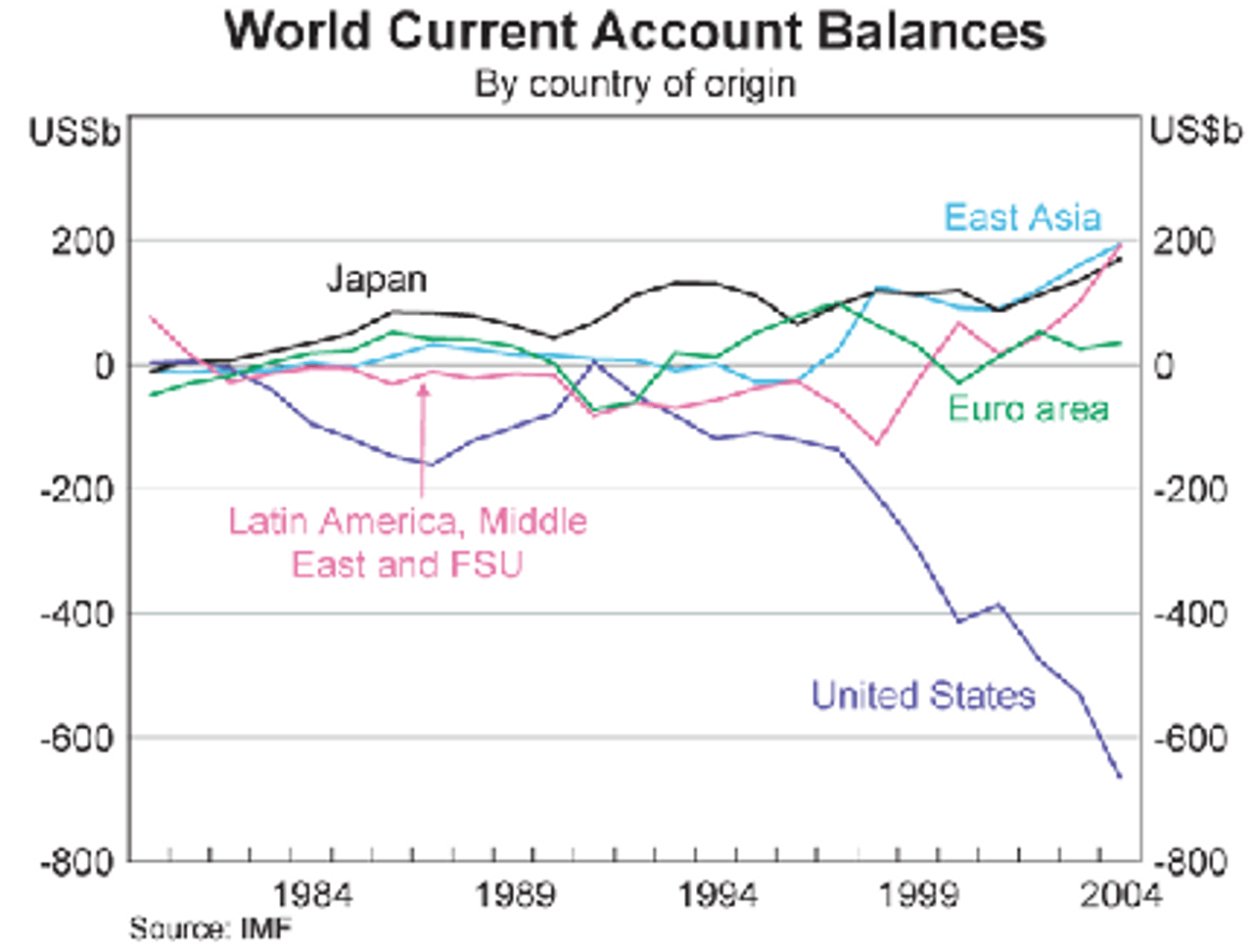
According to Cline, the longer an adjustment in the debt position of the US is delayed, the greater will be the economic damage. An adjustment today would require cutbacks in domestic demand for investment, consumption and the fiscal deficit equivalent to 4 percent of GDP—a sizeable cut. However, if the adjustment were to be delayed for a decade, a reduction equivalent to 9 percent of GDP would be required, setting off a major global recession.
The ever-widening balance of payments gap is only one of the major imbalances in the US economy. Five year ago, when the US stock market bubble burst, wiping off some $7 trillion, the US economy experienced no major recession. This was largely because of a series of interest rate cuts initiated by the Federal Reserve Board. These cuts, which saw short-term rates go to negative levels, provided the financial fuel for the creation of a bubble in the US housing market. According to one study, the size of this bubble is about $5 trillion—around 45 percent of US GDP. This figure is obtained by taking the difference between the current market value of houses and comparing it with the value that would have obtained had housing prices followed their long-term historical trend since 1997, when the bubble started to develop.
This growth in financial wealth—in what might be called the virtual economy—forms a stark contrast with economic events in the real world. The latest figures, for example, show that both hourly and weekly wages were lower in real terms in November 2005 than a year ago. Since the US recovery began in November 2001, the real hourly wages of non-supervisory workers have fallen by 5 cents. Productivity, however, has increased by 13.5 percent over the same period.
In 2005, there was an increase in the number on the payroll of 2 million. But this was well below the historical trend. For recoveries lasting more than 49 months, the average increase is 3.1 percent. From March 1991 to April 1995, a period that was dubbed the “jobless recovery” at the time, employment increased by 7.8 percent. In the period November 2001 to December 2005, the increase was 2.7 percent. Last year the increase was only 1.5 percent. In the previous recovery, payrolls had increased by 3.5 percent at the same point.
It has been estimated that the US is about 8 million jobs below where it should be at this point in a recovery from a recession. Moreover, the jobs which have been created are at the low end of the wages scale. Low-wage employers, such as Wal-Mart (the largest American employer), created 44 percent of the new jobs. Meanwhile, General Motors is on the edge of bankruptcy.
Median household income, in real terms, has fallen for five years in a row. The indebtedness of US households, after adjusting for inflation, has risen by 35.7 percent over the past four years. The personal savings rate is negative for the first time in the post-war period.
Greenspan’s “conundrum”
In his semi-annual report to the US Congress delivered on February 16, 2005, Federal Reserve Board chairman Alan Greenspan pointed to some of the imbalances in the US economy. He noted that large increases in consumer spending had been accompanied by a drop in personal savings rates to 1 percent in 2004, compared to a rate of nearly 7 percent over the previous three decades. While the “rapid rise in home prices over the past several years” had provided households with “considerable capital gains,” those gains, “largely realized through an increase in mortgage debt on the home, do not increase the pool of national savings available to finance new capital investment.” In other words, what had taken place was an increase in fictitious capital, not an expansion of real wealth.
On the business front, he pointed out that, although capital investment had been advancing at what he called “a reasonably good pace”, it nonetheless lagged behind the rise in profits and cash flow. “This is most unusual: it took deep recession to produce the last such configuration in 1975.” Businesses were reluctant to undertake new investment and were “focused on cost containment.” While he did not make the point, this outcome was even more unusual, given that at the time of his report the American economy was three years into a recovery phase, when business investment would be expected to expand.
The situation contained other unusual features. Despite the Federal Reserve increasing short-term interest rates, the long-term bond rate continued to fall. This “broadly unanticipated behaviour of the world bond markets,” Greenspan declared, “remains a conundrum.”
In a speech in June 2005, Greenspan noted that “the pronounced decline in US Treasury long-term interest rates over the past year despite a 200-basis-point increase in our federal funds rate is clearly without precedent. The yield on ten year Treasury notes is currently at about 4 percent, 80 basis points less than its levels a year ago.” Other long-term rates had declined by even greater amounts.
The fall in long-term rates on low-risk debt was one of the factors driving investors to place their funds in high-risk debt, thereby lowering interest rates. “The search for yield,” he explained, “is particularly manifest in the massive inflows of funds to private equity firms and hedge funds. These entities have been able to raise significant resources from investors who are apparently seeking above-average risk-adjusted rates of return, which, of course can be achieved only by a minority of investors. To meet this demand, hedge fund managers are devising increasingly more complex trading strategies to exploit perceived arbitrage opportunities, which are judged—in many cases erroneously—to offer excess rates of return.”
In other words, the cause of this unprecedented phenomenon is that financial capital, continuously circling the globe seeking to extract a profit, now has to undertake riskier investments to make the same rate of return as in the past.
In a speech on March 10 last year, the incoming Federal Reserve Board chief Ben Bernanke turned his attention to the Greenspan “conundrum”. After detailing the rapid rise in the US balance of payments deficit—from 1.5 percent of GDP in 1996 to more than 6 percent today—Bernanke insisted that this was not an American problem. “I will argue that over the past decade a combination of diverse forces has created a significant increase in the global supply of saving—a global saving glut—which helps to explain both the increase in the US current account deficit and the relatively low level of long-term interest rates in the world today.” He noted that while this glut was providing the flow of funds into the United States to cover its balance of payments deficit, and, at the same time, keeping interest rates low, these funds were not being used to finance investment. Rather, they were being utilised to increase consumption and home construction.
Bernanke’s remarks point to another significant feature of the situation: the funds flowing into the United States are not being deployed to finance productive investment, which would see an increase in the supply of goods for the world market, thereby helping to close the US trade gap. Instead, they are financing forms of spending that will require increased imports, thereby widening the payments gap and creating the need for a greater inflow of funds.
The economics correspondent of the Financial Times Martin Wolf published an article on June 13, 2005 entitled “The paradox of thrift”. “Strange things are happening in the world economy: falling interest rates on long-term securities, declining spreads between returns on safe and riskier assets, large fiscal deficits and huge global account ‘imbalances’ should not, in normal circumstances, coincide. So what is going on? The answer, in a nutshell, is a global excess of desired savings against the background of weak investment, low inflation and ever more integrated economies.”
“To understand the present,” he continued, “we need to go back to the 1930s. The ‘paradox of thrift’ was the most counterintuitive and, to the classically trained economist, morally, theoretically and practically objectionable idea in John Maynard Keynes’ General Theory of Employment, Interest and Money, published in 1936, in response to the Great Depression. It is possible, he argued, for the private sector to want to save more than it wishes to invest. That is the paradox: what is good for individuals can be bad for an economy. Today, at the beginning of a new millennium, Keynes’ warning is again apposite.” According to Wolf we are once again living in a “Keynesian world.”
On the face of it, this is quite an extraordinary conclusion from the chief economics commentator of one of the world’s leading financial newspapers. Notwithstanding all the tub-thumping about the wonders of the global market, and forecasts of the best growth figures for two decades, he concludes that the world economy is showing some of the same problems as in the devastating decade of the 1930s. The “Keynesian world”, as he calls it, was a world not only of slump, but of rising trade protectionism and deepening conflicts among the major capitalist powers, leading ultimately to war.
Another analysis of the “interest rate conundrum” has been advanced by the governor of the Reserve Bank of Australia, Ian Macfarlane. According to Macfarlane “the most promising explanation is one which starts with the surplus countries and focuses on why national savings are so much higher than national investment in those countries.” Given that Asian countries have large surpluses, other countries must run deficits.
“If no other country was prepared to run a deficit, then the world economy would enter a downward spiral with ex ante saving greater than ex ante investment. Clearly, the countries that will run deficits will be those where consumers, businesses and governments are most willing to spend and whose financial systems are most efficient at intermediating the flow of world savings” (Ian Macfarlane, “What are Global Imbalances” Reserve Bank Bulletin October 2005).
According to this analysis, the US deficits and debts are necessary to maintain world economic growth and prevent a “downward spiral” into a global slump in the face of a deficiency of investment outlets compared to the level of savings. Back in the 1930s, when confronted with this situation, Keynes advocated an increase in the level of government spending to make up for the deficiencies in effective demand caused by the lack of investment. Now we have a kind of consumer-led Keynesianism, financed by low-interest rates and increasing debt.
A global financial crisis
Looked at in this way, it becomes clear that the source of the problem is not the United States. The growth of the US payments deficit and the rise of debt, the housing bubble and all the other mounting financial contradictions in the US economy are the expression of deep-going problems in the accumulation process of the world capitalist economy as a whole.
When the Asian crisis erupted in 1997-98, the International Committee explained that it was not, in reality, an “Asian” crisis—the lack of proper markets, crony capitalism or the various other explanations offered at the time—but the outcome of contradictions within the world economy. These contradictions first expressed themselves in the Asian region, but then emerged in the Russian debt default and the crisis of the global financial system, following the demise of the US hedge fund, Long Term Capital Management, in September 1998.
Right up until the crisis broke, the East Asian region was the fastest growing region of the world economy—responsible for around 50 percent of world growth in the first half of the 1990s. Hence the claims by the World Bank of an “economic miracle.” With the onset of the crisis, there was a severe contraction. Investment fell back sharply and stayed down. After 1997-98, investment in Asia, excluding Japan and China, fell by between 7 and 8 percentage points of GDP. That is, from a level of almost 35 percent of GDP it has dropped to around 25 percent.
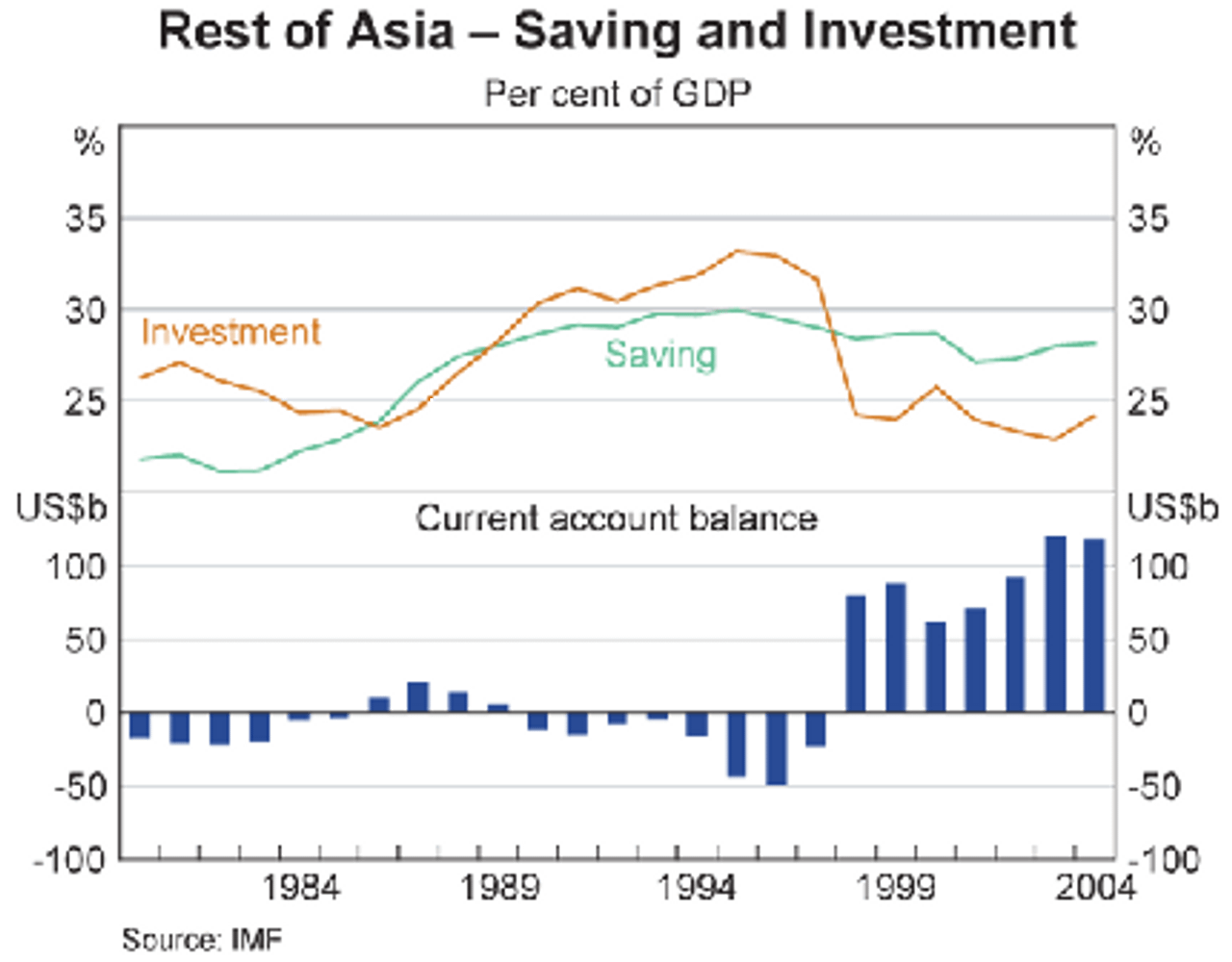
Of course, like all Keynesian explanations, Macfarlane’s stops where it really ought to begin. The important question is: what is the cause of the lack of investment that has led to the “global savings glut.” This phenomenon is the expression, just as it was in the 1930s, of downward pressure on the rate of profit. The tendency of the rate of profit to fall does not mean that a crisis develops when profits fall to zero—a fact forgotten by those who insist that Marx’s analysis provides no explanation because a falling rate of profit still means there are opportunities for investment, even if at a lower rate of return.
Long before the overall profit rate has reached zero, a crisis can emerge when profits from additional investments become negligible. That is, the average rate of profit may remain quite high, but if the profit rate from additional investments is very low—the way in which the tendency for the rate of profit to fall manifests itself—a crisis will develop. In such a situation, investment will be cut back. Investors will not undertake new ventures. Instead, they hold on to their money to wait for better times, seeking other outlets in the financial markets or in speculation.
Such decisions have far-reaching consequences since investment plays the central role in the dynamic of the capitalist economy. As the early critics of the capitalist system pointed out—and their analysis has been echoed by underconsumptionists ever since—the very existence of capitalist profit means that workers’ wages are not sufficient to realise—i.e., turn back into money—the commodities that emerge from the process of capitalist production.
But if that is the case, how does the capitalist economy function? The consumption of workers is not the only source of effective demand. The demand for capital goods, and, within that, the demand for capital goods to meet future demand (that is, investment) plays the key role, not only in maintaining production at the same level but in increasing it. Investment leaps ahead of the given level of economic development and creates the markets of the future. If this process is halted then the capitalist economy experiences a “downward spiral.”
The onset of such a crisis can be prevented if another source of effective demand can be found to replace the deficient investment. However, such measures will not of themselves resolve the crisis, which has its origins, not in the lack of effective demand as such, but in the deficiency of surplus value relative to the mass of capital—a deficiency that is manifested in the downward pressure on the rate of profit. Because they cannot resolve the fundamental problem, stimulatory measures will inevitably lead to the development of new contradictions and problems.
In the present situation, while the financial measures undertaken by US authorities—the maintenance of liquidity and a low-interest rate regime—have kept the US and the world economy as a whole from falling into recession, they have also created deep sources of instability. The vast expansion of liquidity and the emergence of a global financial system, well beyond the regulation of any single authority, coupled with the ever more desperate search for yield—that is, profit—have created the conditions for a financial crisis, something to which various central bankers and financial authorities have recently referred.
In a speech delivered last September, the general manager of the Bank for International Settlements, Malcolm Knight, pointed to the “unprecedented pace” at which the global financial system had expanded over the past 30 years. With the ending of fixed exchange rates in 1973, spot and forward exchange markets developed, followed by an expansion in the markets for government securities, then new markets in which investors could hedge or layoff risks. The result was a “global financial system that appears to have grown more robust to financial shocks emanating from individual countries.”
“The global financial system of today,” he concluded, “is vastly more efficient and resilient to small or moderate shocks than it was 20 years ago, or even a decade ago. And keeping the financial system on an even keel no longer requires the direct, non-market interventions from central banks and regulators that seemed to be needed in those far-off days. But today’s complex, market-dominated financial system also creates more incentives than in the past for market participants to ‘reach for yield’, more capacity to expand leverage, more scope to act on the age-old destabilising sentiments of euphoria and gloom. In short, our financial system may be prone to new combinations of adverse ‘tail risks’ that could feed back on the real economy” (Speech by Malcolm D. Knight at the International Monetary Fund, Washington, September 6, 2005).
IMF chief economist Raghuram Rajan made a similar assessment in a paper published last August.
“While the system now exploits the risk bearing capacity of the economy better by allocating risks more widely, it also takes on more risks than before. Moreover, the linkages between markets, and between markets and institutions, are now more pronounced. While this helps the system diversify across small shocks, it also exposes the system to large systemic shocks—large shifts in asset prices or changes in aggregate liquidity. ... In short, while I think it would be a fair generalization to say that the financial system is more stable most of the time, we may also have the possibility of excessive instability in really bad times (as well as a higher probability of such tail events). Unfortunately, we will not know whether these should be serious worries until the system has been tested. The best hope is that the system faces shocks of increasing size, figures out what is lacking each time, and becomes more resilient ... The danger is that before the economy is stress-tested, it will be hit by a perfect storm.”
And what might be the conditions for such an event?
“One plausible scenario is one where the economy experiences a period of extremely low risk aversion (e.g., a sustained period of low interest rates) where asset prices become misaligned, creating the potential for a realignment with adverse consequences that ripple through the economy.”
In short, a period not unlike the present one.
To be continued