
Water, the latest feature film by Deepa Mehta and the last in her “elements trilogy” has screened at various international film festivals over the past months and is currently on release in Canada, Australia and the US, with other countries to follow. Like the first two films in the trilogy—Fire (1996) and Earth (1999)—the movie has won much praise and critical acclaim.
Set in India, Mehta’s Hindi-language trilogy challenges different forms of religious intolerance and cultural backwardness—sexual bigotry (Fire), religious sectarianism (Earth), and the oppression of widows (Water). For this reason Mehta has become the target of vicious political attacks by the Hindu fundamentalist Bharathiya Janatha Party (BJP) and its affiliated extremist organisations, which under Hindutva (Hindu nationalist) ideology call for a revival of ancient social values and religious practices.
Hindu extremists orchestrated riots and cinema burnings following the release of Fire in 1996, attempted to have Earth banned in 1998, and in early 2000 forced Mehta to abandon her production of Water. At that time, a mob of 2,000 encouraged by the RSS (Rashtriya Swayamsevak Sangh), an affiliate of the BJP, destroyed Mehta’s movie sets in Varanasi in the Indian state of Uttar Pradesh.
The film was falsely accused of portraying Indian women as prostitutes, being part of a Christian plot against Hinduism and even supporting the Western oppression of India. Amidst escalating protests, violence and personal death threats against Mehta and lead actors Shabana Azmi and Nandita Das, the director decided to cancel the production.
Supporting Mehta’s democratic right to make her film, the World Socialist Web Site immediately launched an international campaign to defend the director and her right to conduct her work free from all religious or government control (see: “World Socialist Web Site issues appeal: Oppose Hindu extremist attacks on Indian filmmaker Deepa Mehta”). While the campaign won support from a range of filmmakers, artists and writers internationally, key figures in the commercial Indian film industry, particularly in Mumbai the home of Bollywood, remained silent over this blatant attack on freedom of expression.
Although Mehta was forced to cancel Water in 2000, she never abandoned the project and last year was finally able to resume the production in Sri Lanka under an assumed name and with a new cast and a strict code of secrecy. The younger Lisa Ray replaced Nandita Das, the lead in Fire and Earth, with Seema Biswas (Bandit Queen) playing Shakuntala, the role previously assigned to Shabana Azmi.
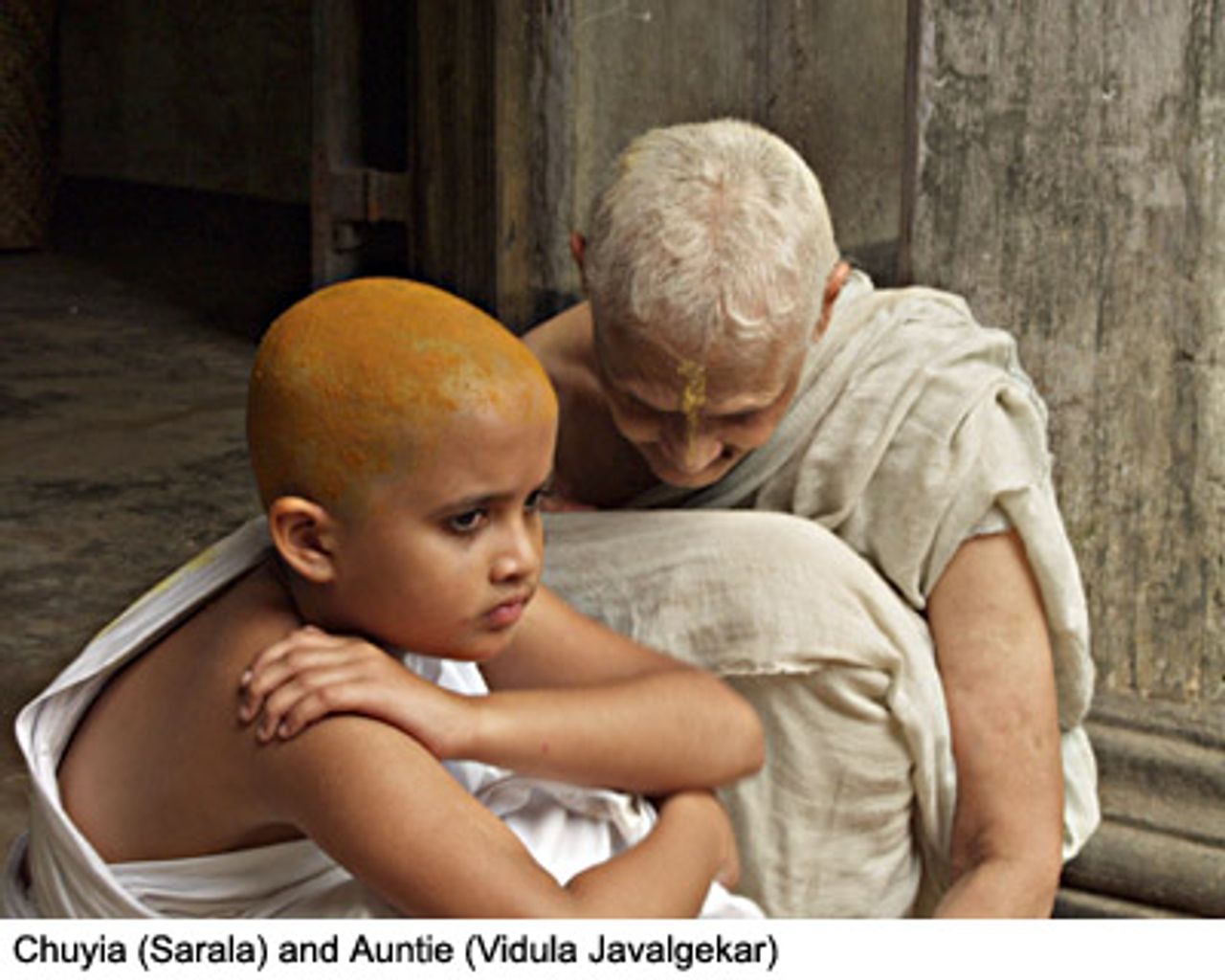
Water is set in 1938 in British-ruled India and against the background of the rise of Mahatma Gandhi and the anti-colonial movement. The story begins when eight-year-old Chuyia (Sarala), a victim of child-marriages still widely practiced in India at that time, learns that her 50-year-old husband has died.
According to Hindu custom widows had three options: to marry their husband’s younger brother; throw themselves on their dead husband’s funeral pyre; or lead a life of self-denial.
The young girl, who can barely even remember getting married, let alone understand what she now faces, is dispatched by her father to an ashram or widows’ home in the Hindu holy city of Varanasi on the Ganges River. She has her head shaved and is expected to spend the rest of life in the poverty-stricken institution with no possessions or personal income and segregated from the rest of society.
Distraught and bewildered, Chuyia eventually settles into ashram life with 14 other widows in the decrepit building. A domineering and corrupt old widow, Madhumati (played by veteran Indian actress Manorama) rules the ashram. She smokes marijuana every night provided by the eunuch and local pimp Gulabi (Raghuvir Yadav).
Madhumati and Gulabi earn additional income, some of which is used to sustain the ashram, by prostituting the beautiful young widow Kalyani (Lisa Ray) to the local Brahmins or high-caste gentry across the river. Kalyani, whose hair was not shaved in order to make her more attractive to her clients, lives in separate quarters in the institution. She also has a small puppy.
Other key figures in the ashram are middle-aged Shakuntala (Seema Biswas), a devout Hindu and the most thoughtful and enigmatic of the widows, and an elderly woman known as “Auntie” (Vidula Javalgekar) who becomes Chuyia’s solace. Shakuntala, who is caught between her religious faith and her human cravings, becomes a surrogate mother to Chuyia.
When a handsome young law graduate, Narayan (John Abraham), helps Chuyia round up Kalyani’s puppy after it escapes during a river bath, a romance is sparked between him and Kalyani. Their love affair, however, threatens the usual dynamics in the ashram.
Narayan is an opponent of caste oppression and a supporter of Mahatma Gandhi’s “passive resistance” movement against British colonial rule. Deeply in love, he rejects the prevailing oppression of widows and, on the basis of a newly introduced legal provision enabling widows to re-marry, asks Kalyani to marry him.
When Chuyia inadvertently tells Madhumati about the planned wedding, the old woman is enraged and vows to prevent it. She has Kalyani’s head shaved and imprisons her in the ashram. Shakunthala, however, decides to defy Mahhumati and frees the young woman.
Without disclosing all the film’s details, Kalyani discovers that Narayan’s father has been one of her clients and the film takes a tragic turn. Shakunthala, who is deeply distressed by the events, rescues Chuyia and in the processes finds herself swept up in a crowd listening to Indian National Congress leader Mahatma Gandhi during one of his national rail tours.
Moved by Gandhi’s brief comment that the pursuit of truth should be one’s religion, the distressed Shakuntala pleads with various people to help her save the child widow by “giving her to Gandhi”. The film concludes with Shakuntala discovering that Narayan has decided to join Gandhi’s journey. He takes the child as the train departs the station.
Water has a number of deeply moving scenes with strong performances by Seema Biswas and Sarala and some striking cinematography and music by Giles Nuttgen and A.R. Rahmans respectively. Its title is metaphorically probably the most appropriate to the film’s subject—Hinduism, which regards water as the creator’s supreme gift to humanity. Images of water recur throughout, with rain and the river forming a backdrop to the film’s central romance and its tragic conclusion.
One of the movie’s most affecting scenes and one that starkly highlights the deep deprivations suffered by the widows occurs when Chuyia manages to smuggle a laddu (fried sweet) to Auntie, the old widow. This is one of the many food items forbidden to widows. Auntie, who was also a child bride, is overjoyed and ravenously eats the laddu, recalling that the last time she tasted this particular sweet was when she was married.
Unquestionably Water’s most compelling character is Shakunthala, whose role becomes more prominent towards the end of the film. Mehta uses Shakuntala to highlight the social and psychological contradictions confronting individuals who seek solace in the religious values that are responsible for their oppressed state. Seema Biswas’s performance is extraordinary as she subtly portrays Shakuntala’s attempts to bridge the gulf between her natural kindness and the traditions that demand she suppress her humanity.
Against the prevailing religious taboos, she supports Kalyani and Narayan’s romance. In fact, being the only literate widow in the ashram, she reads Narayan’s love letters to Kalyani and even offers to help the couple elope, convinced that she is facilitating a happier life and one that she has been deprived of.
Water also powerfully points to some of the underlying economic factors behind the dispossession of widows. As Narayan explains, when widows are segregated from their husband, family and property, they are: “One less mouth to feed. Four saris saved. One bed and a corner are saved in the family house. There is no other reason why you are sent here.” And while the treatment of widows is disguised as religion, he concludes, “it’s all about money.” These few sentences illuminate the situation in an extremely powerful manner.
While Mehta’s film effectively dramatises the human cost of these harsh and dehumanising “traditions”, it also contains elements of Bollywood conventionalism and melodrama, which are at odds with the movie’s challenging subject matter and tend to take the edge off its dramatic impact. The love affair between Narayan and Kalyani is obviously an essential narrative component but the couple needs more depth and complexity. Their love affair has all the externals—beautiful people, romantic visuals and lyrical music, and even a recitation from Kalidasa’s epic love poem “Meghaduuta”—but it lacks genuine intensity.
Moreover, Lisa Ray, a former model, is far too elegant and refined for a member of a poverty-stricken ashram and a prostitute. John Abrahm as Narayan, one of Bollywood’s most sought after movie heroes, looks at times though he has just stepped out of a glossy fashion magazine. His character lacks passion, which is a problem because he is supposed to be one of Water’s more conscious political figures.
The final scenes involving Gandhi provide an indication of his mass support and the hopes of millions that he and the Indian National Congress would put an end to British rule, the caste system and other forms of economic and social oppression.
Much more could obviously be said about Gandhi and Congress, which despite criticism of certain aspects of caste oppression, such as the segregation of widows and “untouchability”, never challenged the caste system itself or its essential political and economic foundations.
The struggles initiated by Gandhi-led Congress were always tempered by its fear of provoking a working class challenge to capitalist and landlord property and the religious dogma that helped defend it. This guaranteed that none of the essential problems confronting the masses could be resolved and ensured that the dispossession and segregation of widows and other forms of social oppression still exist in India.
While there are some, including perhaps Mehta, who may hope that a revival of Gandhism can somehow resolve these problems, the movie itself ends with Shakunthala’s troubled face and then fades to titles pointing out that in 2001 there were over 34 million widows in India, many of them still living in conditions of social, economic and cultural deprivation. Thoughtful viewers will obviously want to know why Gandhi’s movement proved incapable of ending this and how the hopes of the Indian masses could have been so tragically dashed.
While India’s censor board has approved Water’s release uncut later this month, there is little doubt that the movie will provoke the ire of the Hindu extremists. For her courage Mehta can only be praised and congratulated. Her refusal to be intimidated will encourage those in India and elsewhere fighting religious backwardness and other social ills. Notwithstanding its imperfections, Water is an important achievement.