
Click here to download this article as a leaflet.
American television presents itself as an immense and often painful contradiction. The use of a technology with the most extraordinary potential to reach masses of people in the privacy of their homes with information, amusement and spectacle is monopolized by a small number of transnational corporations.
Many appealing figures appear on television, genuine talent goes into the production and distribution of various shows. There are inspired moments in both comedy and drama. Technical miracles are performed on a daily basis. However, the overall content of television programming is dominated, in the end, by the terribly narrow profit and ideological interests of the corporate elite.
These interests inevitably come into conflict with the elementary need of the artist to look at the world in a free and unfettered fashion. There are certainly mediocrities and toadies who have no difficulty accommodating themselves to the constraints. For others, it is a source of conflict and even anguish.
The current strike in the entertainment industry, now in its fifth week, pits 12,000 film and television writers against the giant firms. The writers have been demanding an improvement in the rate at which they are paid residuals (royalties) from the sale of their television and film work on DVD and the introduction of a reasonable residual payment system for writers’ material that appears on the Internet and other media.
Given the greater and greater concentration of the media and entertainment industry and the companies’ intransigence in the face of the writers’ legitimate demands, it is not only appropriate, but entirely natural, that discussions with the writers and their supporters gravitate toward a great political question: who is to control film and television content, the writers, other artists and the audiences they create for, or the corporate pirates? Can an enormously complex and diverse society afford to have a handful of executives, whose interest lies in the maintenance of the status quo, determine the shape of its everyday cultural life?
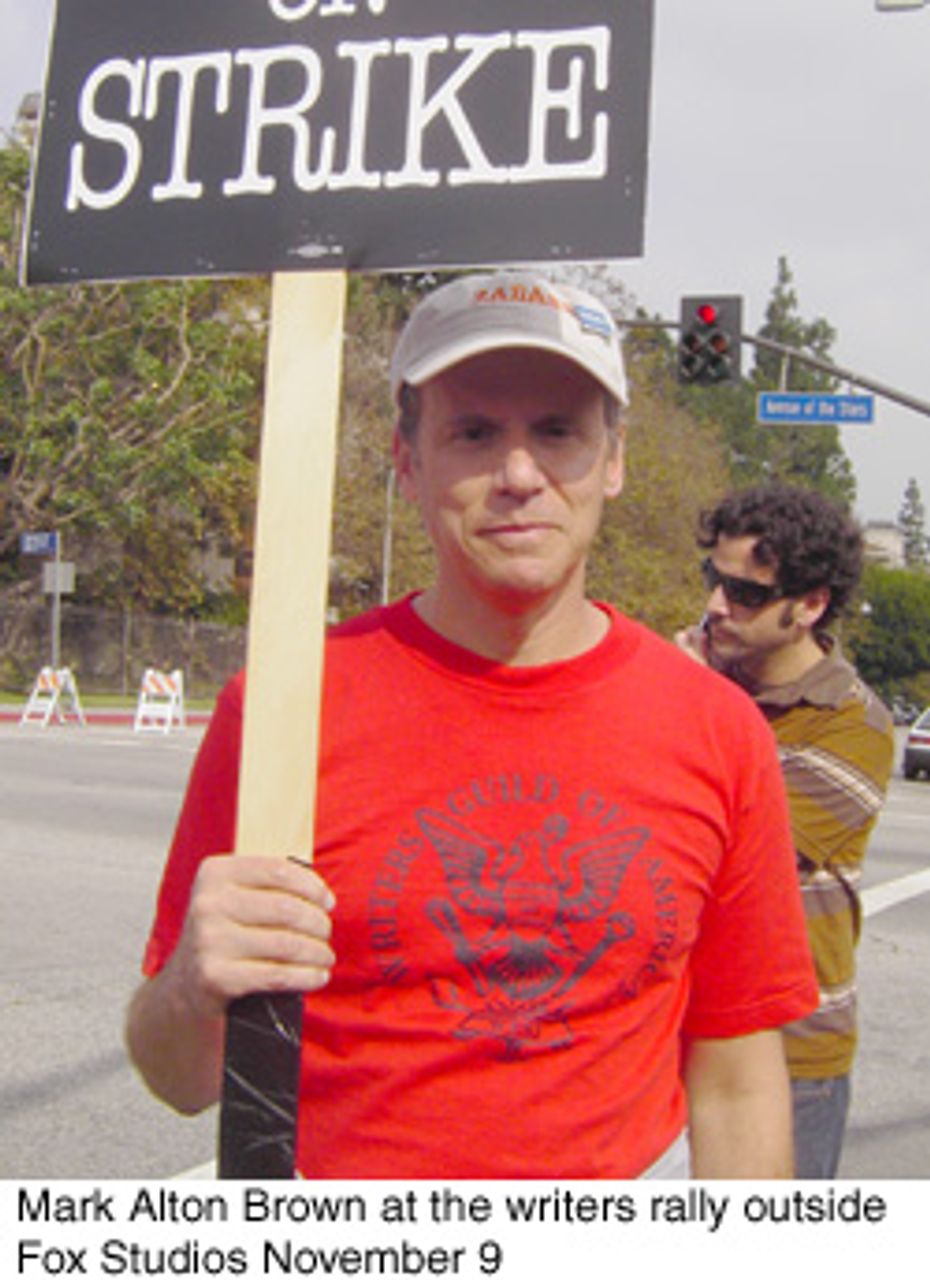
I first spoke to television writer Mark Alton Brown at a rally November 9 in Century City, California, near 20th Century Fox headquarters (See More writers and their supporters in Los Angeles and New York speak to the WSWS). According to the Internet Movie Database, Brown has written for numerous programs, including “Designing Women” in the early 1990s and, most recently (2000-2007), “Girlfriends.” November 29 we spoke again, on the telephone this time, about the situation in the strike, the character of American television and more general subjects.
* * *
David Walsh: What is the current mood of the strikers?
Mark Alton Brown: I would say the present mood is anxious. I think there is a wish on all the writers’ parts to get a good deal. We’re pleased that the two sides are back at the table. We’re pleased that although they only scheduled three days of negotiations, they’re back at the table today. And we’re trying really hard not to buy into the rumors we hear.
DW: I’d like to ask you about your own background. How did you get into this field?
MB: I started off as an actor years and years ago, and I was really bad. I think I was always drawn to writing and I just sort of fell into it. I started writing comedy for a friend of mine who was doing a lot of nightclub work, and then got a job working in the press department at MTV. And through that I made connections at Nickelodeon and VH1 and starting making inquiries and got a couple jobs writing things there, and one thing led to another and I just kept writing. It wasn’t as though I set out to do that. It presented itself and I pursued it, and it seemed as though it was my calling.
DW: Is it true that your father was a civil rights attorney?
MB: Yes, in Cincinnati, Ohio. He practiced law from the late 1940s until the early 80s. He passed away three years ago. He was the ACLU in Cincinnati and he did a lot of First Amendment work. He actually argued a landmark case in front of the Supreme Court and won a unanimous verdict, Brandenburg vs. Ohio, which struck down sedition laws in the state of Ohio. He was a criminal defense attorney, but he did a lot of pro bono work for the ACLU. He represented the Southern Christian Leadership Conference [civil rights organization] in Cincinnati and any number of other progressive causes.
DW: How would you weigh the most positive and negative aspects of writing for television?
MB: The most positive aspect is the ability to work with a group of writers with whom you have a great relationship. And I’ve been very fortunate to have worked on a number of shows where that has been the case, and particularly these last eight years on “Girlfriends,” which is on the CW network. It’s an extremely tightly-knit group of writers, we’ve worked together a long time. We have a lot of respect and affection for each other. We’re very proud of what we do.
The worst situation is working on a show that doesn’t have the support of the studio or the network, where you have protracted battles with them about content, about the tone of the show, about characters, plot points, etc. And I’ve worked on a lot of shows that from the pilot on you knew were somehow doomed.
There’s the fact that you’re not delivering a show to a viewing audience, rather you’re delivering a show to advertisers and that’s a bit frustrating because they’re not the most discerning audiences. I think that the general viewing audience is much more sophisticated than the advertisers think it is.
DW: You obviously speak from a certain amount of bitter experience. What kinds of problems have come up?
MB: Just about everything. Certainly over content. For example, there’s a desire in comedy to make all the characters likable. And if you make everybody likable that largely negates the conflict. In comedy and drama, you don’t have action unless there is conflict. At times the networks are so worried about protecting a character they don’t allow conflict to flourish.
On the other hand, I’ve worked with studios and networks in situations where it’s been a wonderfully collaborative situation and yet that still did not work out. Or it did, in the present case. On “Girlfriends” right now we do have a good relationship with our studio and network and I think we see eye to eye and I think we all see the show through the same lens, which is a very pleasant experience. It’s not often that way.
DW: What’s the situation with your show in regard to the strike? Do they have scripts stored up?
MB: We have episodes that have been shot and edited that would get us through Christmas. I would say that after the first of the year, they have nothing they can air. There are scripts in the can, but they have not been edited. I’m one of the hyphenates [writer-producers] on the show. None of the producers will cross the line to edit.
DW: Do the writers in your group have similar levels of experience?
MB: It’s a combination of some older and some younger. I’m certainly the old man on the show. There are four writers who have a lot of experience. One of our writers was formally a lawyer; she’s very, very bright and she’s only been in the business for 5 years, but she’s a superb writer. She a quick study. Then there’s the junior staff. For some of them this is the first show they’ve worked on. But they’re all very, very good writers. They get on the show because their material is good.
DW: I hadn’t realized age discrimination was such a serious problem for writers.
MB; There’s a huge problem with age discrimination, particularly in half-hour comedies. I don’t think it’s so prevalent in hour-long dramas and it’s not much of an issue in feature films. But definitely in television comedy. The younger you are the more you’re seen as having your finger on the pulse of the audience. I can’t say that I’ve personally faced ageism in my career yet, but I know that it exists and I know people who have faced it.
DW: What’s your general take on where television is going as a technology?
MB: I think the death of broadcast television is greatly exaggerated. I think that television will continue to exist, but how we get it will be different. More and more people will be getting their television content via the Internet. And watching television on their computers. We’ve been in the midst of a technological revolution in communications since the advent of television. Certainly since the emergence of VHS—all of a sudden, people did not have to be home to watch a show, they could set a timer and watch a show when they wanted to watch it.
Now there’s TiVo, there are Internet downloads. It’s possible that television will become more and more fragmented. There will be more and more ‘on demand’ via the computer. And I think the situation may return to the earlier days of television when everything was sponsored-presented. So that an advertiser virtually becomes a network rather than the present situation. I think that’s a possibility. For example, it would be “This show is presented by GE,” or whatever.
I think it could go any number of ways. Right now comedy is down, drama is up. Procedural drama is up. I’m hoping that reality television will start to peter out, just because I think it’s mostly insulting. Although I think there are some reality shows that are well done. I don’t think programming per se will change so dramatically from what we’ve known, but how we get it might change radically. That’s my guess.
The quality of television has actually improved. There’s still a lot of dreck out there, but in some ways we’re in a golden age where there is a great deal of intelligent, insightful, breaking-the-mold kind of television being made. I think that has to do with the fact that the marketplace is so fractured. The whole idea of a network ‘brand’ has diminished. It used to be that you’d turn on ABC or whatever and you’d leave it there all night. Nobody does that anymore.
DW: As a socialist, I have to ask about the issue of intellectual property rights. Everybody on the picket line says ‘we want a fair deal.’ Fair enough, but why should these conglomerates control your life to begin with?
MB: Because we live in a capitalist society.
DW: Doesn’t that have to be challenged? Obviously there’s a need for organization and technology and investment, but why does it have to be under the control of this handful of sharks? If you could just tell the audience the truth all the time and have a more flexible, interactive relationship ...
MB: I think is some cases it would be a more interesting situation. Sometimes the audience does not want the truth. Sometimes people turn on the television because they want fantasy.
DW: Fantasy is completely legitimate.
MB: I happen to think that successful television is that which mirrors the culture. I could make the case that the success of The Sopranos, which is probably the best show that’s been on television to date, occurred because it so mirrored our values. The Soprano family is every American family, it’s about the moral compromises we make for material goods.
In an ideal world, I would love to see much more opinion-laden television. Yes, I’d love to see the truth being told, or the truth as I see it. Because of deregulation, it’s gotten worse than it was before. Now the networks own their own content, which they never did before and the entire mass media is basically controlled by six corporations. There is very little independence any more. Ideally, if every channel was an independent entity, we’d have better choices.
Television is a tool of capitalism. The business of television is selling products. The studios and networks don’t see viewers as the people they’re trying to reach. They’re trying to reach advertisers. They’re trying to help advertisers sell goods.
DW: From their point of view, the program itself is merely a scaffolding for selling goods.
MB: Exactly. And in a lot of ways, that’s become more and more egregious. In that now rather than just commercials, we’re actually planting commercials within the content of a show, with product placements. It’s an issue that comes up on my show constantly. It’s true of every television show.
Every year you get a list: ‘OK, this company will give you $50,000 towards production if you mention its name, if you develop a plot line that revolves around that company’s product.’ Product placement is probably a greater source of revenue than commercials are at this point.
We are bombarded with it. If you start looking for product placement, you’ll start noticing it in features. More and more, it’s becoming the name of the game in television too. We have done episodes that were virtually paid industrials for a given company, because the advertiser has essentially paid for a significant portion of the production of that episode.
And then as a writer of the program, you feel like a whore. But most of the time as a writer you feel like a whore, anyway. Well, you’re bringing your consciousness and you’re bringing in some ways your very soul to your work. Writing is not easy. And you’re basically selling your soul, you’re basically selling the rights of it away. So you’re giving pieces of yourself. So in that way, you’re kind of a whore. But we don’t determine all the conditions of our lives.
I am well compensated for what I do. In terms of what I do and its impact on society—teachers should be making a lot more than I am. Part of the reason writers get paid the amounts they do is that their life expectancy is short. Most writers work 10 years if they’re lucky and then that’s it, especially television writers.
Compared to an executive making millions, we don’t get paid that much. I can have years where I can make an enormous amount of money—at least to me it’s an enormous amount of money—but the next year I can make less than an eighth of that. It’s seasonal work. And you don’t know from year to year whether your show is going to continue or what’s going to happen.
DW: As far as one can tell, public support for the strike has been overwhelming.
MB: Public support has been amazing. Hands down, we have won the public relations battle thus far.
DW: These are ruthless companies. They’re trying to impress their large investors all over the world. And those people want them to take a hard line.
MB: By the same token, these are people who live and die by their popularity, by ratings. If they don’t deliver the ratings, they don’t get the advertising dollars and then their shareholders don’t get their profits.
The studios and networks are already terrified of the Internet, which is why they’re trying to control it. They’re already terrified of the fact that there are people all over this country who are tuning out of television altogether and watching everything on the Internet.
Look at the war they’ve declared on YouTube. They do risk losing their audience and if they lose their audience, then they lose money.
DW: Their thinking, I suspect, is that if they lose tens of millions today in order to make billions in the future by what they won’t have to pay the writers, it’s worth it.
MB: Unfortunately, I think that is the thinking on some of their parts.
DW: They did it with the DVDs, and they did make billions!
MB: They did do it on the DVDs, and that’s what they’re trying to do now; we got screwed on the DVDs and that’s why we’re saying ‘never again.’ We learned our lesson.
DW: Another question of a more general character. Hollywood—television of course was in its infancy—went through the McCarthy period, the blacklist. What social and political taboos are there in terms of what you can and cannot write about?
MB: Oh, absolutely there are taboos. Every network has its own set of program standards, and there are things that we’ve been told point-blank we cannot write about. Abortion, for example.
“Girlfriends” is a program with a considerable amount of sexual content. There’s a real double standard in terms of the way we present that. They seem to have a problem with women owning their sexuality, or enjoying their sexuality. They don’t have problem with male characters.
We’re a program with a primarily African-American audience, this audience is not for the most part a fan of this administration. We have been asked more than ten times a year not to make negative references about the current president or the administration. We manage to sneak them in here and there, but we’re told to remove them.
This has changed over the course of time. When we first premiered we were on UPN and they had much looser standards. We could more or less say whatever we wanted politically. CW is CBS and Warner Bros., but the show is produced at CBS Paramount.
DW: What about references to the war in Iraq?
MB: One of our characters is engaged to a man who has been sent to Iraq. It’s been a huge issue all year and we have addressed the fact that our characters are opposed to the war. But we’ve gotten notes on every single one of those statements and every single one of those lines, and we’ve had to address them or modify them, in some way, shape or form. Basically, they want you to stay neutral about the war.
DW: Despite the fact that the audience is overwhelmingly opposed to it.
MB: Despite the fact that the country is overwhelmingly opposed to it!
DW: What about the need to spread the strike? Isn’t it a fact that for the strike to be effective it’s necessary to shut down film and television production?
MB: Yes.
DW: That would bring you into conflict with all sorts of people, including other union bureaucracies, and the Democrats. John Edwards wouldn’t come near a strike that became a serious confrontation like that. This issue has been raised spontaneously by numerous pickets. One said, ‘This is a nice, respectable picket line, but it’s doing nothing, it’s merely symbolic.’
We think a different orientation is necessary, toward the other workers in the film community, toward the working population at large, a socialist strategy. What is your view of the present orientation of the Writers Guild leadership?
MB: In the past, the Writers Guild has seen itself as a breed apart from other unions. We’ve seen ourselves as a guild. In fact, we’re not even affiliated with the AFL-CIO, or with the Teamsters. We’re not affiliated with a larger body. Writers Guild East is AFL-CIO.
There’s a lot of bad feeling within some of the other unions. In the past, the Writers Guild has not been supportive of their struggles. The current leadership acknowledges that and was elected because of that. We have a radically different board of directors. It’s a much different union than it was in 1988.
I think that we learned our lesson the hard way and I think there’s much more of a sense that we’re all in this together. One of our goals on the picket line has been to win the hearts and minds of the Teamsters, the IATSE [International Alliance of Theatrical Stage Employees] people, the Screen Actors Guild and Directors Guild members. We haven’t had to work too hard to get the SAG members on our side. They’ve been there from day one.
Within the Teamsters’ rank and file there was a lot of animosity toward us. I would have to say that over the course of this strike they’ve become more and more vocal, and more of the Teamsters are joining us. A lot of that results from the fact that as shows shut down, the Teamsters are losing their jobs, and they’re saying, ‘Well, I’m going to go join the writers on the picket line.’
We all are connected financially. IATSE and the Teamster members don’t get residuals as individuals, but they get residuals that make up to 50 percent of their health and pension plans. Shows that they’ve worked on contribute to their health and pension plans. And if they did away with our residuals they could effectively do away with their health and pension.
DW: More generally, if the writers are ‘taught a lesson,’ intimidated and suppressed, then obviously that’s going to have an impact on everyone.
MB: Right. I think the studios honestly thought we weren’t going to go out. I think they thought we were going to wait for the actors. A lot of us thought we were going to wait for the SAG contract to expire. I think the WGA decided that it was better to go it alone.
As far as I understand it, the DGA, which was even more of an elite organization, has said they will not even begin talks until the studios and networks settle with the writers.
DW: I was struck by the mood there, among the writers, their supporters, the general public. The writers are not just speaking for themselves. I have a feeling the writers were surprised by how angry their fellow writers are, how angry everybody is and how angry the whole population is.
MB: And how angry the whole country is! The fact of the matter is, the vast majority of writers are middle class, or struggling to get into the middle class. The middle class has been screwed certainly since the advent of Reaganomics. There has been a concerted effort to destroy the middle class and divide the county into a class of serfs and a class of lords—to go back to some form of feudalism.
They have set out systematically to destroy whatever the New Deal put in place. Those of us who were raised in what was the great middle class revolution in this country, from World War II until Reagan, realize that it’s harder and harder to stay in the middle class. Our quality of life is not as good as our parents’ was, our dollars don’t go as far as our parents’ did, we’re angry. The whole country is angry. The whole county’s in a bad mood. We’ve been had. We’ve been duped. We’ve been voting for these idiots.
DW: I would say both parties.
MB: I would tend to agree with you, personally. Although I think generally the Democrats have a little more interest in people of lesser means.
DW: They have more sensitivity to the issue. Because of their particular history they’re a bit more aware of the dangers of social upheaval.
But Clinton destroyed welfare in this country. Clinton carried out the sanctions against Iraq that led to half a million deaths. Social polarization soared in the 1990s, under Clinton.
MB: You’re right.
DW: Do you remember what happened to the serfs and lords? It was called the French Revolution.
MB: Right. I think the public is about that angry again.
DW: Your general feeling about Bush and the Iraq war?
MB: Oh ... I’m a social democrat, that’s how I classify myself. I was raised by left-wingers, I’m a left-winger. My grandfather was a Norman Thomas [Socialist Party leader and presidential candidate] supporter. I come from a long line of left-wing, Jewish agitators. So I don’t think highly of Mr. Bush and company.