
This is the fourth in a series of articles on the 2007 Sydney Film Festival, held June 8-24. Part 1 appeared on July 4, Part 2 on July 10 and Part 3 on July 11
In the last few years there have been important signs of a revival of Romanian cinema, with younger directors attempting to deal with aspects of life in that country. These include Titus Muntean’s Exam (2003), Ruxandra Zenide’s Ryna (2005) The Death of Mr. Lazarescu by Cristi Puiu (2005), Radu Muntean’s The Paper Will Be Blue (2006) Mitulescu’s How I Celebrated the End of the World (2006) and Tudor Giurgiu’s Love Sick (2006).
12:08 East of Bucharest, which won the 2006 Cannes Camera d’Or for best debut and screened at the Sydney Film Festival, is an endearing and at times amusing look at life in contemporary Romania. Written and directed by 32-year-old Corneliu Porumboiu, one of its most striking aspects—intentional or otherwise—is that it shows how the restoration of capitalism, following the overthrow of the Stalinist Ceausescu regime in 1989, has brought nothing but misery to ordinary people.
The film is set in an unnamed small town east of Bucharest, where a thuggish ex-textile engineer Virgil Jderescu (Teodor Corban) owns the local TV channel. He hosts the station’s talk-back show and, with the 16th anniversary of the 1989 events approaching, decides to devote a program to the topic “Was there a revolution or not in our town?”
After last-minute cancellations by the better known guests, he settles on a local high school history teacher and chronic alcoholic, Tiberiu Manescu (Ion Sapdaru), and an eccentric, older man, Emanoil Piscoci (Mircea Andreescu), best known for his work as Santa Claus in local schools.
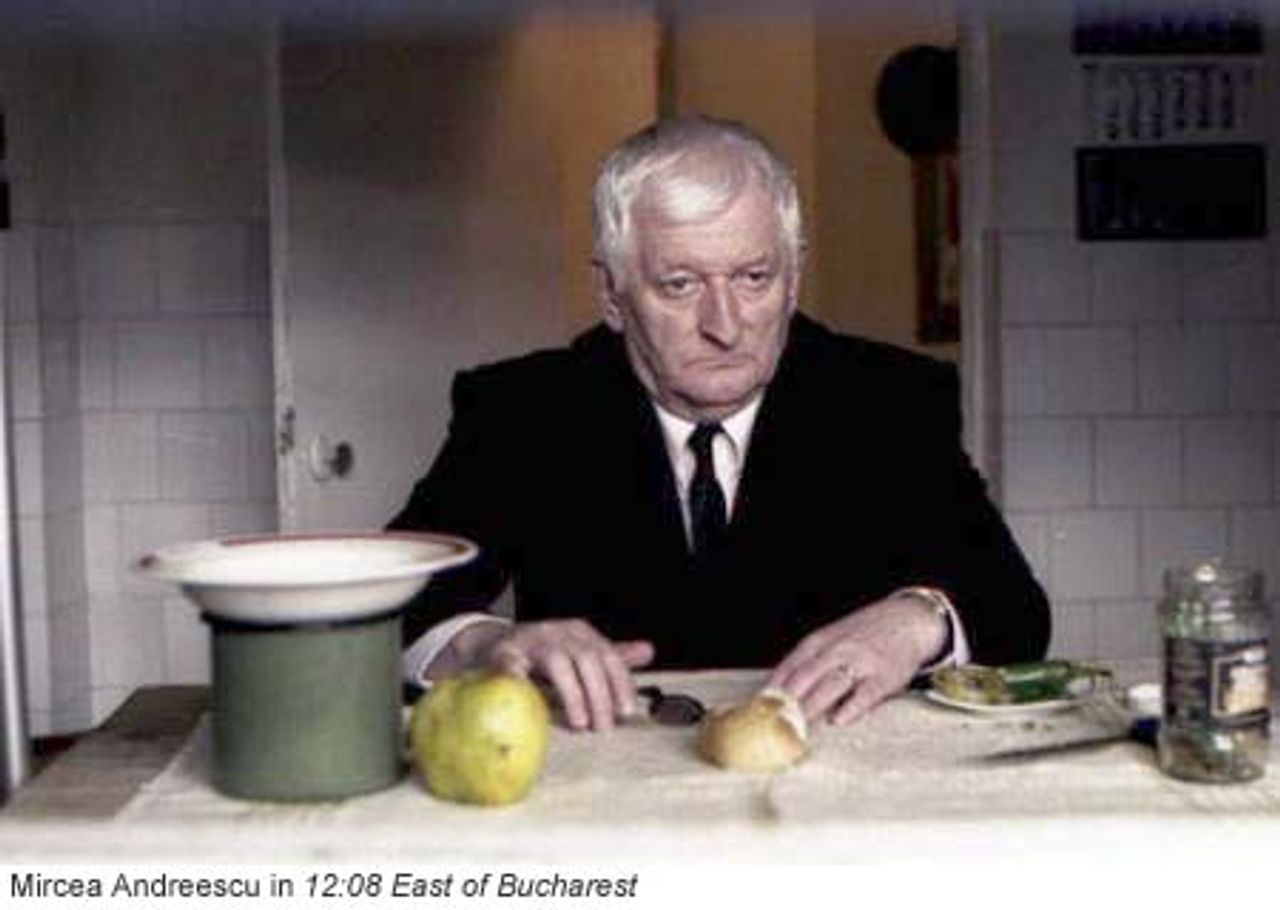
The program, which is based on an actual show Porumboiu saw in his hometown, quickly descends into farce, with the guests arguing with callers and Jderescu becoming hysterical as he tries to control the situation.
The film can be divided into two parts. The first meticulously explores the life of the three main characters, focusing on mundane aspects of their lives as they prepare for the show.
Manescu, the teacher, begins the day with a hangover, having no recollection of the previous night, when he hurled racist insults at a local Chinese shopkeeper. He has spent all his monthly salary repaying debts to colleagues and the next day is forced to ask the shopkeeper for a loan, after apologising for the racist remarks. Things at school are no better. There are appalling classroom conditions and troublesome or apathetic students.
Emanoil lives in a crummy, small apartment. He is asked to be Santa but is not happy with the dirty costumes, which he calls “dirty dishtowels”. In the meantime Virgil Jderescu is frantically trying to get a local high profile figure to appear on the show, abusing those who decline.
This part of the film is the strongest, as the director skillfully introduces the main protagonists and their environment. Images of the poverty-stricken, cold and grey town clearly reflect the unhappiness, despair and frustration gripping most of its inhabitants.
The second part, more amusing and farcical, occurs as the television show is being broadcast.
The debate is about whether those demonstrating in the town square on December 22, 1989, were there before 12:08 on that day (hence the title of the film) or came after, when it became evident that Ceausescu had already been ousted. It attracts many callers, all with conflicting and contradictory opinions.
Jderescu’s philistinism is hilarious, as are the amateurish efforts of the inexperienced television studio cameraman. The funniest moments occur during Jderescu’s introduction as he pompously alludes to Plato and then Heraclitus’s famous axiom that “no one steps in the same river twice”. Clearly unfamiliar with these famous Greek philosophers, he clumsily muses on the importance of the past for the future.
That someone like Jderescu, who is reminiscent of a bullying petty Stalinist bureaucrat, now owns and controls the local TV channel is just one indication of the bleak cultural climate in contemporary Romania. Likewise with Costica Bejan, an ex-accountant to the Securitate (secret police) and who also owns a few factories. He rings the television show, angry because Manescu, the teacher, alleges that Bejan beat him up when the Stalinists were in power. Costica arrogantly demands that he has been defamed and threatens to sue the show.
12:08 East of Bucharest is Porumboiu’s first feature and has genuine warmth for ordinary Romanians and the difficult situation they confront. The director’s interest in the 1989 collapse of the Ceausescu regime is to some extent inevitable. He was too young when the upheavals occurred to understand their full significance at the time, but life in Romania, like in every other country in Eastern Europe, is now so difficult and bleak for masses of people that he cannot ignore them.
Porumboiu told one interviewer that: “Like my characters, I had a lot of hope after the revolution. We were all thinking that in two years, it would be just like in the United States! This didn’t happen...” He admitted, however, that he was not interested in the political mechanics of the overthrow of the Romanian Stalinists but “how people fictionalised history.”
“People change history,” he continued, “according to who they want to be; their own personal histories become entwined with a larger historical picture. I wanted to look at this with the movie, to look at individual points of view, each with their own truths.”
This approach may suffice for a collection of character vignettes, but it cannot provide an objective basis for understanding what really occurred in 1989.
Porumbriou’s movie constantly refers to the overthrow of Ceausescu as a revolution. But it fails to identify the class character of this movement. This weakens the movie, which never seems quite sure what direction it is taking.
The collapse of Romania’s hated Stalinist regime on December 22, 1989, and the execution of President Nicolae Ceausescu and his wife three days later by a section of the Stalinist bureaucracy, was part of a series of collapses of Stalinist governments throughout Eastern Europe in 1989. It began in East Germany and was followed by Poland, Czechoslovakia, Hungary, Bulgaria and finally Romania in late 1989. Eighteen months later, in August 1991, the Soviet Union was dissolved.
While the liquidation of these regimes—which were neither communist nor socialist—varied slightly, each began with the spontaneous eruption of mass anti-government demonstrations by ordinary working people. The deep-seated hostility against the ruling Stalinist bureaucrats, however, was politically confused, lacked a genuine socialist perspective and was therefore hijacked by petty-bourgeois elements, pro-capitalist sections of the bureaucracy and other right-wing forces.
The emergent bourgeois regimes falsely promised democracy and freedom, but quickly liquidated the state-owned industries and launched unprecedented assaults on the jobs and living standards of the working class, destroying important social gains and plunging millions of people into abject poverty.
There are certainly legitimate questions to be answered about what happened in Romania on December 22, 1989. These could well be the subject of a different sort of film—that exposes the role played by the former Stalinist bureaucrats and their allies who have enriched themselves since that date.
It is not clear whether Porumboiu’s unflattering portrait of former bureaucrats Jderescu and Bejan is deliberate or not. Either way his honest characterisations of these elements highlights their grasping, thuggish nature and no doubt resonates with popular opposition to such types. 12:08 East of Bucharest has undoubted charms, but Porumboiu’s limited understanding of the events of 1989 restricts the movie to an amusing collection of confused personal opinions about them.
At an impasse
Many movies made in the former Czechoslovakia during the 1960s were defined by their whimsical nature, a style that became a way of poking fun at the Stalinist bureaucracy. Jirí Menzel, whose film Closely Observed Trains won an Oscar in 1966, is the best-known exponent of this approach. His latest movie, I Served the King of England and previously reviewed by the WSWS, was screened at the 2007 Sydney Film Festival.
Prolific young Czech filmmaker Jan Hrebejk, who was born in 1967, has clearly been influenced by this stylistic tradition.
Big Beat (1993), his first feature, deals with the arrival of rock ‘n’ roll in Czechoslovakia in the late 1950s; and his highly successful Cosy Dens (1999), an intelligent comedy about two neighbouring families in Prague just before the Soviet invasion of Czechoslovakia in 1968, broke local box office records. His next movie, Divided We Fall (2000), shows how the compassion and goodwill of ordinary people challenged Nazi rule during World War II. It was voted the most popular film by those attending the 2001 Sydney Film Festival.
For this reason I had reasonably high expectations for Hrebejk’s latest feature, Beauty in Trouble. The film, unfortunately, is a slight work and one that indicates that Hrebejk is at somewhat of an impasse.
The film’s title is from Robert Graves’s poem of the same name, which was turned into a popular hit song in the Czech Republic during the 1980s. The poem’s first lines—”Beauty in trouble flees to the good angel/On whom she can rely”—form the central basis of the film.
Evzen Benes (Joseph Abrhám) is a wealthy Czech expatriate living in Tuscany. During his mother’s funeral wake, the mourners watch TV footage of a devastating flood that has just hit Prague, his mother’s hometown. The image is one of chaos and devastation with houses and cars submerged.
Viewers are then introduced to victims of the catastrophe—a family whose home is severely damaged, and the damp has caused asthma in the younger son. The mother, Marcela (Anna Geislerová), works for a travel agency and her husband, Jarda (Roman Luknár) steals cars and re-sells the parts.
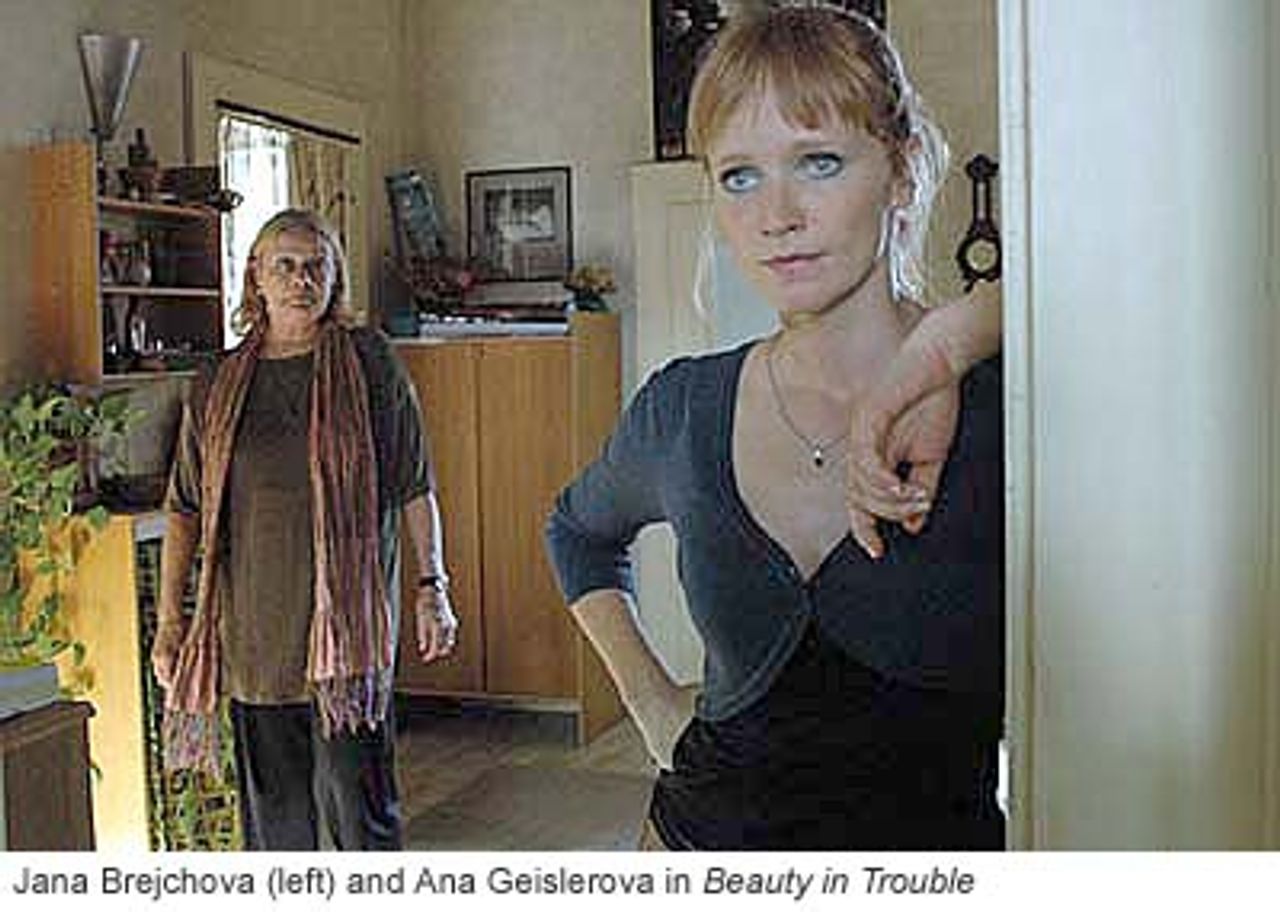
Marcela, fed up with their plight and her husband’s activities, decides to take her children and move in with her mother (Jana Brejchová) and stepfather Uncle Richie (Jirí Schmitzer) who is less than pleased to have them. Meanwhile, Jarda is arrested after one of his men is caught with a stolen car, belonging to Evzen, who has come to Prague to sell his mother’s house.
Marcela and Evzen meet at the police station—she waiting to see her arrested husband, he coming to see about the car. He takes pity on the woman and invites her to lunch at an exclusive restaurant. They hit it off and he offers to take her and the children to Tuscany for a holiday.
Marcela’s mother dies suddenly and the family returns for the funeral. She meets up with her husband who has now been released from jail. He wants to reconcile and has repaired their old house. He takes her home for lunch and they make passionate love. Marcela, however, realises that her husband hasn’t changed when he boasts of being able to make her “crawl” back to him. She returns to Tuscany with her kids and her cantankerous stepfather.
The film ends with all of them at Evzen’s Tuscan house, having fun in the sun. After a while Marcela retreats from the gathering and is seen on the phone. She is touching herself longingly as she talks to, presumably, her estranged husband.
What Beauty in Trouble all adds up to is far from clear. While there are some funny moments—although for the most part the laughs are cheap and clichéd—the movie does not measure up to Hrebejk’s previous work.
The most sympathetic character is Evzen—the ‘good angel’—who is kind, generous, gentle and honest. The other characters—mainly working class people from the Czech Republic—are presented as backstabbers or car thieves and are crude, crass and loud.
Is the filmmaker suggesting that life in that country is so vile that no one there has any redeeming or endearing qualities? If that is the case, then he makes light of it and shows little interest in investigating why.
In the past, Hrebejk was able to balance comedy and important social questions without trivialising the latter. His latest movie, however, is a slight work and raises an important question. Has the filmmaker’s quirky style become a diversion from dealing with a reality that requires a far more serious and penetrating approach?