
More than 3,000 writers, members of the Writers Guild, and their supporters among actors, directors and other professionals in the film and television industry participated in a rally outside Fox Studios in Los Angeles on Friday. WSWS reporters spoke to a number of participants in the protest.
Mark Alton Brown, a veteran comedy writer, offered his thoughts.
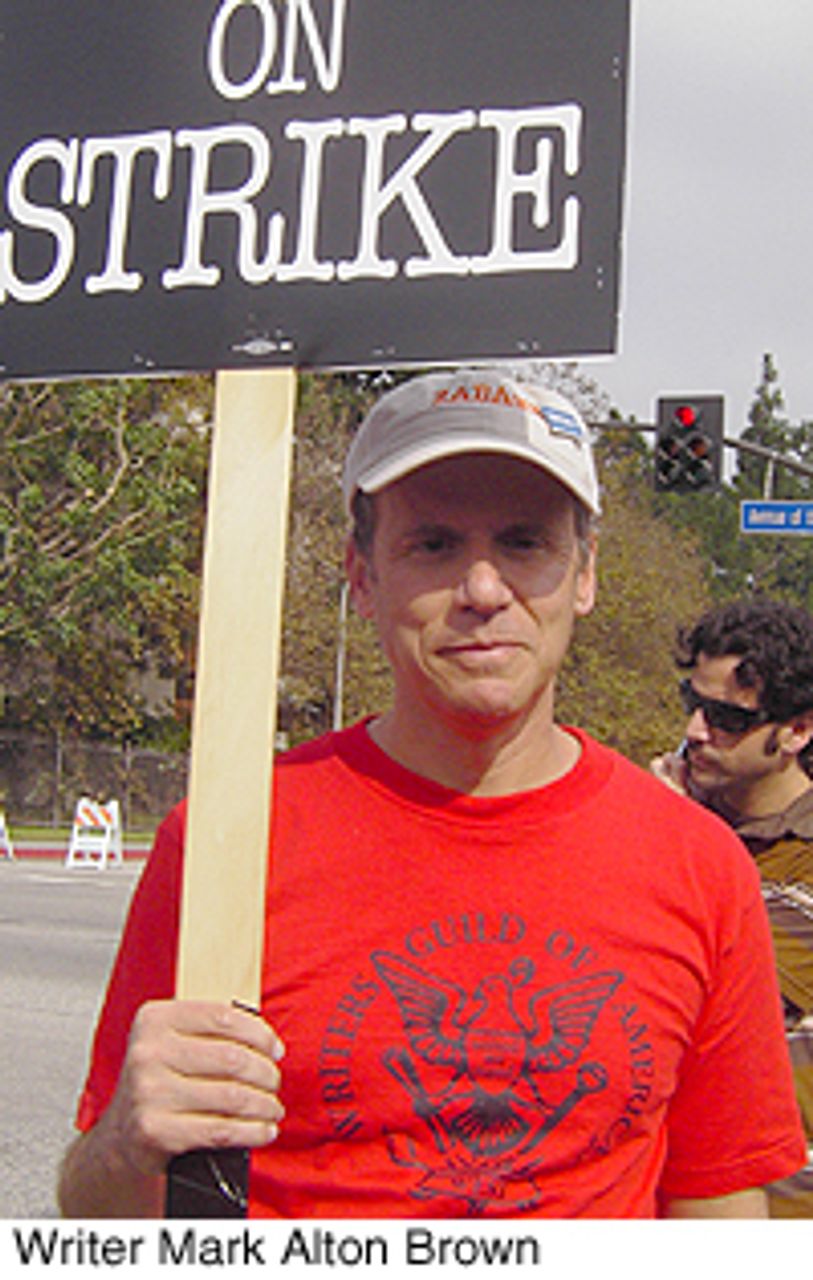
“The critical issue is being paid. If they get paid, we should get paid. Musicians get paid for writing songs and authors get paid for books sold. When we write material, we expect to be paid. We’ve been being paid since 1960. They’re trying to do away with the residual system. They’re trying to crush the guild. They’re trying to break the unions. We’re the sacrificial lambs.
“If they can break us then they can break the Screen Actors Guild, they can break the Directors Guild, we have to all be in this together. All we want is a fair share. Last year, in DVD residuals, they paid out $56 million of DVD residuals on $16 billion of sales. And $56 million to 10,000 writers, say. When Tom Freston was fired at Viacom he was given an $84 million severance package. And they’re saying they can’t afford to pay us $56 million.
“I think it’s greed, and the fact is that there are six major corporations that control all the media in this country. And I think this is all in line with George Bush’s America, which is basically a return to some sort of feudalism where you’ve got the landed gentry and the rest of us are serfs. I think that’s the philosophy, but that philosophy is guided by greed.
“Well, the impact of the control of these big companies is that they control the message. So the impact is that we can march out here and we can make our voices heard, but when you turn on the news it’s not favorable to us at all. They control all the major news outlets. And the impact is that with fewer voices, fewer and fewer voices are heard. What we’re getting is the opinion of six very powerful men who control these major media conglomerates.
“I’m a comedy writer. I write half-hour situation comedies. I’ve been in the business for 19 years. I’ve worked steadily for 19 years. And I’ve seen my pay diminish over those 19 years because every year they plead that they can’t pay any more; they’re hemorrhaging money and yet the CEOs keep taking home larger and larger and larger packages.
“I joined the guild right at the tail-end of the ’88 strike. That was a long divisive strike. That was my understanding. I came in late. I wasn’t privy to what was going on internally in the guild during the strike. But I think the feeling was that basically we got screwed in ’88. We capitulated because there was no way out and we want to rectify that at this point.
“And we’re at that kind of juncture again where new media is what it’s all about. In ten years, maybe even in five years, there won’t be DVDs, there won’t be reruns, everything will be downloads. And they’re basically trying to cut us out of that. And they’re already turning a profit there, they’re already showing a profit and yet they’re claiming that they’re making nothing.
“These are predatory companies. The only way to get them is to hit them where they live, which is in the pocketbook. This is why it’s so fantastic that the show runners are out, who they expected would capitulate like they did in ’88. They broke the lines in ’88 and they went in and edited and they did their producer duties. This year they have been absolutely fantastic in refusing to cross the line under any circumstances. And I think that the powers that be are shocked by that. They didn’t expect it.
“I would urge the actors ... I know they have no-strike clauses. They have to cross the lines. But I applaud all those SAG [Screen Actors Guild] actors who have refused to cross the picket lines. I think it’s just a matter of time before the Teamsters stage their workout in support. They’ve been very supportive. And I think the Directors Guild needs to follow suit also. And IATSE [International Alliance of Theatrical Stage Employees]. Most of the other people are covered by IATSE.
“We’re the sacrificial lambs. If they can bust us, they’ll go after every single other union. Our union is first. Their unions will follow. We all have to unite. And we have to tell them this is a union town. It has been a union town since the 1940s and that’s not going to change.
“I know that auto companies are laying people off and cutting wages and benefits. But you know there’s something that’s different, and not that I’m making excuses. The auto companies are in trouble through their own stupidity and their own lack of vision. But these companies are making a fortune. They’re posting the biggest profits they’ve ever posted.
“They want concessions? Well, they’re not going to get ’em. Not from us.”
Bill Rubinstein, writer and producer: “The World Socialist Web Site? Then I’m preaching to the choir.
“The basic problem is you have a greater concentration of wealth here than in any country in the world.
“That’s not sustainable. And what we’re seeing here are a few pigs that want everything. I was raised in this industry. I worked my first job at ICM [International Creative Management] to be trained to become a talent agent and I was told the first rule of any deal is you can never have harmony without fairness. That’s true in an industry and in a society.
“If you look at our Countrywide mortgage meltdown, our Enron meltdown, our health care meltdown, our war in Iraq, they’re all linked to a few things, which are pigs who want everything. They want to go into a sandbox and have it all.
“That’s what this strike is about. This is a strike to preserve the middle class and to preserve the harmony in this country. That’s all there is to it. There are a few pigs who want to pay themselves more money than all these people put together and that’s not right. And that’s why this is a strike not for us, but for everyone. There you go, that’s my comment.”
Aubrie Woods, aspiring writer: “I think that writers and artists are the portal to human evolution. And that’s why I’m here. What is the impact of these conglomerates on film and television? The same impact that they’ve had on music. It holds back the evolution that I am speaking of. You have to support the people that are the leaders in that field. The companies are the moneymakers, the managers, they’re not the leaders. Artists are the leaders.
“Yes, absolutely, there’s a tendency toward the bland, the homogenized, the unthreatening.
“What can we do? Well, we can continue to support at a grassroots level and challenge the establishment as we’re doing because we certainly have the power as the masses. We just need to realize that. I write drama, poetry. I want to show my support.
“I’m a hopeful future writer who is here to support those who are ahead of me.”
 Will Koza, assistant at Paramount:“Everything is at stake here—the stake of the entertainment industry as a whole.
“I’m not a writer actually, I’m an assistant. I just came out to show my support and hope that everybody gets a fair deal. I’m still working, at Paramount Productions.
“Well, I mean I think it’s good to set a precedent. This is all about the future, not so much about now, but about 10 years from now. That is how people are going to be making a living, from the Internet and new media, so we have to start now.
“I want to get into writing, so you know, we’re paving the way for the future.
“The dominance of six conglomerates? Well, that’s true for everything, really. The whole world is controlled by a few people and it’s getting smaller and smaller and smaller until people start doing something about it.
“I think most of the people I work with support the strike, yes. The vast majority of people I know, in my position, support it. It’s just some of the other people, who you know, say ‘What are they doing?’
“I do just regular assistant work, a lot on the telephone. I do regular script coverage. Research.”
New York City rally in Columbus Circle
On Thursday afternoon, the WSWS spoke to a number of pickets in a large and spirited line in front of the Time Warner Center in Columbus Circle. The strikers were bolstered by actors and students who came to support their efforts.
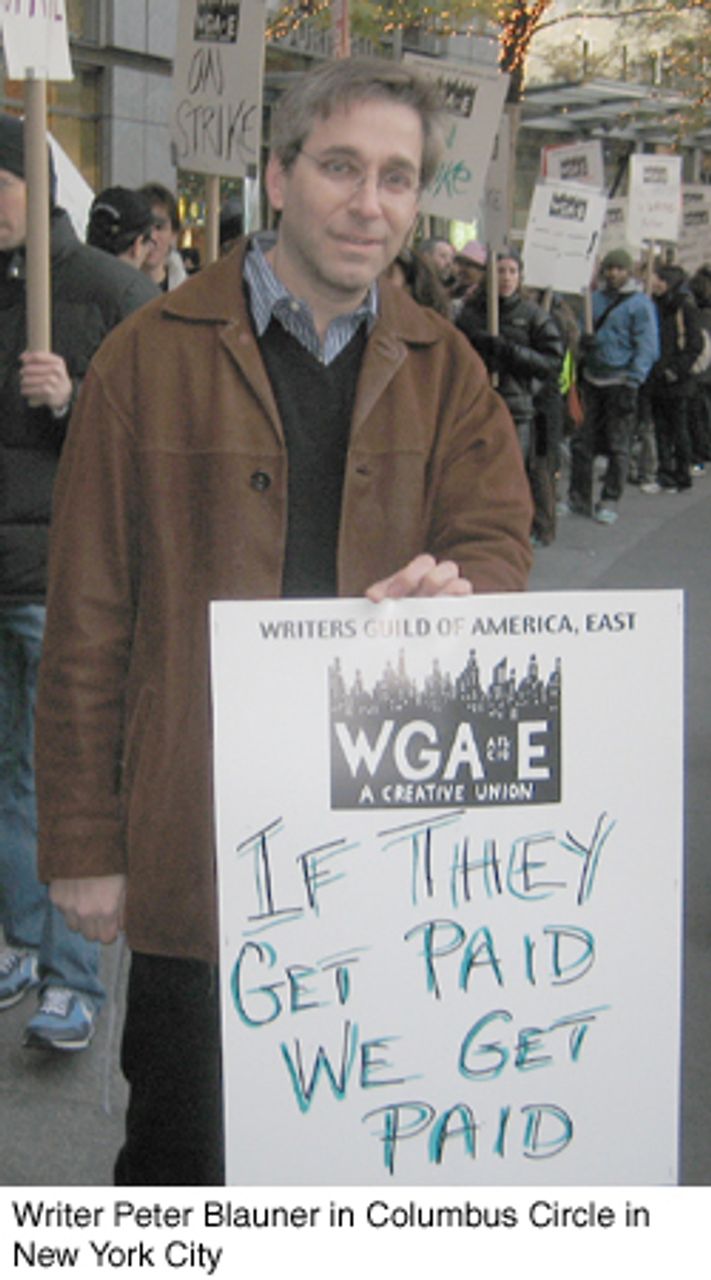 Peter Blauner, a staff writer for “Law and Order, Criminal Intent,” told our reporter: “I am here to support the strike because the issues affect everyone on the Internet. In five or six years, no one will sit down in front of a television to watch a program. People will simply access it online. It seems reasonable that those who create the content for those shows should be fairly compensated.
“I usually try to see both sides of an argument, but here I don’t see the conglomerates’ side of the case. On the Internet, they are relieved of a tremendous number of costs; unlike DVDs, there are no factories, no plastics, they don’t pay for trucking costs. All that is gone. Entertainment is now an international industry. Content can be broadcast anywhere in the world, but it still has to be created by someone.”
When asked about the political issues in the strike, he responded, “The viability of this union is a political issue. The corporations need to respect the union as a legitimate entity.”
Robert Benabib, a writer for Showtime’s “Weeds,” said that he was on the picket line to support fair wages. “Corporate greed is the motivation for these companies. I don’t know that you can fight this, but we have to strike. “
 Louis Venosta, a screenwriter: “I’m here because for what I do, this is a huge issue. To me this is like the air traffic controllers. How do we stop them this time? This is a once-in-a-hundred-years strike. This is it for everyone in the entertainment industry.
“I’ve watched it develop for the last few years, and if we can’t get Internet rights now, then we never will. The corporations don’t seem to realize that the only way we can keep writing is if we get paid.
“I don’t even recognize this country any more, and the point is, the decline of America is not happening accidentally. The people in power want to bankrupt the government. They know what they’re doing.”
Ross, a student from Vermont College who lives in New York City, said, “I’m here because there is not a lot of equality between big corporations and the little people. These conglomerates make so much money. They take the work of writers and turn them into huge profits. More young people are becoming aware of this.”
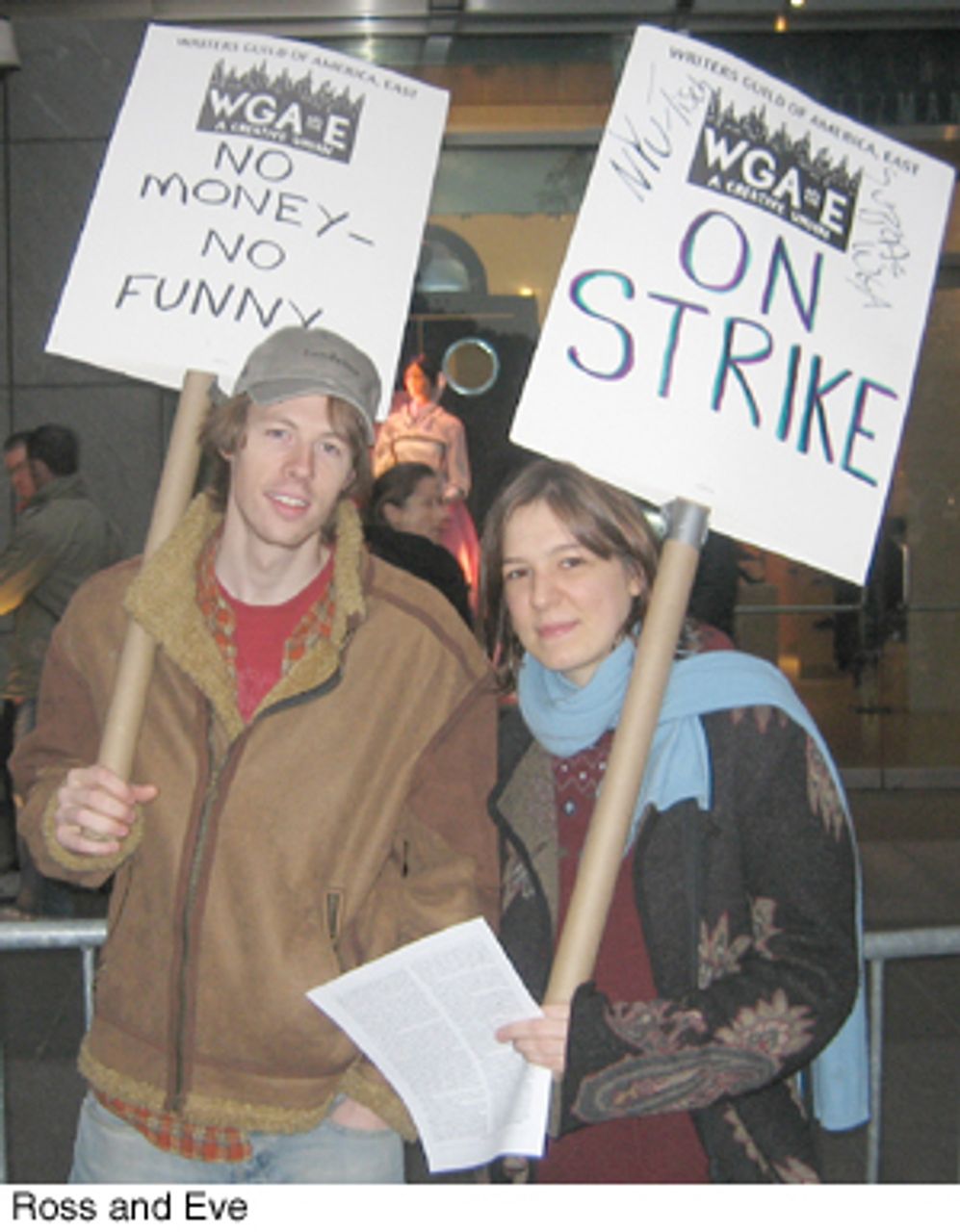
His girlfriend Eve, an actress, added, “We need another revolution. My brother was writing for a major producer who expected him to work for free. He eventually said he wasn’t getting paid enough and he got fired. Young writers try to make their way up the ladder, but this is what they encounter. It’s all about money.”