
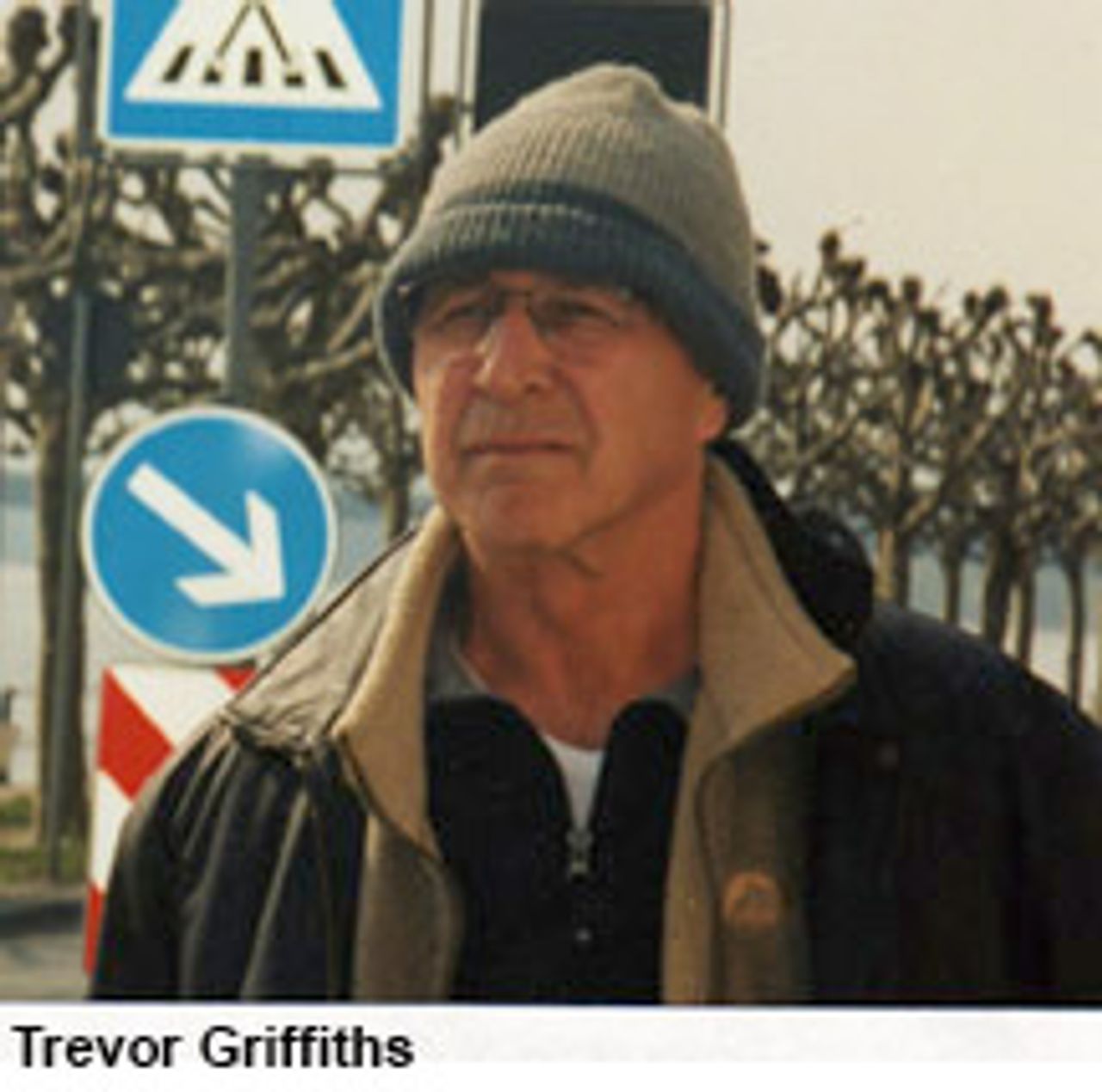
Trevor Griffiths has just published a screenplay for a film about the life of the eighteenth century revolutionary Thomas Paine. He wrote the screenplay for the film Reds with Warren Beatty and has a long list of television and theatre plays to his credit.
It is highly unusual for a screenplay to be published, but Griffiths has taken this step because, after working on this project for over a decade, he and the producer Richard Attenborough have been unable to get financial backing. Hollywood is just not interested in a film about the life of one of the most radical and significant figures of the eighteenth century, who played a leading role in both the American and French Revolutions. Yet readings of the screenplay have attracted substantial audiences, who have been quick to recognise both the quality of Griffiths’ writing and the contemporary relevance of Paine’s life.
AT: What drew you to Tom Paine?
TG: I had a problem with Tom Paine to start with because I had a problem with the eighteenth century. I’d taken a rather stupid view that the eighteenth century was so much less interesting for anyone interested in politics than the nineteenth century.
 I got a call from Dickie Attenborough in 1988 or ’87, who wanted to know if I would work with him on a screenplay about Thomas Paine. And for all kinds if reasons I said: well I’m not really sure that I want to do that, and in any case I’m not free. And he said: well I can wait. Anyway, it was about nine months later when I finally got to meet with him. Somewhere still I’ve got a napkin, a napkin off a train, the restaurant of a train, where I wrote down everything I knew about Paine. It just about filled a napkin, one side. But at least I thought I ought to have some notes ready.
So I went down and talked with him and realised that he was asking me what to write. Hollywood doesn’t do that. I mean film doesn’t do that. When film comes at you it knows what it wants you to write. It may not tell you that it knows what it wants.
So I started re-reading Paine. I knew nothing about his life—I mean I knew that he’d been involved in the American Revolution and that he’d been involved in the French Revolution, but I didn’t know much else about him.
So I started reading books about him and his political writings, and then I began to feel: well there is a film here and I’m probably well placed to write it. I think I wrote the first draft in 1990 or 1991 and the second draft in 1993 and the third draft in 1996 or 1997 and the fourth draft in 1999. And each of those drafts was a response to a particular moment in the preproduction process—trying to find producers, a distributing company, a studio if necessary, associate producers and then a kind of infrastructure of staff of arts people, company managers, all of those people and locations.
AT: Did they want a big name to play Paine?
TG: Yes. Well you’ve looked at the film and even in that version, which is a heavily chopped version, it’s around four hours and the cost then would have been X million and now its probably $170 million to make that film.
AT: Is that the blockage?
TG: Well I think cost has been a huge blockage. It’s just lying across the road to production like a fallen tree. It’s been very difficult to get round it. To Dickie’s credit he has never ever, ever suggested that we start again and make a 108 minute film.
AT: He’s very committed to it?
TG: He knows it’s a rare and extraordinary piece. It’s not your average Hollywood script. It’s really not. He played around for a time with two movies. Let’s make two movies and we show them on separate nights. But no one was interested in that in Hollywood and no one was really interested in the eighteenth century.
AT: You’ve given Paine more humanity than I’ve ever seen in a biography of him.
TG: I still haven’t got to the root of Paine because he’s a difficult guy. I’ve always found him contentious and awkward and fractious, difficult to get hold of, constantly slipping out of your intellectual understanding. Like Strindberg in a way. Like people from another age. Totally, exhaustingly, obsessed by the whole tree of knowledge. He was incredible. He had real feelings. He spent a lot of time reading, a lot of time writing, a lot of time walking, a lot of time with experiments with gases in ponds. All of those are scenes—not in my head—they’re on the page. But they’ve all gone. There’s a limit to what you can do.
AT: You’ve given him more personal relationships than the historians allow him.
TG: It would have been unthinkable to do a piece about anybody that didn’t involve some aspect of their humanity, which is usually expressed in relational terms. There are a number of key relationships. A key relationship is with the black kid Will. Another key relationship is with Lotte, the daughter of the landlady, Marthe.
The relationship with Jefferson is also much warmer than is generally acknowledged. I mean Paine suffered, the longer he lived the more he suffered from neglect and malignity. People wanted to suppress him. They wanted to put those important books down once and for all. It started with the British government—the Pitt government—sorting out a biographer—a fake biographer who was a spy—to rubbish him. So that first so-called marriage and the second one became evidence of Paine’s brutality, bestiality, and lack of responsibility, inhuman arrogant behaviour.
It’s not difficult to demonstrate that was rubbish. But thinking and imagining him in relationships for which there is no evidential provenance, or scarcely any, or just hints and whispers, that was the task of the writer. And there are some footnotes in books about the landlady and the way that his associates in Philadelphia talked about him. They wrote letters to each other. In his correspondence with Jefferson, John Adams refers to the indignity that was done to the landlady by Paine staying there on his own, and taking dinner with her and her daughter, and behaving familiarly with her when people were round at the house. We understand the custom and practice of eighteenth century people of that class, and there would be that slight alarm about the unconventionality of Paine’s position there. It spoke to me very clearly of a man who was very lonely and was, in fact, sharing a bed and a life with a woman he really respected, so that’s what I wrote.
The second one is a different kind of rumour. Carnet, I call her Carnet, Madame de Bonneville, [1] she was very close with him, no question, but so was the husband. She did have three kids, one of whom she called Thomas Paine de Bonneville. The first one she called Benjamin, after Benjamin Franklin.
AT: But we can’t suspect anything there, surely?
TG: Well I do, because Franklin fucked everything that moved, especially in France. The King of France, this is true, the King of France had several mistresses for whom he had Sevres piss pots made, piss pots with an image of Ben Franklin painted at the bottom, because he was such a lecher. Everywhere he went his hands stuck on somebody. I love Franklin. I think he’s ace. But that was his life anyway and he spent a lot of time away from home. I think he was the guy who got all the cogs working at the right time, and that’s how that revolution somehow clicked into gear.
AT: Franklin had the contacts in England among people who knew Paine, didn’t he?
TG: Absolutely, and for 30 years he was, not secretly, but he was just quietly bringing likely lads into America and placing them in positions where they might be useful. You get the sense, for example, that Matlack, Cannon [2] and various other people who became part of that network of revolutionaries in Pennsylvania had been put there in some previous moment—in some previous decade—to be useful when they were needed—when caucuses were afoot and all the rest of it. I love, suddenly I’m in love with that period, as soon as I write it and appropriate parts of it then it becomes important to me.
AT: I’ve never seen the eighteenth century so real and tangible. How did you achieve that?
TG: It’s hard to say this. It’s the most abandoned piece of historical writing I’ve done. I sought within my own principles, and my own craft, to validate and justify every major decision about what that century shall look and smell like to the person watching the film or reading the text, and I’ve gone to great lengths to find out those things I didn’t know. I wrote a play which you ought to read—it’s called Who shall be Happy? It’s about Danton on the final night of his life. I had the cast of that play read Perfume, the novel. That’s about the sense of smell. It’s a murder story, but it’s just loaded with what it was like to be alive in the eighteenth century. Your nose led you to places, not your eyes, because everything looked fairly similar—grey and dirty—but your nose would tell you where the bread shop was or where the hostelry was. So I had them working for a day, just the two of them with blindfolds on, just smelling each other. It sounds crazy, but it really worked.
AT: Why do you think Paine’s interesting now?
TG: Why do I think Paine’s interesting now? It’s very difficult to find where the purchase of Marx is in the contemporary political world. You don’t find it. It’s kind of been sidelined. The Marxist approach has been blocked. When the Soviet Union collapsed I immediately went back to the previous revolution, the French Revolution, and began to say: well, if I can’t solve the problems of the world via the Russian Revolution I’ll have a look at the French Revolution, because I know it had a huge agenda and only a fragment of that agenda was ever realized in historical terms. So I began to examine that, and one of the things that came out of that was the Danton play, which, at another level, was a literary riposte to a great Buchner play Danton’s Death, [3] which I think is a great play, but one that somehow romanticizes what Danton was up to.
So I looked at the French Revolution and said: well, let’s see what’s unfinished and finish it, at least at the level of literature and drama. Which took me, interestingly, back into Tom Paine, because I thought: I’ve finished Tom Paine, it isn’t going to be done; there is nothing to be done. Screenplays are like snow on grass. It needs a bit of heat and they’re gone. You never see them again. And I reached out for something with These are the Times. I reached out to have it printed if it was not going to be recorded on film. If it was not going to be played, realized and given a chance to live in people’s minds and hearts and practices, then I would at least enable it to go in individually to people as a read.
First of all you’ve got to apply for permission to do that. You don’t own it. A Hollywood producer is the only person who’s allowed to have his or her name associated in the Library of Congress with your book, with your script. It’s not These are the Times by Trevor Griffiths, its These are the Times by whoever was the producer. I know it’s astonishing. We don’t know how feudally we live. We really don’t. But we’re talking about Tom Paine.
AT: Yes, Tom Paine. At the end of the screen play his grave is still open and we hear his words about the need for a revolution. Then it cuts to the present and we see modern New York and he’s still talking about the need for a revolution. Is that what would draw people back again and again to see it?
TG: Yes, rich and poor chained together. I first read that in public in Toronto. I’d just written it that year and there were people crying afterwards who came up and asked me to sign it.
We’ve sold I don’t know how many books, maybe 1,500, maybe 2,000, which at £15 a shot, and a book that you cannot get reviewed, is not bad. You cannot get it reviewed because no one reviews screenplays, because screenplays are not published, really. They are, but it’s such a sliver of interest in the literary world.
Within all of this there is a craft trajectory of which I’m always aware. I’ve written about five or six screenplays and they’re all very specific screenplays. But I think this is the best screenplay I’ve written. I think it’s good. It’s a very exciting piece of work.
AT: It’s very contemporary.
TG: I think it is. It’s become increasingly, and this is the worrying thing, it’s become almost autobiographical. In the 12 years I was writing it, in those different drafts, more of myself was going into it. It’s interesting that you talk about Paine, as he’s historically presented, as being extremely lonely, because I think there is loneliness in that life, and it’s a loneliness I associate with my own life, which is not a loneliness about not having people to love, and to trust, and to cherish and treasure, but also just about the craft of writing. Lonely is too emotional a word, but you do it on your own.
I’m keen on group writing. The very first we ever did was called Layby. I mean that was Brenton and Hare and Poliakoff [4] and me. It was one wet Sunday afternoon when we were supposed to have a meeting about politics in the theatre. It was pouring down and we were all fed up. So we said instead of doing that meeting why don’t we write a play. And we got a role of lining paper and some pens and started writing a play which went on to Edinburgh and became the darling of the festival. People were fainting it was so exciting. It disappeared without trace thereafter.
AT: That’s quite a group.
TG: It was an interesting group. I always knew it would be a very limited time that we were allowed to work like that. Because it’s not the nature of capitalism to have people licensed to knock shit out of it at every opportunity. They don’t mind as long as we’re ineffectual. But if we start getting a voice in things, and helping people to side against what capital wants, then we’re in trouble. In 1979 I did an interview and said that we’re going to see a lot of people, whom we now absolutely trust as a comrade, ducking behind doors when they see you. What I meant to say was, and what I think I did say, was that as it gets tougher to make a living we’re going to see people breaking, buckling and doing what’s required of them. And I think on the whole that’s true.
AT: Do you think a young writer now could do what you did then?
TG: No. No, I mean the trajectory is completely different. You can’t have politics in your bag. You just can’t. It’s not allowed. It’s not only not allowed. It’s found to be quite distasteful.
I didn’t invent myself. The world invented me. I came out of teaching. I came out of New Left Clubs. I came out of the Campaign for Nuclear Disarmament and the Committee of 100. I had an active back history pushing me forward. So when I got to confronting producers and production units and the BBC and all of that stuff, I didn’t feel that I was on my own. I felt that I was shoulder to shoulder with a hell of a lot of people.
AT: When did that period end?
TG: [laughing] That was 1997 and I was the last one to be killed. You keep having to shout from the grave.
AT: In the Paine screenplay and also in The Party there’s the same line that you’re only dead if you don’t take root in other people. Do you think that’s a very important concept for you?
TG: Yes, I do because we all have other people in us. I could start listing mine. There’s huge numbers of people. People you’ve met. People you’ve read. I never met Kurt Vonnegut, but I could tell you about his books and the way they’ve lodged in me. And how they’ve kept me going since. So, yes, people and books. And books are people, but with pages.
Notes:
[1] Mme Marguerite Bonneville see: John Keane, Tom Paine: A Political Life (London: Bloomsbury, 1995) for the rumours about her connection with Paine.
[2] Timothy Matlack (1736-1829) and James Cannon (1740-1782) were key figures among the supporters of independence in Philadelphia. See: http://www.archives.upenn.edu/histy/features/1700s/people
[3] Georg Büchner German playwright (1813-1837)
[4] Howard Brenton (1942-) English playwright and screenwriter; Sir David Hare (1947-) English playwright; Stephen Poliakoff (1952-) English playwright, screenwriter and director.