
Directed by Ang Lee, screenplay by Wang Hui Ling and James Schamus and based on the short story Se, Jei by Eileen Chang
In the sixteen years since his first feature in 1992, Taiwan-born director Ang Lee has produced an eclectic and artistically inconsistent range of films. Some early movies, such as The Wedding Banquet (1993), a comedy about a gay Taiwanese man living in New York who tries to salvage relations with his Taipei-based parents by organising a fake marriage in the US; Sense and Sensibility (1997), Lee’s version of Jane Austen’s famous novel; and Ride with the Devil (1999), about young Missouri men caught up in a pro-slavery “border ruffian” terror group during the American Civil War—were interesting although not ground-breaking efforts.
Multi-million dollar productions that followed, however, such as Crouching Tiger, Hidden Dragon (2000) and Hulk (2003) were overblown and empty and seemed to indicate that Lee had lost his way. In fact, the US-based director has since admitted that he was seriously disillusioned after directing Hulk and had considered making it his last film.
Lee returned to form in 2005 with the Oscar-winning Brokeback Mountain and last year won numerous accolades, including the Venice Film Festival’s Golden Lion award, for his latest movie Lust, Caution. Both movies were made for about $15 million, small amounts by contemporary filmmaking standards, and are arguably his best films to date.
Lust, Caution (Se, Jei), which is based on a short story by popular Shanghai-born writer Eileen Chang (1920-95), is a sexually-charged thriller set from 1938 to 1942 in Japanese occupied China, a period largely untouched by European and American filmmakers. It tells the story of a young actress caught up in a dangerous and personally disorienting assassination plot against a leading pro-Japanese collaborator.
Lee’s 157-minute film has its limitations—an issue we will return to later—but it does provide some sense of the dark days of the Japanese occupation, events that one hopes other filmmakers will further explore.
The story begins in Shanghai at the Japanese military-protected compound of the Wang Jingwei quisling government and briefly introduces us to its key protagonists. It’s 1942. There is a mahjong game underway and the well-heeled women gossip about jewelry and other petty concerns. But there are furtive glances and the movie soon indicates something unsettling and dangerous is being prepared.
Lust, Caution then flashes back to four years earlier and to Hong Kong where young drama student Wong Chai-chi (Tang Wei) has fled to escape the Japanese military. She makes friends with some drama students, led by Kuang Yu-min (Wang Leehom), who perform anti-occupation agitprop theatre. Wong eventually becomes their principal actress.
Despite local success, the students are impatient with their theatrical gestures and hatch a plan to murder Mr Yee (Tony Leung), a local collaborator with the Japanese. Wong is assigned the most dangerous role—her task is to masquerade as a “Mrs Mak”, the bored wife of a young businessman, seduce Yee and thereby create the conditions for his elimination. Notwithstanding their careful preparations the plot fails and the students are confronted with a bloody and disturbing denouement. In the ensuing chaos Wong flees, leaving the group to its fate.
The story moves forward three years to 1941 and Wong has returned to Shanghai. She is living with relatives and has resumed her studies. Yee, likewise, has come back to Shanghai, this time to head the quisling regime’s ruthless secret police. Former members of the Hong Kong drama group have also relocated to the city and are now involved in one of Chiang Kia-shek’s nationalist Kuomintang (KMT) assassination groups.
Wong is eventually discovered by the students and introduced to their KMT handler. He asks her to reprise her role as “Mrs Mak”, promising that she will be given sanctuary in Britain after the assassination. Wong agrees and successfully inveigles her way into the Yee household where she eventually arouses Mr Yee’s interest.
What follows is a series of complex sexual encounters. Does Yee suspect Wong and is he just stringing her along? Does the odious and grasping Mrs Yee (Joan Chen), and her circle of gossiping wives, suspect her husband is having an affair? Is Yee anything more other than a cold blooded killer? Does she have the experience and internal strength to maintain this dangerous and psychologically destabilising charade?
Yee is tight-lipped about his “work” but there are chilling references to torture and assassination and he is shown burning documents in the dead of night. At the same time there is an overarching sense that the quisling rulers and their Japanese military protectors are on borrowed time. Yee admits at one point: “I listen to men all day, so-called prominent politicians and the like, talking their supposed serious talk. And you know what? No matter what high-sounding words come out of their mouths, I see only one thing in their eyes ... fear.”
The sex scenes in Lust, Caution have attracted much media comment, most of it sensationalist and superficial, and last year the movie was given an N-17 or “Not 17 or under” rating by Motion Picture Association of America, which limited its US distribution. Malaysian censors have slashed the film by 15 minutes and Lee agreed to cut seven minutes from the movie in order to secure a release in China. The graphic sexual encounters, however, are not gratuitous but an important element in the complex and contradictory tension that develops between the movie’s key protagonists.
Wong hopes that she can deal with Yee and fulfill her mission but with each sexual encounter she becomes more enmeshed. At one point she clashes with her KMT handler over these difficulties but all he has to offer is a stern lecture that she must be “loyal to the cause”.
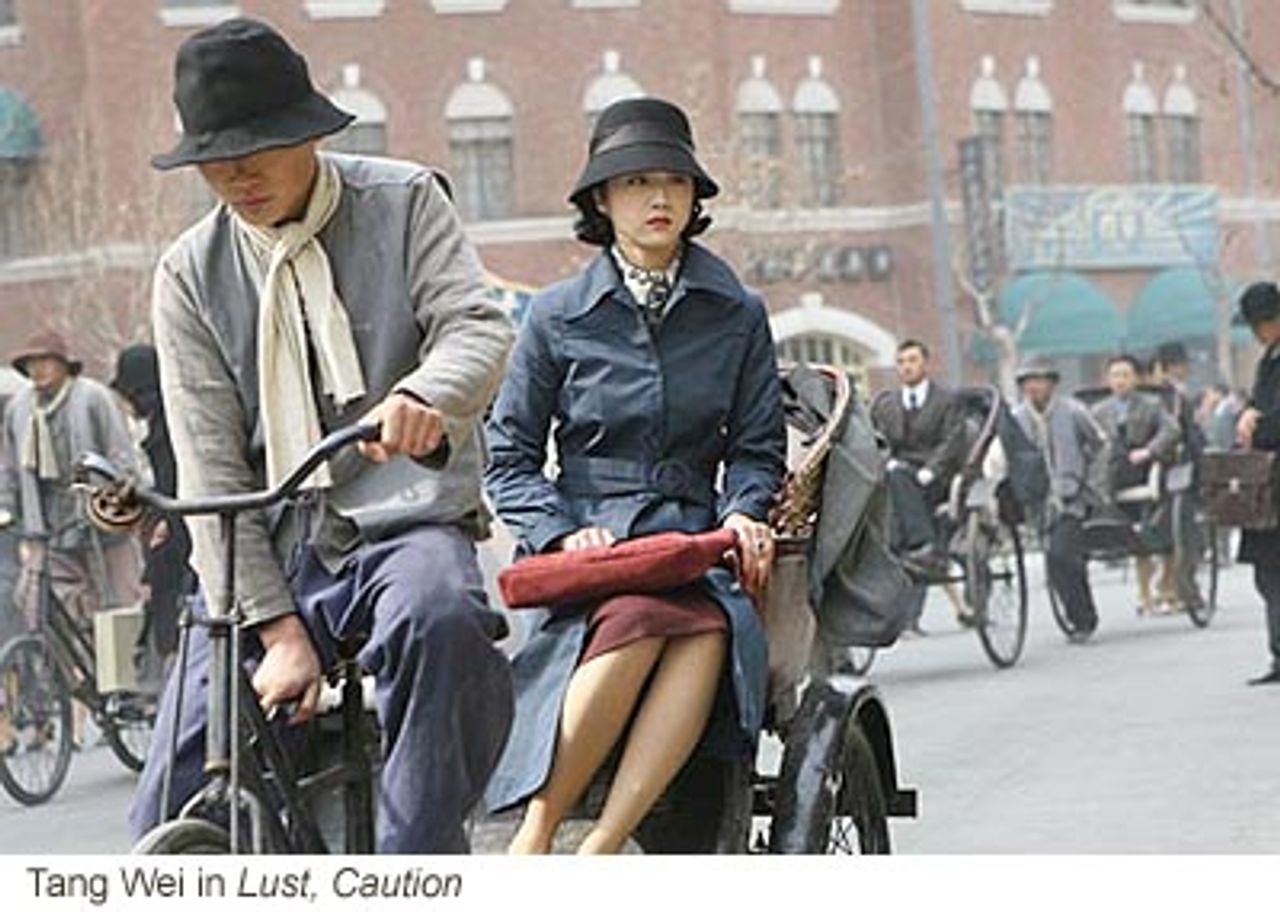
Lust, Caution slowly builds to a climax and has some mesmerising moments. These include its skillful transitions from the claustrophobic quisling compound and wealthy Shanghai shopping districts, to the city’s poverty-stricken laneways. There are food queues; local undertakers routinely sift through the homeless, sorting out those killed by disease and starvation from the barely alive; and there are fleeting glimpses of corpses lying in major city streets, obviously hunted down by death squads. Office workers and others rush past in silence. The film’s final street scene, as Wong hails a cycle-cab outside a jewelry store only to be stopped a short while later at a police/military roadblock, is hypnotic and disquieting.
Several American reviewers have criticised Lee’s movie for its length and for being too slow and unfavourably contrasted it with Black Book (2006), a fast-paced action thriller about the Dutch anti-Nazi resistance, by Paul Verhoeven. While Black Book achieved some popular success in Holland and other European cinemas, Verhoeven’s movie is a glossy, superficial and deeply cynical movie with an underlying message that everyone is venal and can be bought.
Some Chinese commentators have claimed that Lust Caution denigrates women involved in the anti-Japanese resistance and suggested the film is too sympathetic towards Yee. Such critics are looking, not for serious artistic work that sensitises audiences and encourages them to think more deeply, but for political clichés and “heroic” posturing to reinforce pre-conceived ideas.
That said, Lust, Caution is not without its problems. Lee obviously feels deeply about the Japanese occupation and has spoken in several interviews about the importance of understanding this period. His comments, however, are exceedingly vague and one senses that he doesn’t want to step on anyone’s political toes, particularly in China, Japan or in his birthplace Taiwan, where this period remains a deeply explosive issue.
Lust, Caution, carefully avoids any mention of the Rape of Nanking, when the Japanese military conquered the then capital of the Chinese republic in December 1937 and for the next six weeks massacred more than 300,000 of the city’s inhabitants.
In fact, the film refuses to explore any of the major political events in China from 1938-42 when the story is set. This ensures that Lee’s portrayal of the young drama students, who were obviously horrified by the Japanese occupation, is perfunctory and unsatisfying. Nor is there any serious attempt made to explore Wong’s political motivations; her actions are largely left on the level of personal psychology.
Lee might argue in his defence that he has followed the spirit of Chang’s short story, which is no doubt true. But the director is not legally or artistically bound to the original story. Lee, like Chang has chosen to make the central preoccupation of Lust, Caution an investigation of what is strongest in Wong and Yee’s relationship—personal emotion or political commitment.
Some audiences will recognise that Lust, Caution has an eerie resonance with events in Iraq and Afghanistan, where Machiavellian intrigue, fear, torture and bloody repression is part of daily life for US-led occupiers. These issues and the broader question of how imperialist occupation and war destroys and distorts all civilised human relations, however, are not the primary concern of Lee’s movie, which reduces everything to psychological questions with history, politics and class relations left as a scenic backdrop.
Lust, Caution is a fascinating and at times visually compelling work but one that unfortunately avoids too many key questions.