
Informal discussions continue between negotiators for the Writers Guild (WGA) and the major studios and networks, organized in the Alliance of Motion Picture and Television Producers (AMPTP). The film and television writers’ strike is now in its 13th week.
The strikers continue to enjoy widespread support within the entertainment industry and from the public at large. A survey conducted in mid-January by Interpret LLC, a leading new media consultancy firm, found that of those in the general US population who knew about the strike and held an opinion on its rights and wrongs, only 7 percent supported the entertainment companies.
Film and television actors, who face their own battle with the companies later this year, continue to back the writers in large numbers, and the Academy Awards ceremony remains in doubt. At the Screen Actors Guild (SAG) Awards on Sunday, leading performers made clear their solidarity.
Rumors abound about the state of the current informal talks, whose secrecy only assists the employers. The Hollywood executives have decades of experience at fighting off the legitimate demands of film and television workers. They will resort to and combine a variety of tactics—intimidation, flattery, stalling, efforts to ‘divide and conquer,’ red-baiting and, ultimately, brute force. Insofar as the struggle remains on the narrow and sterile terrain of trade union negotiations, the studios and networks will always be on the offensive.
The recent tentative agreement reached between the AMPTP and the Directors Guild (DGA) has been the signal for an intense campaign in the media aimed at stampeding the writers into accepting a miserly settlement.
Before talks broke off in December, the conglomerates offered the writers $250 a year payment for one year’s use of an hour-long television show on the Internet. The DGA leadership accepted $1,200 for a year’s worth of streaming, with the companies provided an initial 17-day window free of residuals.
SAG board member Justine Bateman points out in a comment on United Hollywood that the studios and networks are effectively seeking to eliminate residuals. She argues that “the DGA deal does that for TV. Are you ready to trade an entire year’s worth of TV residuals for a one-time fee of $1,200?
“Currently, writers and directors both make approximately $20,000 for the first prime-time rerun of an hour-long episode. The residual gradually decreases on any later reruns (if the writer or director is lucky enough to get more reruns). So the directors’ deal potentially gives up 97 percent of the first prime-time residual while the corporations can ‘rerun’ their work infinitely over an entire year.
“It seems to me that if the DGA formula for streaming is ratified, the networks will be on a fast track to never, ever rerun our work on broadcast TV.”
These figures convey the kind of rollback in income and conditions that the massive corporations are determined to impose. Bearing down on the writers are the demands of global financial markets and huge investors, backed by the media and the political establishment, Republicans and Democrats alike.
The US ruling elite has enriched itself over the past almost three decades in large measure by driving down wages and destroying workers’ benefits. It has looted the national economy and transferred vast amounts of wealth to itself at the expense of the working population. Powerful business interests have no intention of relenting in their assault on wages and conditions, as a growing economic slump takes hold. An example must be set with the writers, reason these interests, which will not be lost on other workers.
Moreover, in the case of the writers, there is the cultural and ideological issue as well. The conglomerates want a cowed and disciplined pool of ‘talent’ that will toe the line as far as content goes and not raise troubling questions about social life in America.
The Democratic Party is as committed to the maintenance of low wages and minimal benefits, in the name of keeping America ‘competitive’ in the world market, as are its counterparts in the Bush administration.
The Hollywood hierarchy helps finance the Democrats to the tune of tens of millions of dollars. The party’s various presidential hopefuls made pro forma statements of support for the strike months ago, but the operations of the Clintons’ favorite public relations firm, Fabiani & Lehane, on behalf of the AMPTP and the silence of the California Labor Federation indicate the real attitude of the Democrats and their allies in the trade union bureaucracy: hostility to the writers and the threat their struggle represents to the social status quo, especially in an election year.
The writers’ effort to win decent economic and creative conditions has led them into a confrontation with this array of social forces. It is a political and social struggle with American capitalism.
The writers may not have set out to remake the entertainment industry, but they will not be able to make gains without consciously taking up that task. To believe that writers can assure themselves of their conditions of life without taking into account the ongoing unraveling of the world financial system and apart from the struggles of workers all over the world would be a serious error.
In the process of struggling against the monopolies that own and run film and television, we are convinced the writers will discover a need to deepen their own understanding of society and history, as well as the need to develop their art in a more critical and penetrating direction. The prejudices of anticommunism will need to be discarded and the tradition of genuine revolutionary socialism, represented by the Trotskyist movement, considered seriously.
We urge writers to consider the broader issues involved in the strike.
A conversation with a striking writer
On January 24 a WSWS reporter spoke to strikers outside Warner Bros Studios in Burbank, California. Veteran writer-producer Paul Barber (Andromeda, X Files, Nash Bridges) offered his thoughts on the current situation.
WSWS: What is your opinion of the AMPTP’s deal with the Directors Guild of America?
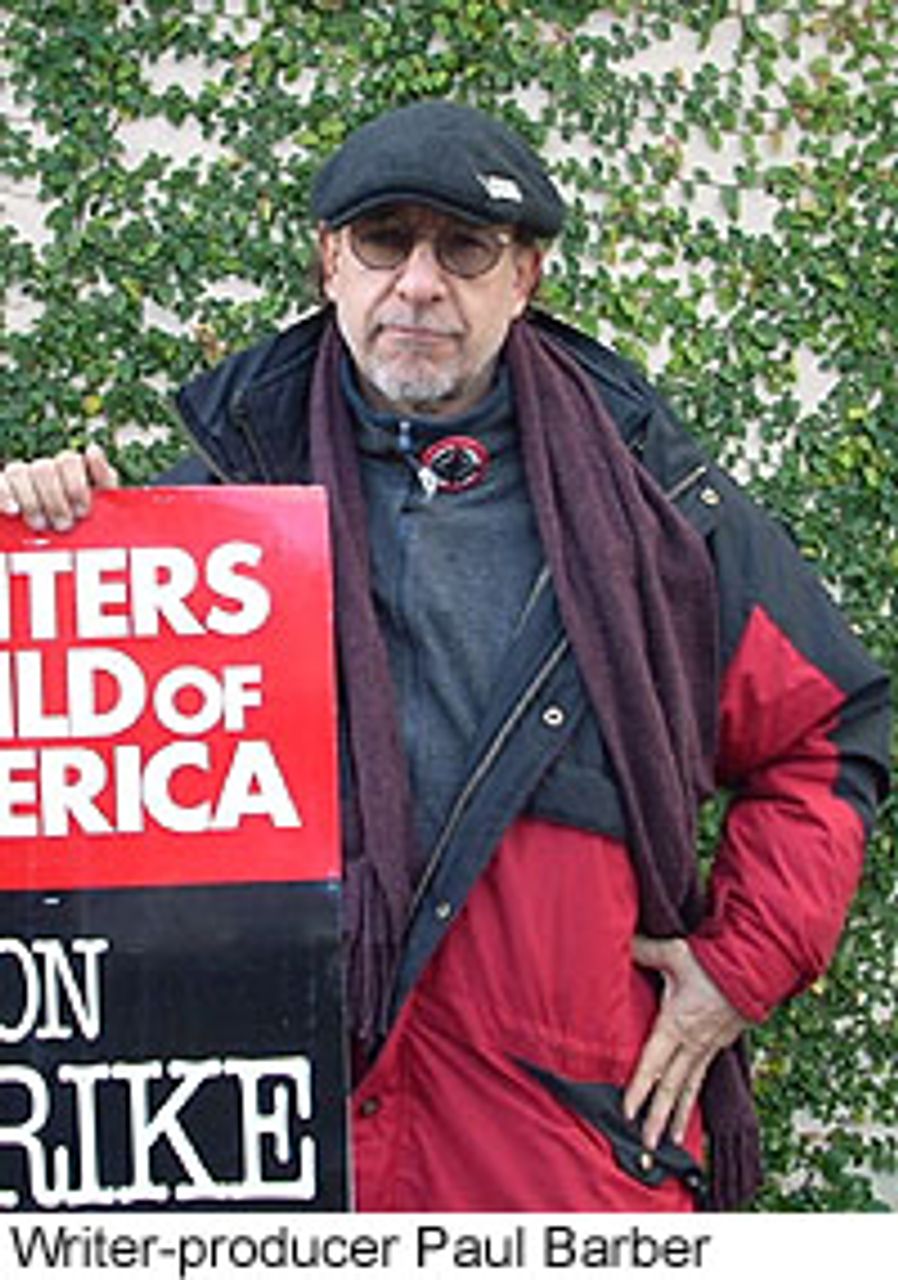 Paul Barber: As you know, we haven’t seen the details of this deal. We’ve only seen press releases at this point. With the information we do have, however, we know that it’s really not a good deal. And I always figure that if someone is hiding something, it’s because they have the power base to induce them to hold their cards.
However, the DGA deal is like a toe in the door. It opens up a crack by virtue of the fact that we’ve been out here for almost three months now.
WSWS: How do you feel about the fact that the WGA has just announced that it will be entering into informal negotiations with the AMPTP?
PB: Well, I think that’s to be expected. I don’t think anything that’s happening has been unexpected. This has been the game plan from the very beginning for the AMPTP, and it’s really obvious how they’re going to play out their game, because this is how they’ve always played out their game. And so, to a large degree, this is what we’ve been expecting.
So we’re hoping that perhaps now they’re going to show up and perhaps be serious with us for the first time. The fact that there’s a news blackout is established practice.
Unfortunately, we’ll have to find out what we need to find out when we find it out. Furthermore, I believe that the DGA actually formalizes their deal by voting on their contract, and thus the AMPTP can’t actually enter into formal negotiations with us until that process is complete.
WSWS: Are you happy that the WGA has announced that it would be taking two key demands off the table, concerning animation and reality shows?
PB: Again, that’s to be expected. You go in putting things on the table which you know will eventually come off. So again, I’m not surprised, it’s just part of the process.
The argument would then become, ‘Is the process itself efficacious?’ From a—for lack of a better word—“radical” point of view, you’re playing with their ball in their field with their rules, so to bring about real change, there’s perhaps another direction to be taken altogether. Right now, however, what’s being done by Patric [Verrone] and the WGA East has the support of the membership, and it’s not idol worship or anything like that. We all stand up and speak our minds.
WSWS: May I ask if you read our web site?
PB: Yes, I do.
WSWS: How do you see the work of a writer in this larger historical and social context? Right now we’re entering a major recession in this country and internationally. Companies are laying off hundreds of thousands of workers, and social services are being either drastically reduced or eliminated altogether. [California] Governor [Arnold] Schwarzenegger, for example, has recently proposed cutting nearly $6 billion from the state’s educational budget. What does a writer do in this context and why is this struggle important?
PB: I’m going to answer you as honestly as I can. I’m a writer second and a human being first. Those political concerns highlight the fact that this is a human rights issue. The people striking are all working class people.
However, we live in a system and in a country where class isn’t recognized, and, unfortunately, the most visible members of our group are immensely well paid. You also have to look at a larger picture when you look at this strike.
Even a situation like Burma is connected to this struggle. Writers can and are using the Internet as a tool to highlight what’s going on there and in all parts of the world. So the Internet, in particular, demonstrates that the workers of the world can be united.
WSWS: Why hasn’t there been a call for an industry-wide shutdown?
PB: Because I don’t think that the system functions that way. It’s a much slower bureaucratic process. For instance, an actor was walking here yesterday morning and asked our forgiveness for crossing the line, and after speaking with him, we found that he was more vehement about our rejecting the DGA’s deal than any of us were. He understands that whatever deal we make with the AMPTP will also affect the actors. So we are, in a sense, the vanguard, the tip of the spear.
And, historically, that role has always fallen to the WGA. However, I think that an industry-wide strike is coming. In other words, the playing board is already set, and we know that the more time it takes, the more pressure will be built up on both our side, the entertainment workers, and on their side, the producers, and you will see the consequences of that in the weeks and months to come.